Digging into the state’s mining history invites visions of the Old West in Philipsburg, Anaconda, Butte and other places rich in the lore of our pioneer past
Story and photos by Randy Mink, Senior Editor
The wide-open spaces of America’s fourth-largest state just seem to invite a road trip and so do the small towns scattered between the cattle-dotted grasslands blanketing the Big Sky Country of Southwest Montana.
Set against backdrops of snow-dusted mountains, places like Philipsburg, Anaconda, Deer Lodge, Butte, Helena and Virginia City beckon history-minded wayfarers traveling the 400-mile route between two of our greatest national parks—Glacier and Yellowstone.
Offering heady whiffs of Western flair, each of the following Montana towns deserves a stopover:
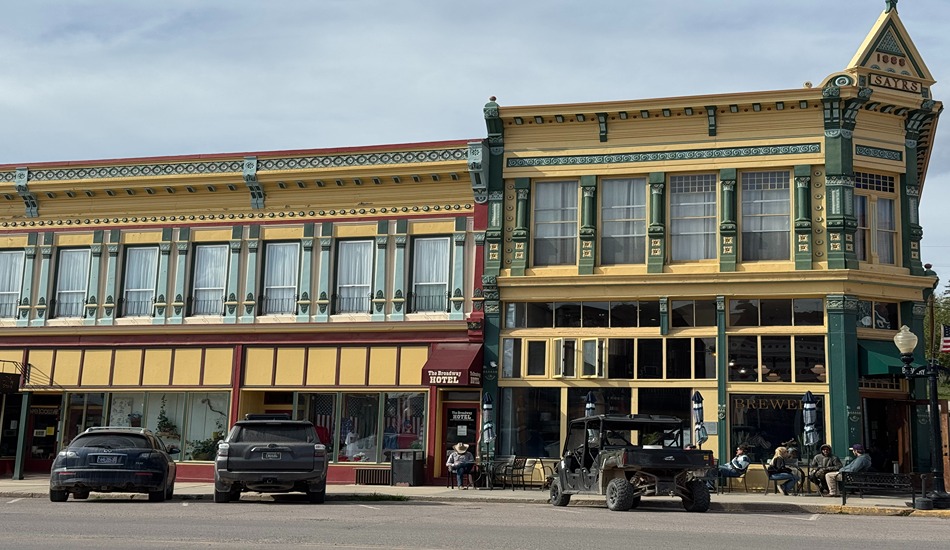
Philipsburg: Small-Town America at its Best
A silver mining boomtown in the late 19th century, Philipsburg almost became a ghost town but today is a thriving tourist mecca with an idyllic main street flanked by beautifully restored buildings housing shops, eateries and a microbrewery with two locations.
Philipsburg Brewing Company uses local water, Montana wheat and barley, and Oregon hops to produce quality craft beers served in every local tavern and restaurant. Its most popular brew is Haybag Hefeweizen. Also on tap: Razzu Raspberry Wheat, Gonk Amber Ale, Bourbon Barrel Porter and Garden City Czech Pilsner, among others.
At the brewery’s storefront location on Broadway (the super-wide main drag), its gift shop occupies a walk-in bank vault dating back to Philipsburg’s boom days. Most of the beer is produced up the street at The Springs, the site of Kroger’s Brewery from the 1870s. Open on weekends from Memorial Day to Labor Day, The Springs has a patio, outdoor kitchen and concert venue.
The Sweet Palace, an old-fashioned candy store on Broadway, is another must stop in Philipsburg. They make their own chocolates, including truffles infused with beer from Philipsburg Brewing and nearby Big Sky Brewing. You can watch candy makers at work and choose from more than 1,000 varieties of sweets, from chocolate peanut clusters and malted milk balls to lemon lime fruit slices and key lime cheesecake fudge.
Since the 1890s, the Rock Creek area near Philipsburg has attracted rockhounds searching for gem-quality sapphires. Travelers can get into the act at three jewelry stores on Broadway that offer “sapphire mining.” The family-friendly outdoor activity at The Sapphire Gallery, Gem Mountain and Montana Gems involves paying for a bag or bucket of gravel from a sapphire mine, washing the gravel and then going through it with tweezers, all in the hopes of spying a real sapphire in the rough. Most people find a few sapphires, usually tiny and of low quality, but it’s all about the fun of treasure hunting.
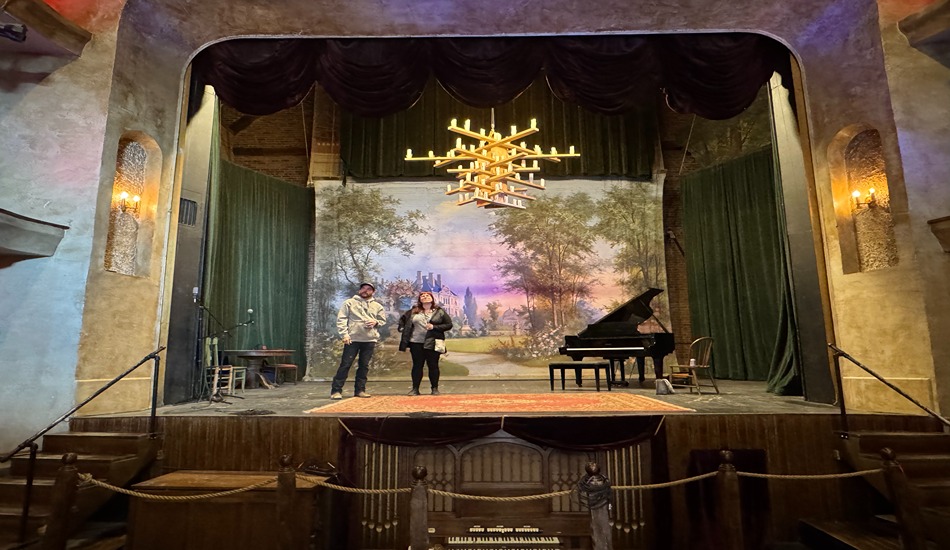
The Philipsburg Theatre is known for its historic, artist-painted stage backdrops.
The Philipsburg Theatre, established in 1891 as the McDonald Opera House, was saved from the wrecking ball in the 1980s and has undergone major improvements under various owners. Kelly Clarkson, who in 2025 filmed a music video there, is financing installment of a new sound system. The remodeled balcony features a beer and wine bar.
Montana’s oldest operating theater presents plays, concerts, movies and community talent shows. Artist-painted stage backdrops from the early 1900s appear in some of the productions, and one was used in the Clarkson video. Historical tours are available.
The theater’s basement turns into a haunted house at Halloween time.
Butte: Copper Capital of the World
Butte stakes its claim to fame on copper. From 1889 to 1982, the “Richest Hill on Earth” produced more than 21 billion pounds of the valuable mineral used in the wires that electrified America.
With more than 100,000 residents in its heyday, Butte (rhymes with “cute”) was among the biggest cities in the West, an oasis of culture. Today’s city of 36,000 boasts one of the largest National Historic Landmark Districts.
Butte’s prime attraction is the World Museum of Mining, which offers walking tours through the retired Orphan Girl Mine. Led by a former miner, visitors don headlamp-equipped helmets as they venture 100 feet below ground.
The museum complex, situated across from the campus of Montana Tech, features a mine yard filled with heavy equipment, ore carts, smelter cars and a towering headframe, the structure that supported massive pulleys used to hoist miners and machinery into and out of the ground. Historic buildings transplanted from other locations include a church and sauerkraut factory. Replica buildings, such as a dentist office and Chinese laundry, populate the streets of Hell Roarin’ Gulch, the museum’s recreated 1890s mining town.
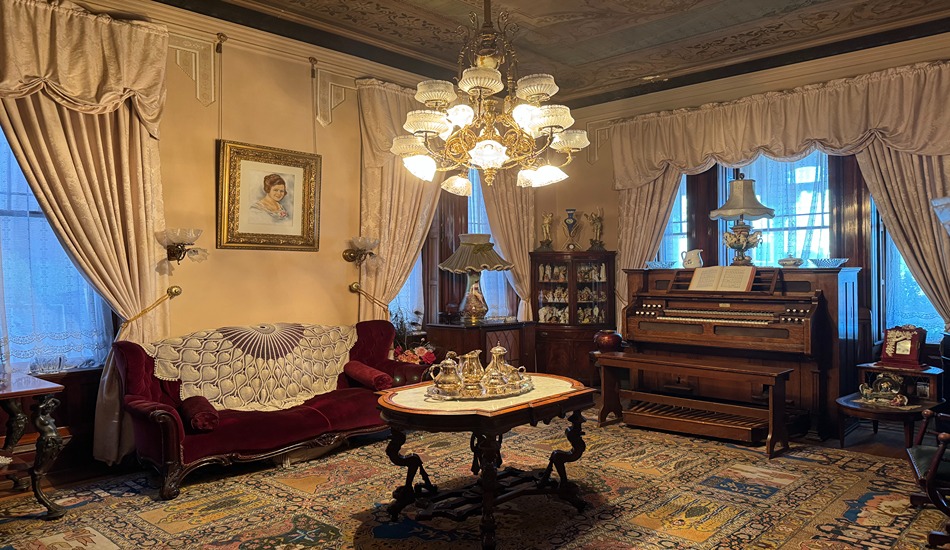
The Copper King Mansion, a major Butte attraction, offers tours of its lavishly decorated rooms.
Butte’s 1888 Copper King Mansion was the showplace of copper magnate/politician William Andrews Clark and now operates as a house museum and bed-and-breakfast inn. Victorian splendor is reflected in the hand-carved woodwork, stained-glass windows, chandeliers, ornate plasterwork and soaring frescoed ceilings. Every nook and cranny is filled with china, glassware, porcelain figurines, photographs and other period treasures.
Spooks and Spirits Paranormal Tours offers a look at haunted Butte and its raucous past. Included in the tour is Dumas Brothel. Now a museum, the longest continuously running house of ill repute in U.S. history operated in the red-light district for 91 years before closing in 1982.
Our Lady of the Rockies, a 90-foot statue of the Virgin Mary, watches over the predominately Catholic city from high atop a crest of the Continental Divide. Built between 1979 and 1985, she is lit at night. The statue cannot be reached by private car, but bus tours go there in summer.
Curiosity seekers will want to check out the viewing platform at the toxic Berkeley Pit, a massive scar on the Butte landscape. Operated from 1955 until being shut down in 1982 because of falling copper prices, the former open-pit mine has filled with water contaminated with sulfuric acid and dissolved metals that give it a blue-green color. A threat to wildlife, the mile-long lake is a federal Superfund environmental disaster site that’s been undergoing a clean-up for years.
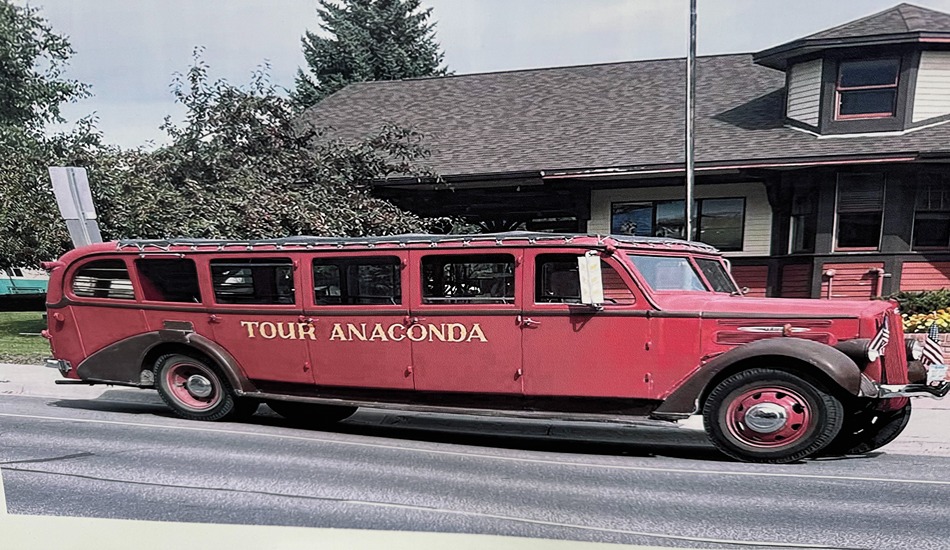
This vintage bus offers tours of Anaconda.
Anaconda: Smelter City USA
Steeped in industrial history, Anaconda was home to the Anaconda Copper Mining Company, which employed thousands who worked at the smelter that processed copper from Butte. The 585-foot-tall Anaconda smelter stack, visible from miles away, towers against the backdrop of the Rocky Mountains. It is the tallest free-standing masonry structure in the world.
Closed in 1980 and saved from demolition by townspeople in 1985, the brick stack (30 feet taller than the Washington Monument) stands as a reminder of Anaconda’s past as a one-company town. More than 100 structures in the industrial complex were demolished in 1986, leaving the stack (built in 1918) as the only vestige of the internationally significant smelting operation.
The stack, high on a hill and off limits to the public, is best viewed from below at Anaconda Smoke Stack State Park, Montana’s smallest state park, which serves as an interpretive site for the massive landmark.
The park is one of many places visited on tours aboard the vintage red 1936 bus that leaves from Discover Anaconda Visitors Center three days a week from mid-May to September. Stops are made at the Washoe Park Fish Hatchery and Washoe Theatre, an Art Deco movie palace whose lavish interior features ceiling and wall murals, elaborate light fixtures, and silver, copper and gold leaf. You pass Old Works Golf Course, a Jack Nicklaus-designed layout on the site of Anaconda’s first copper smelter. Built atop contaminated wastes left by the smelting operations, the 18-hole public course is the centerpiece of ongoing Superfund cleanup.
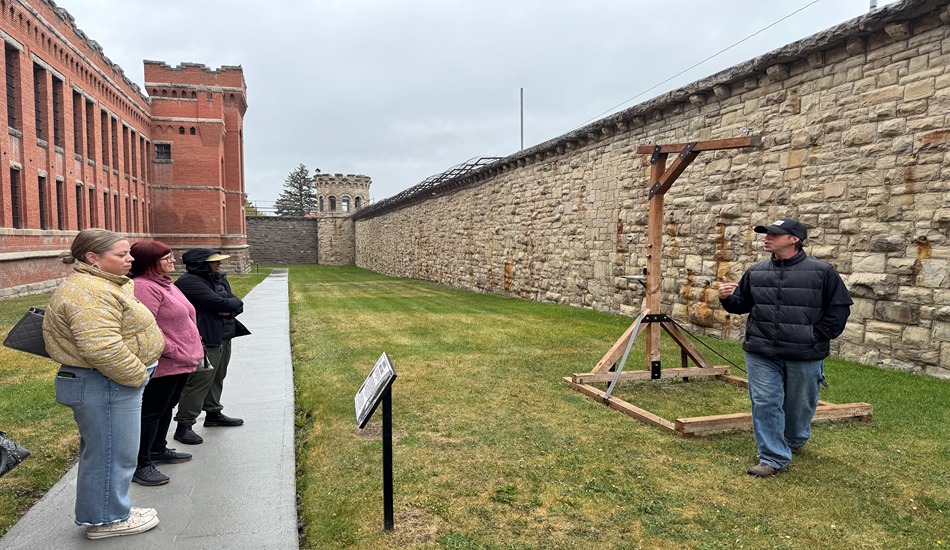
Old Montana Prison gives a peek of life behind bars.
Multiple Museums Fuel Tourism in Deer Lodge
Tales of escapes, executions and inmate riots captivate visitors on guided and self-guided tours of Old Montana Prison. From 1871 until it closed in 1979, the castle-like facility housed convicted criminals doing hard time. Visitors can stroll through the cell blocks and enter some of the cells. They can see the “Hole,” where difficult prisoners languished in solitary confinement, existing on a diet of bread and water with a peephole as the cell’s only light. After 10 days, prisoners in the “Hole” were examined by a doctor and could be sent back for another 10 days.
Exhibits throughout the buildings shed light on prison life, including recreational activities and prison industries. One display shows everyday items, as simple as a toothbrush or comb, that prisoners made into deadly weapons meant to kill or maim staff or other inmates. Prisoner-produced crafts on view include picture frames woven from cigarette packs.
One gallery, a real eye-opener, shows mug shots of Montana men and women incarcerated for crimes of sedition during World War I, a time when anti-American, pro-German sentiment was punished with sentences of up to 20 years. One man, for example, was arrested for saying these words on a train: “Americans are no good, and I hope the Germans will win.” Another served time for saying that if he was drafted, he would fight for the Kaiser, not the U.S.
Across from the Old Montana Prison, the Montana State Prison Shop sells inmate-made merchandise ranging from beadwork, leatherwork and knitwear to hatbands, key fobs and fishing flies crafted from horsehair. Prisoners receive 75 percent of sales, and 25 percent goes to operation of the store.
Horsehair hitching has been part of Montana penitentiary craft programs since the 1880s and is learned from fellow inmates. The painstaking process is time-consuming—one inch for every two hours of work.
The Old Prison complex offers more to see than the prison itself. Admission covers the neighboring Montana Auto Museum, featuring over 160 antique and classic cars; Frontier Montana Museum, a treasure chest of guns, spurs and other Old West artifacts; Yesterday’s Playthings, a vast collection of vintage toys; and Powell County Museum, a repository of local history.
Grant-Kohrs Ranch, a historic cattle ranch operated by the National Park Service, also brings tourists to Deer Lodge. A working ranch with grazing cattle, it preserves the main house, bunkhouse, blacksmith shop, horse barns, cattle sheds and other buildings dating back as far as the 1860s. Ranger-led activities include house tours, chuckwagon programs and blacksmith demonstrations.
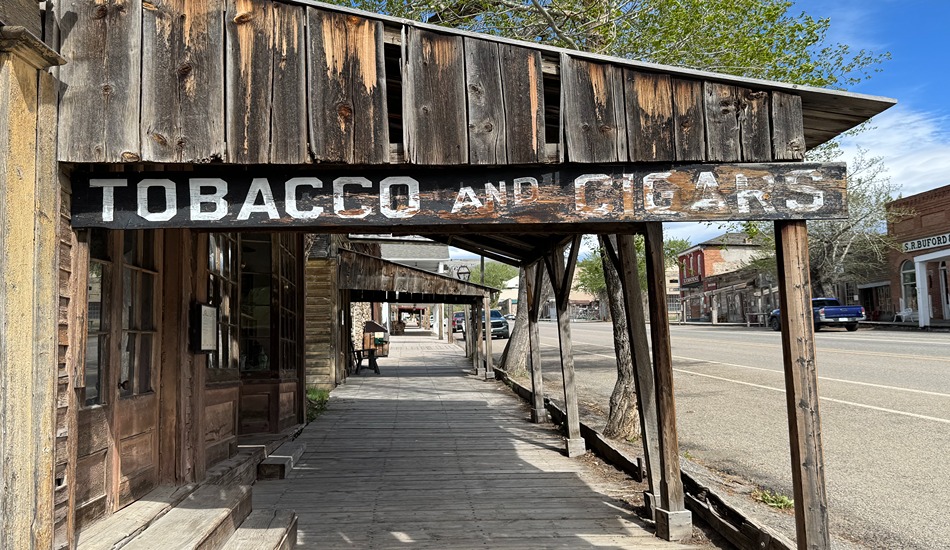
Historic buildings line the wood-plank sidewalks of Virginia City, Montana.
Virginia City and Nevada City: Relics of the Pioneer Past
A survivor of the gold rush in the 1860s and ’70s, Virginia City is billed as a “living ghost town.” After gold mining played out, its wooden buildings were dilapidated and in ruin by the 1940s. The population had dwindled to a handful of people, and few businesses were left. But a dedicated family – Charles and Sue Bovey and their son Ford – devoted their financial resources to preserving Montana’s frontier history, and today the museum town is a National Historic Landmark. Stagecoach and fire truck tours give a quick overview of the place.
Old storefronts lining the main street’s rustic boardwalks have been rehabbed and contain displays of period-authentic furnishings. A ladies clothing store that opened in 1908 remains exactly as it was on the last day of business in 1945, its merchandise completely intact, frozen in time. The blacksmith shop, which repaired stagecoaches and wagon-pulling ox teams, has original tools and machinery still in place.
Some of Virginia City’s historic buildings host operating businesses under their pressed-tin ceilings. There are candy and ice cream shops, art galleries, gift emporiums and old-time photo studios. Road Agents Roost, one of several restaurants and bars along the strip, is a German place serving schnitzels and sauerbraten. The Victorian-themed Fairweather Inn offers 15 guest rooms furnished with antiques.
The Virginia City Players, Montana’s oldest professional acting company, stages melodramas and vaudeville shows. Brewery Follies is live comedy in an 1863 brewery building.
Nevada City, one mile down the road from Virginia City, was a mining ghost town before being transformed into an open-air museum that charges admission. More than 100 historic buildings from throughout Montana have been transplanted to the site. Living history interpreters are on duty on weekends from Memorial Day to Labor Day.
Nevada City and Virginia City together claim one of the largest collections of Old West memorabilia outside of the Smithsonian. The Alder Gulch Shortline Railroad connects the two places.
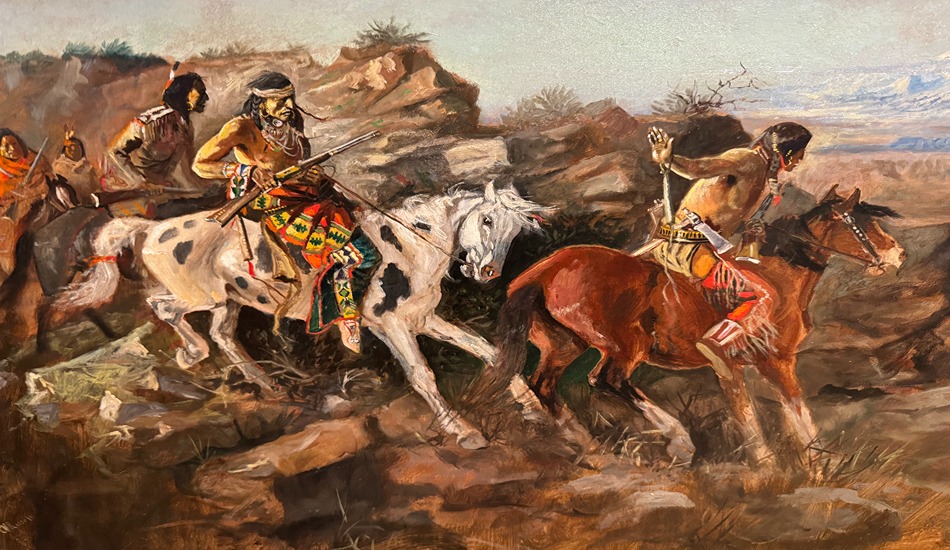
The Charles M. Russell Gallery at the Montana Heritage Center showcases fine examples of art capturing the spirit of the Wild West.
Helena’s Crown Jewel
One could spend hours roaming the galleries of the new Montana Heritage Center, the Montana Historical Society’s sparkling showcase of all things Montana. Located across from the Montana State Capitol in Helena, the museum made its debut in December 2025.
Bold exhibits filled with artwork, artifacts, enlarged archival photos, videos and computer kiosks tell Montana’s story. A copper mine simulator ride is enhanced with audio comments from former miners. Inside a tepee, the 15-minute film “Nations Today” spotlights the state’s 13 sovereign nations. Visitors learn about westward expansion, the buffalo and beaver fur trade, cattle ranching, railroads, wildlife, development of the tourism industry, and the life of Chinese immigrants in gold mining towns. The Charles M. Russell Gallery features an enviable collection of paintings and sculptures by the Montana cowboy artist who captured the spirit of the American West like no one else.
The main introductory exhibit has glass cases of shoes from all walks of life—cowboy boots, contemporary dance moccasins, beaded athletic shoes and the green silk pumps worn in 1950 by Hollywood actress Myrna Loy, a Helena native who generously gave back to her hometown. (A downtown theater housed in a former county jail offers is a performing arts center named after Loy, who grew up down the street.)
Departing from the historical society, the open-air Last Chance Tour Train offers a one-hour narrated loop through Helena. The tram swings by opulent West Side mansions dating from the mining boom days; travels along downtown’s Last Chance Gulch, a collection of shops in historical buildings that stand where gold was discovered in the 1860s; and passes the Myrna Loy Center. Also on the route: the magnificent 1908 Cathedral of St. Helena, a neo-Gothic masterpiece modeled after a famous church in Vienna, Austria.
Travel smarter, plan better – Get top destinations, itineraries, and industry trends by subscribing to Leisure Group Travel now.
Lead Photo – Broadway is Philipsburg’s wide main street.