Rock Springs, Green River and the unspoiled backcountry of Sweetwater County provide a variety of Western adventures for those who seek the less obvious
By Randy Mink, Senior Editor
When experienced travelers hit the road, they like new places that are rather obscure, off the beaten path, away from the crowds. My recent trip to Southwest Wyoming met those criteria.
High-Desert Oasis Rich in Natural Beauty and Western Culture
A kingdom unto itself, Sweetwater County, a sprawling domain where the state’s southwest corner meets Utah and Colorado, is hours away from Yellowstone and Grand Teton, two of America’s most-visited national parks. But because the major towns—Rock Springs and Green River—command exits on Interstate 80, their hotels and restaurants host many road-trippers on their way to or from those popular Wyoming preserves, and to Utah national parks as well.
While some motorists are just passing through, those who linger find much to discover. From sand dunes to ancient petroglyphs, a bounty of natural and historical treasures awaits.
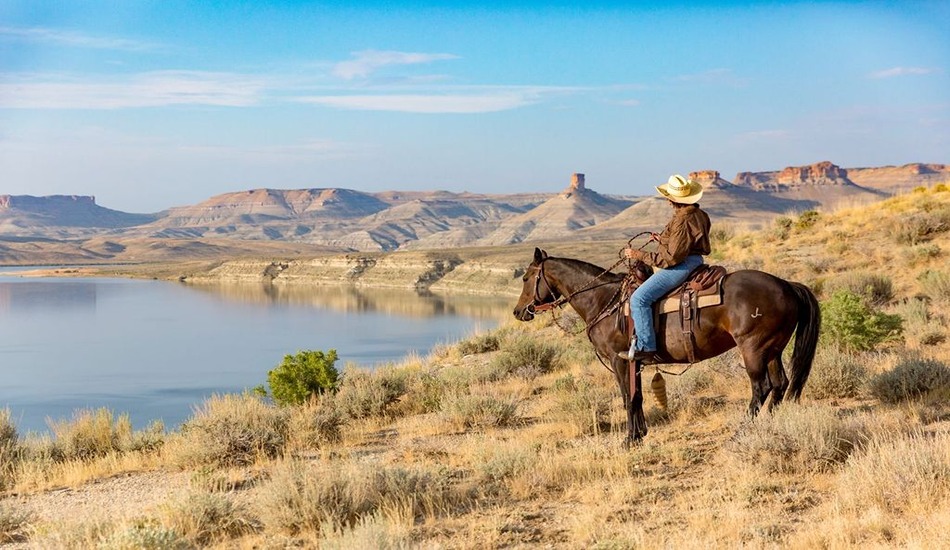
Wide-open spaces carpeted in sagebrush define the rugged landscapes of Sweetwater County, Wyoming. (Photo credit: Sweetwater County Tourism)
Sweetwater County, bigger than six states but sparsely populated, is one of the largest counties in the country, with elbow room aplenty. (Wyoming is the 10th largest state in size but, with only 590,000 residents, the least populous.)
Knowing that it’s sort of in the middle of nowhere, I was surprised to learn that Rock Springs (pop. 24,000) is served by United Airlines, which has two flights a day from Denver. And the town has the usual fast-food, hotel and retail brands, including Walmart, Walgreen’s and Home Depot. Ten of the area’s lodging options are group-friendly. Our group stayed at a top-notch Hampton Inn.
At elevations of more than 6,000 feet, this high-desert empire offers sweeping vistas of rugged federal lands covered in sagebrush and backed by barren mountains, all under an infinite Wyoming sky.
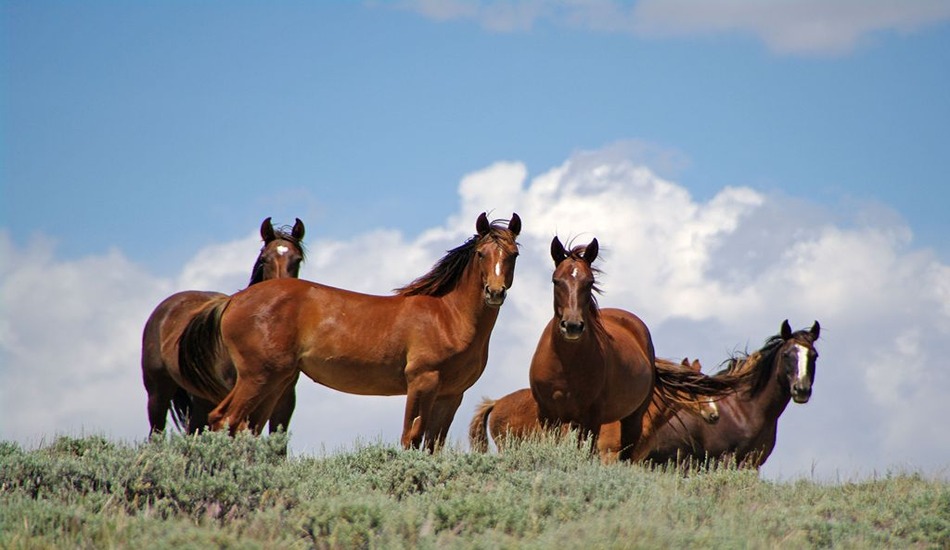
Going down gravel roads, my group was always on the lookout for wildlife, especially wild horses. One morning we drove the Pilot Butte Wild Horse Scenic Loop in hopes of spotting a few of the 1,000-plus horses that roam free in the scrubby wilderness. We did see horses in the distance but were luckier another day when, conveniently for us, they were grazing roadside. When we got out of the car to take pictures, they posed nicely for us.
This stroke of luck had followed our visit to the White Mountain Petroglyphs, an open-air gallery of rock carvings made on sandstone cliffs more than 200 years ago by Plains and Great Basin Native Americans, Wyoming’s earliest-known inhabitants.
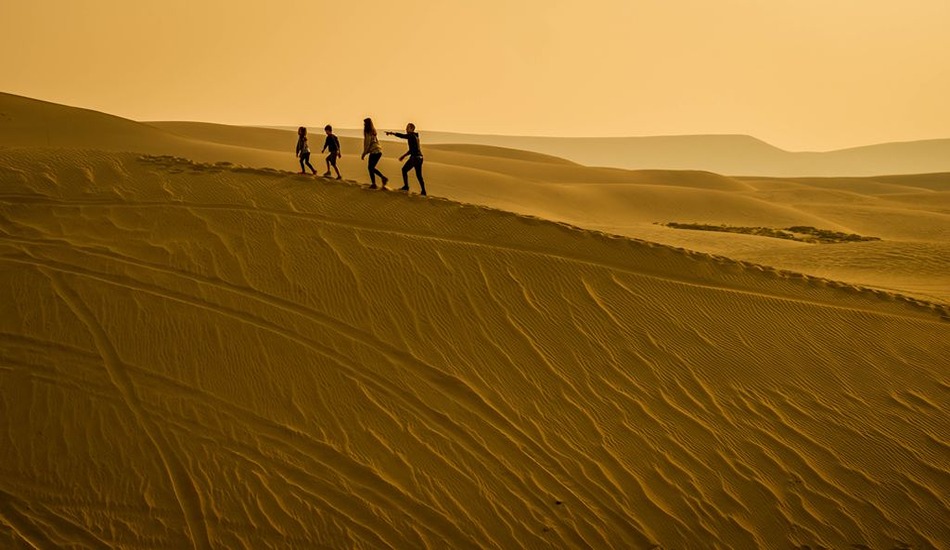
Killpecker Sand Dunes. (Photo credit: Sweetwater County Tourism)
Killpecker Sand Dunes: Nature’s Sandbox
Not far from the petroglyphs, we did some hiking in the designated open play area at Killpecker Sand Dunes. One of the world’s largest active dune fields, it stretches over 100 miles from west to east, reaching heights of over 100 feet. Some tackle the hills in dune buggies, dirt bikes and ATVs, while others surf the shifting expanse of soft, golden sand on sandboards (similar to snowboards) and sleds.
The seemingly endless dunes, 33 miles northwest of Rock Springs, afford views of some flat-topped buttes and Boar’s Tusk, a 400-foot-tall rock spire that the region’s Native Americans hold sacred. Bring your binoculars for glimpses of horses, deer, pronghorns, birds and the rare desert elk.
Pronghorns, colloquially referred to as antelopes but actually a different species, are a common sight in Wyoming. In fact, the state has more pronghorns than people. North America’s fastest animal can run at speeds up to 55 mph. Only the cheetah is faster.
Both Killpecker Dunes and the White Mountain Petroglyphs are managed by the Rock Springs office of the U.S. Department of the Interior’s Bureau of Land Management (BLM).
In Farson, a small town about 30 miles north of the dunes, the old-fashioned Farson Mercantile serves up outrageously huge ice cream cones at surprisingly affordable prices. The “Home of the Big Cone” offers more than 20 ice cream flavors, from root beer and huckleberry to cotton candy and bubble gum.
Flaming Gorge Country By Bus
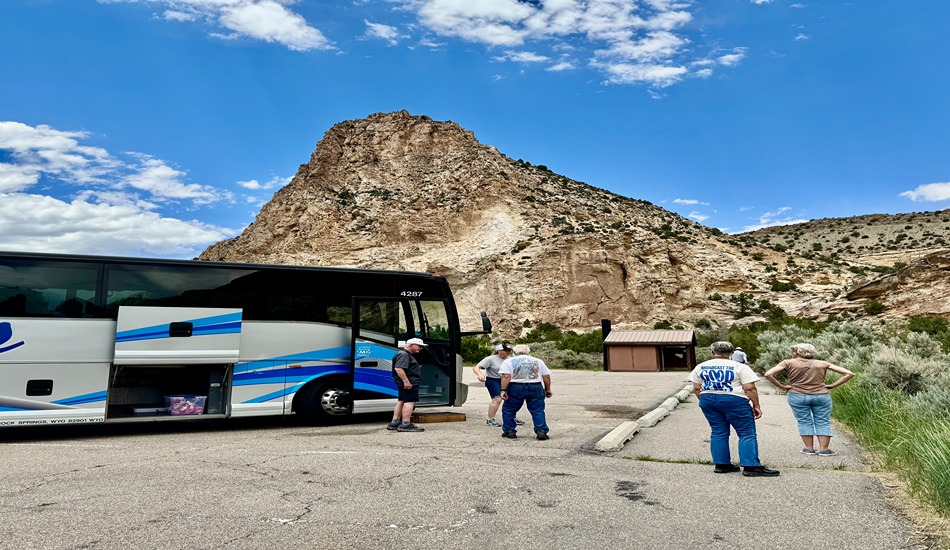
In this intriguing corner of Wyoming, the highlight for me was the full-day bus tour following Flaming Gorge-Green River Basin Scenic Byway, newest of the country’s 37 designated All-American roads. Departing from the visitor center in Rock Springs on select days during the summer, the guided tour showcases dramatic high-desert and alpine scenery as it encircles Lake Flaming Gorge, a 91-mile-long reservoir that begins south of Rock Springs and Green River and continues into northeastern Utah.
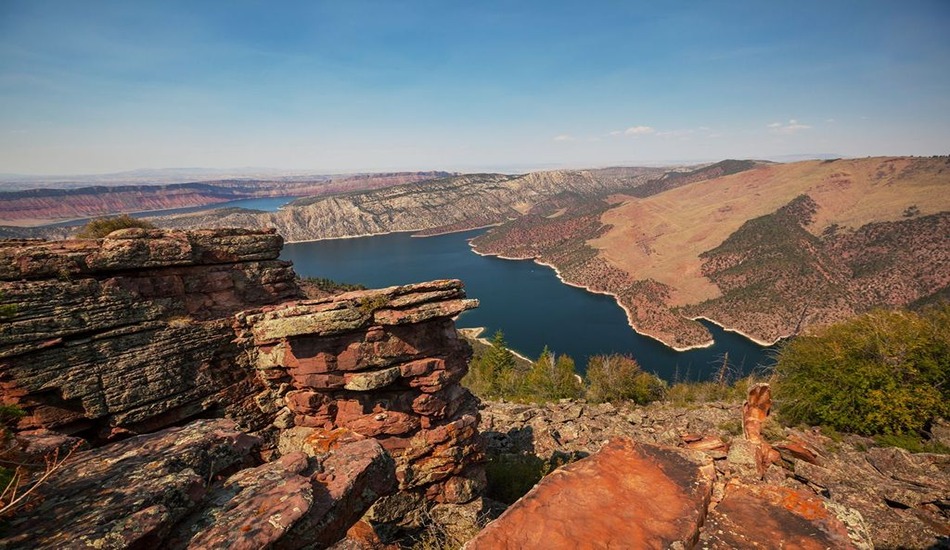
Stunning vistas mesmerize travelers in Flaming Gorge Country. (Randy Mink Photo)
Besides viewing layered red-rock walls and boulder-strewn stands of junipers in Flaming Gorge National Recreation Area, we caught glimpses of wildlife—pronghorn, mule deer, wild mustangs, bighorn sheep, ospreys, bald eagles, a rattle snake, even river otters hiding under a boat dock.
Several roadside signs read, “Open Range, Loose Stock,” and at one point we saw a lone cowboy riding a white horse and herding cattle.
Red Canyon and Sheep Creek Bay overlooks, offering vistas of classic red-streaked cliffsides and deep blue-green waters, gave us our best pictures. (When the sun strikes the red sandstone walls at certain times of day, they appear to be on fire, thus the name Flaming Gorge, as given by explorer/geologist Major John Wesley Powell on his groundbreaking 1869 expedition down the Green and Colorado rivers.)
At $68 a person, the bus tour (a 160-mile roundtrip) is a real bargain, considering that it includes a boxed lunch, snacks (ice cream, donuts) and bottled water. Everything is planned out, with stops at key lookout points and Flaming Gorge Dam Visitor Center, so you just sit back and go with the flow. We ate lunch at picnic tables under the pines of Ashley National Forest in Utah. (The dam, dedicated in 1964 by Lady Bird Johnson, impounds the Green River.)
Best of all, the full-size bus (equipped with a restroom) never takes more than 30 passengers, so there is room to spread out. And, except at the marinas, Flaming Gorge never seemed to have a lot of visitors. We often had the overlooks to ourselves. This was the untamed West we wanted to see, without the crowds.
Besides regularly scheduled Flaming Gorge bus tours, private departures can be arranged. Tickets for groups of 20 or more are $49 per person.
Rock Springs: Melting Pot of Cultures
Entering Rock Springs from the Dewar Drive exit off I-80, you’re greeted with the sign “Welcome to Rock Springs, Home of 56 Nationalities” and flags of many nations flapping in the breeze.
The town, you discover, takes pride in its ethnic make-up, a result of its history as a coal mining hub that, during the late-1800s coal boom, attracted skilled workers from countries around the world—Scotland, Wales, Estonia, Latvia, Slovenia, Albania, Norway, Sweden, Lebanon, Argentina, China, Japan, just to name a few. In 1915 nearly half the county’s residents were foreign born, and miners accounted for a quarter of the population.
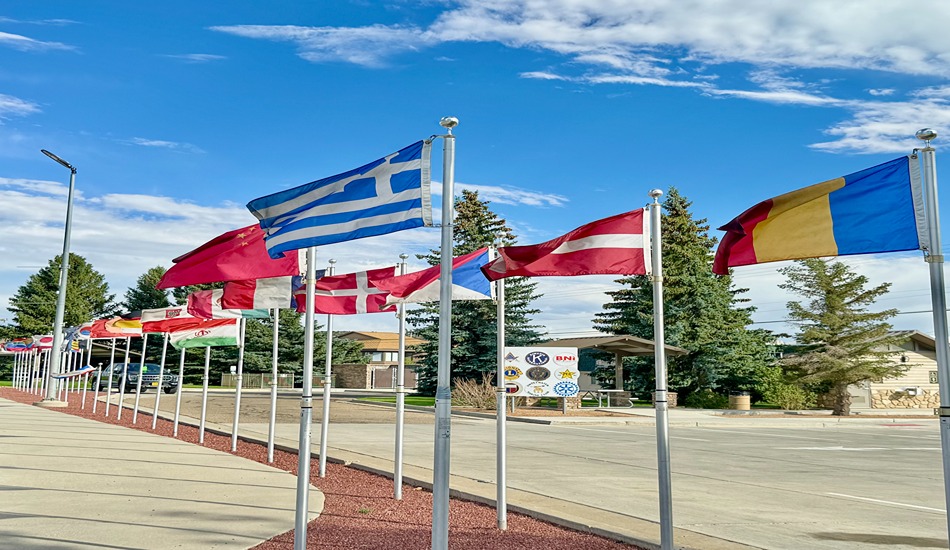
Flags of many lands lend a festive touch to one of Rock Springs’ main roads. (Randy Mink Photo)
My group got a taste of this multicultural flavor at International Day, a big July event that happened to coincide with our trip. Held at tree-shaded Bunning Park, the celebration features food, crafts, musical acts and dance performances, plus a candlelight ceremony that recognizes each nationality.
Things to See and Do in Rock Springs
The free-admission Rock Springs Historical Museum, housed in the old city hall/police station/jail, spotlights the town’s melting pot of cultures with folk costumes and other artifacts. It sells decals and miniature flags representing many of the countries.
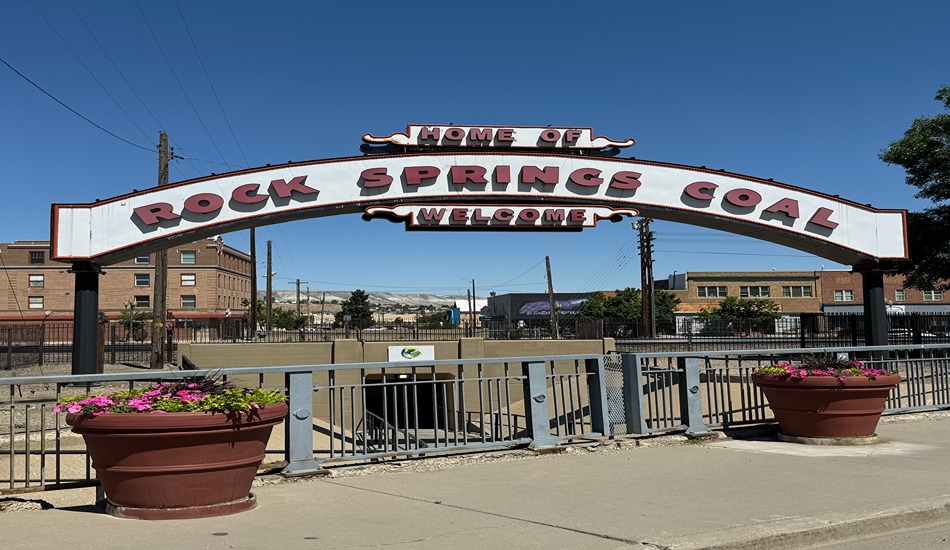
The welcome arch stands proudly above South Main Street in downtown Rock Springs. (Randy Mink Photo)
One museum exhibit sheds light on the Rock Springs Chinese Massacre of 1885, in which coal miners of various nationalities murdered 28 Chinese co-workers in a labor dispute and burned Chinatown to the ground.
Nearby, the Community Fine Arts Center has oversized artwork depicting the massacre along with Chinese artifacts. The center’s impressive collection, started by a science teacher during the Depression, includes paintings by Norman Rockwell, Grandma Moses, Salvador Dali and Alexander Calder as well as works by local and regional artists.
With a downtown walking tour pamphlet, I delved into town history and drifted into some shops, including The Stellar Cellar thrift store and Remedies Grill, a 1950s-style diner inside a store offering a nice selection of Wyoming-themed souvenirs.
My group had lunch at Broadway Burger, another ’50s-flavored hangout, enjoying burgers, fries and milkshakes in a nostalgic setting decorated with pictures of Elvis Presley, James Dean and Marilyn Monroe. To get into the Wyoming spirit, I ordered the elk burger. Next door is the 1948 Broadway Theater, which hosts more than 50 performances a year, from musicals and comedy shows to dramatic plays.
By the downtown railroad tracks are a monument to coal miners, a restored Union Pacific train car and the towering welcome arch, a town symbol first illuminated in 1929. (From the beginning, Union Pacific operated most of the coal mines and continues to play a big part in the area’s economy.)
The area still has a few coal mines, but its most valuable underground resource these days is a mineral called trona. In fact, Sweetwater County, with four trona mining companies in the Green River Basin, is billed as the Trona Capital of the World.
Exploring Green River
We learned all about trona while perusing an exhibit at the Sweetwater County Historical Museum in Green River, discovering that the whitish, flaky, translucent mineral is processed into soda ash (sodium carbonate), an ingredient in things like glass, paper, soap, toothpaste, baking soda and laundry detergent. Mines in the county provide 90 percent of the U.S. supply of trona and account for 25 percent of worldwide production. The museum gift shop has chunks of trona for sale.
Housed in a former post office, the museum also looks at coal mining, railroading, sheep and cattle ranching, fur trading, Native American cultures, the Pony Express and the John Wesley Powell expeditions. A laptop shows a 17-minute video on the Chinese Massacre.
Green River (pop. 11,000) lies 12 miles west of Rock Springs. Those looking to beat the summer heat come to float and paddle in the flowing waters of the Green River Whitewater Park and Tubing Channel. Expedition Island Park, a great place for picnics and trout fishing on the Green River, was the launch site for Major Powell’s voyages.
Our group enjoyed a gut-busting breakfast at Green River’s Western-themed Hitching Post Restaurant & Saloon. Several of us ordered the Cowboy Biscuit, a plate of buttermilk biscuits, scrambled eggs and cubed potatoes topped with chopped chicken-fried steak and drenched in white country gravy.
Travel smarter, plan better – Get top destinations, itineraries, and industry trends by subscribing to Leisure Group Travel now.
Lead photo courtesy of Sweetwater County Tourism