Mouthwatering meals, comfortable accommodations and excursions to grand French chateaux highlight travels on the Loire Princesse, a great way to see France
Groups that have cruised the Danube, Rhine, Seine and other popular rivers of Europe might put a fresh new destination on their radar—the Loire Valley of western France.
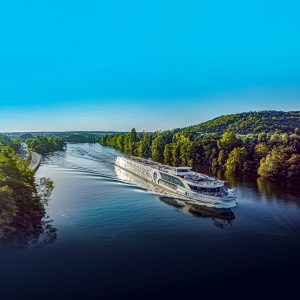
Gliding gently from east to west through the center of France, the Loire River flows past fertile fields, rolling hills and countless palaces and castles. Only one ship—CroisiEurope Cruises’ 96-passenger Loire Princesse—offers this route, and I was onboard last November.
On a five-day/four-night itinerary from Nantes, my daughter, her husband and I sailed to the Atlantic port of Saint-Nazaire and then headed east to visit grand Renaissance-era chateaux and do some wine tasting. To reach Nantes, we rode for two hours and 19 minutes on a high-speed train from Paris, where we spent three days both before and after the cruise.
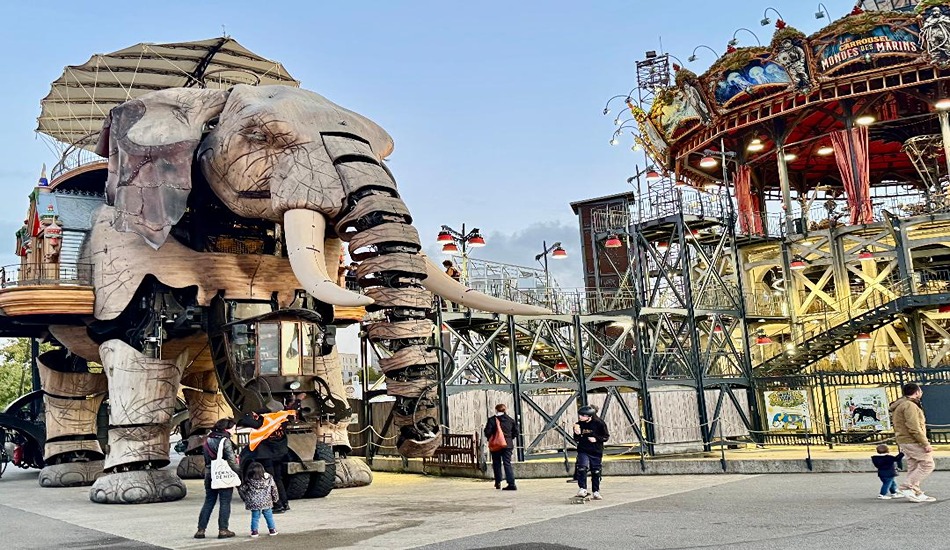
The Grand Elephant, a mechanical wonder at Les Machines de L’ile in Nantes, lumbers past the carousel, just steps from the Loire River. (Randy Mink Photo)
Enchanting Nantes
Nantes was a pleasant surprise and a highlight of our 10-day trip to France. I had never heard much about it and was expecting just another big city, but the most westerly of France’s large urban centers turned out to be a charmer.
In the heart of town, just steps from the Loire Princesse dock, lies Les Machines de L’ile, one of Nantes’ premier tourist attractions. At this gallery/workshop where oversized mechanical animals come alive, a group of us from the ship saw demonstrations of a giant spider, ant, heron, sloth, caterpillar, chameleon and other creatures in motion. Occupying former shipyard buildings in a reimagined district that preserves reminders of Nantes’ maritime past, it’s a one-of-a-kind artistic project inspired by the fantasy worlds of science-fiction novelist Jules Verne (a native of Nantes), Leonardo da Vinci’s mechanical aesthetic and the city’s industrial history.
Getting the most attention at Les Machines de L’ile is the Grand Elephant, which can be seen ambling along the quay carrying up to 50 people on its back. Made of steel and wood and fitted with a hybrid engine, the 39-foot-high, 48-ton creation has been offering rides since 2007 and is practically a symbol of modern Nantes, the sixth-largest city in France. Robotic-like, he walks by the project’s massive Marine Worlds Carousel, a three-story, interactive ride populated by sea animals that can be manipulated with ropes and levers.
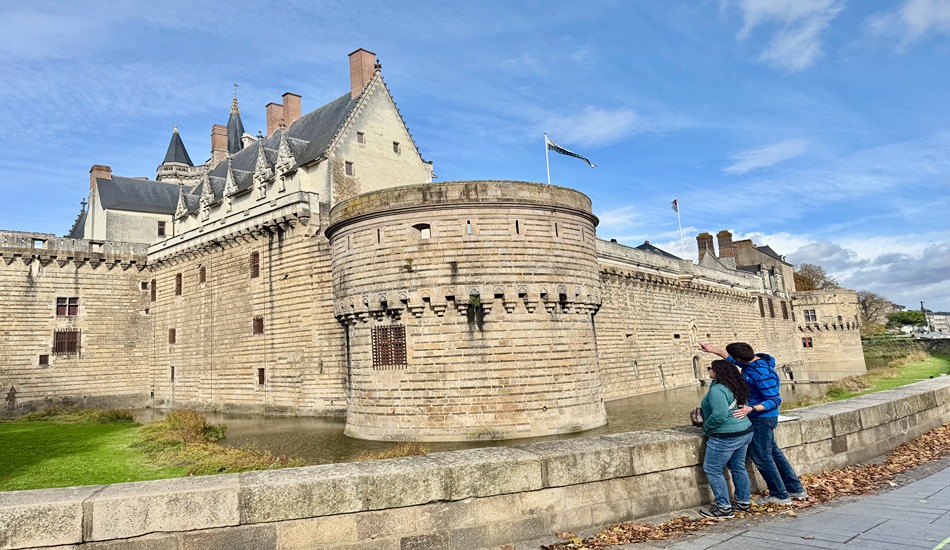
Castle of the Dukes of Brittany in Nantes, France. (Randy Mink Photo)
Before boarding the ship, we had a chance to poke around Nantes’ historic core, a compact area dominated by two attractions dating from the 15th century—the Cathedral of St. Peter and St. Paul and the Castle of the Dukes of Brittany. Exhibits in the castle’s museum chronicle the history of Nantes. You can stroll the ramparts for free. Also worth a look is the 1843 Passage Pommeraye, a grand covered shopping gallery with a monumental iron-and-glass roof.
Saint-Nazaire: Shipbuilding Center on the Atlantic
Downstream from Nantes, at the mouth of the Loire, resides the great seaport and shipbuilding center of Saint-Nazaire. On our shore excursion, I made good use of touchscreens, videos and a handheld audio guide during an immersive virtual voyage into the heyday of ocean liners at Escal’Atlantique, a museum housed in a German WWII submarine base a short walk from the Loire Princesse.
Besides artifacts like furniture, artwork, dinnerware and large sections of paneling and other decor fragments, the museum showcases re-creations of staterooms and grand public spaces of legendary French Line ships like the Normandie, a 1930s classic built in Saint-Nazaire. A movie with archival footage provides a timeline of important chapters in trans-Atlantic ship travel and explains how the airlines, beginning in the late 1950s, made ocean crossings a relic of the past. Visions of the ill-fated Titanic come to mind as your museum visit ends with a ride in a lifeboat that’s lowered to the floor below.
From the roof of the old submarine base, I could see the MSC World Asia under construction at Chantiers de l’Atlantique, one of the few shipyards that builds today’s mega liners. Our cruise did not include a visit there, but normally a shipyard tour is part of the program.
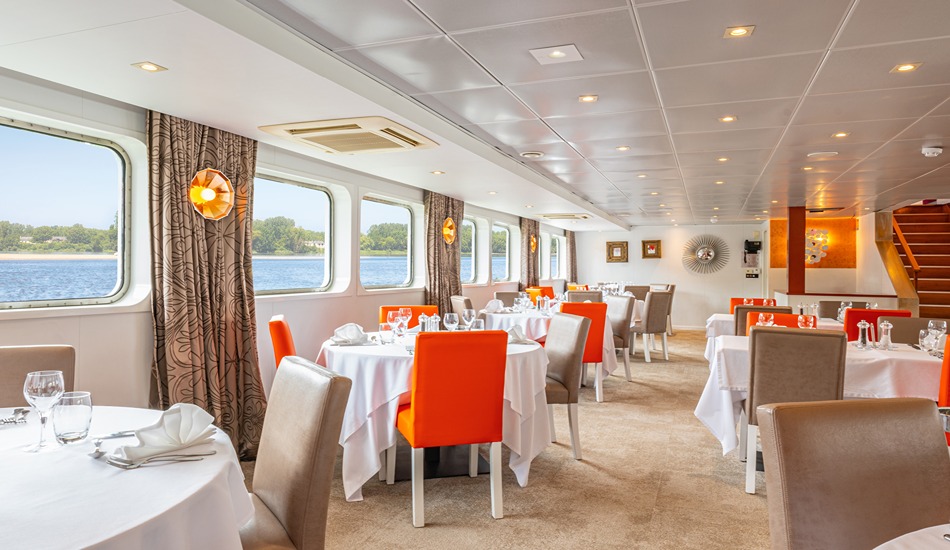
The Loire Princesse restaurant. (Photo credit: CroisiEurope Cruises)
Loire Princesse Amenities and Mealtimes
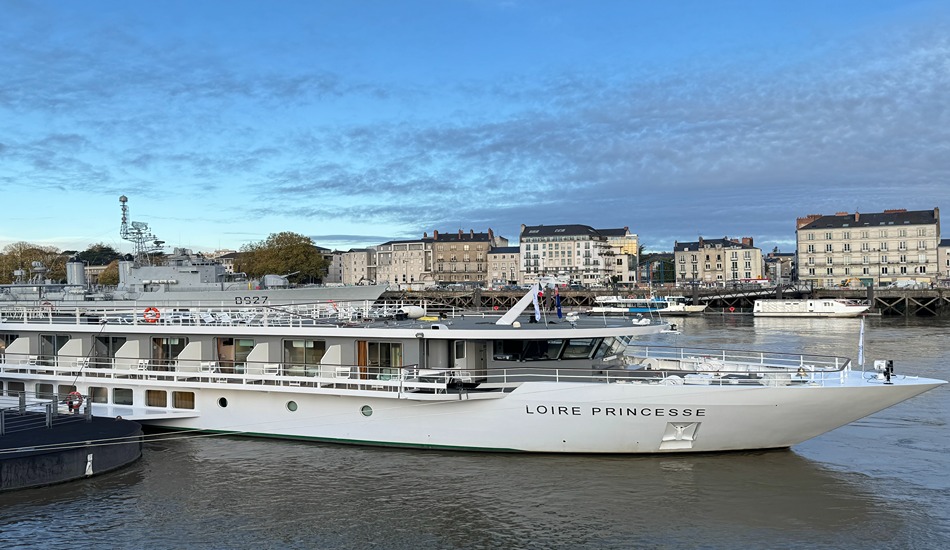
The Loire Princesse, a product of Saint-Nazaire’s shipyards, was built in 2015. Sporting side paddlewheels, the floating hotel is outfitted with a shallow draft suited to Loire River travel.
In fact, “the MS Loire Princesse was engineered specifically for this river,” says Sandrah Gurash, North America general manager for CroisiEurope. “As this is a ‘wild’ river, water levels are not controlled by lock systems and it can impact navigation abilities. The shallow draft and paddlewheels allow her to navigate the river in all but extreme water level conditions.”
The 30 Upper Deck cabins feature a sliding panoramic window and a terrace with two chairs and a table, while the deck below has 18 cabins with high windows. I liked how my bed faced the terrace and appreciated the ample closet space and floor-to-ceiling mirror. Bright and white, the room and bathroom showed no signs of aging.
Large windows grace the Loire Princesse’s lounge/bar, where the fun and music happens. One night in this welcoming living room, we were serenaded with traditional Breton songs performed by a spunky duo that encouraged audience participation. The lounge’s outdoor patio affords great landscape views. One level above, the Sun Deck offers 360° panoramas.
The best part of a CroisiEurope cruise, we had heard, is the refined French cuisine, and the Loire Princesse culinary team did not disappoint. Indeed, mealtimes in the restaurant merited exclamation points. The courses were exquisitely presented, the ingredients top quality, the sauces phenomenal. Each lunch and dinner (a plated meal orchestrated by a chef from Cameroon) seemed to outdo the previous one. Breakfast was a bountiful buffet. The cruise fare includes all drinks with meals and at the bar.
My favorite dinner started with assorted canapes and a silky, melt-in-your mouth duck foie gras, followed by a quail filet in port wine sauce, brie filled with mascarpone and the grand finale—baked Alaska flambéed in Grand Marnier. A memorable lunch starred leek quiche and salmon steak in a white butter sauce the region is known for.
Our lunches and dinners did not include a choice of main course, but, starting in 2027, a selection of mains will be standard on all CroisiEurope river and canal cruises.
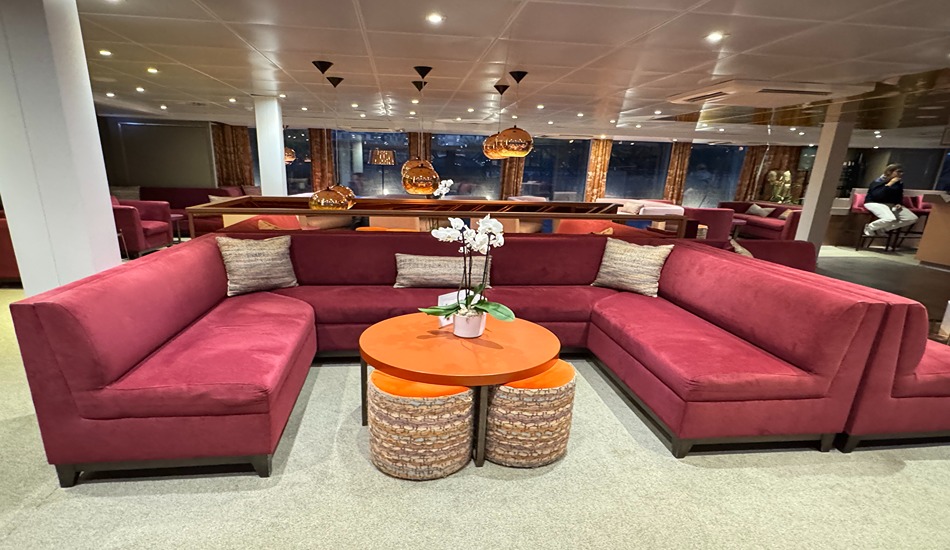
The lounge/bar is the gathering spot for guests of the Loire Princesse. (Photo credit: CroisiEurope Cruises)
Special Cruise Arrangements for Charters and Groups
For charter clients at present, an enhanced meal package for €10-12 pp. per day consists of a lunch buffet and dinner with a choice of mains. It also includes the European breakfast buffet (which our group experienced) with the addition of a different American breakfast option daily (waffles, pancakes, French toast, etc.) and a made-to-order omelet station.
On charters, CroisiEurope also can customize the itinerary, excursions and entertainment options. And on request for a reasonable premium, the line can stock the bar with specific brands. For groups of 20 or more, it can provide (for a per-person charge) a special cocktail reception with hors d’oeuvres.
Groups of 20+ also can book customized excursions, with an English-speaking guide guaranteed. (On a non-group, non-chartered sailing, a CroisiEurope cruise in Europe typically has 10-15% of passengers from English-speaking markets.)
For group and charter information, email groups@croisieurope.com.
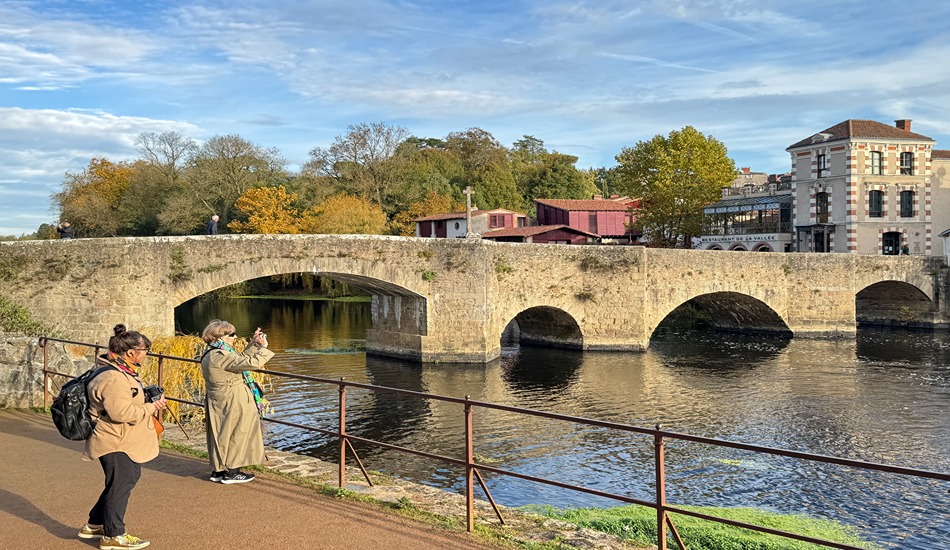
Loire Princesse shore excursions visit the picturesque French village of Clisson. (Randy Mink Photo)
Clisson Walking Tour and Muscadet Wine Route
Heading east from Nantes on Day 3, our shore excursion took us to Clisson, a pretty village centered around picturesque castle ruins. Steps away from the medieval fortress is Clisson Market, a timber-framed structure where vendors sell fresh fruit and vegetables and locally caught fish. Clisson, rebuilt in the 19th century in the Italian architectural style, Clisson easily could pass for a town in Tuscany.
At our next stop, we gathered in a tasting room at Chateau Cassemichère to try several types of Muscadet, a dry white wine with a fruity bouquet that’s perfect with fish and seafood. The countryside south and east of Nantes has almost 400 wine growers, with Muscadet accounting for 80 percent of everything produced.
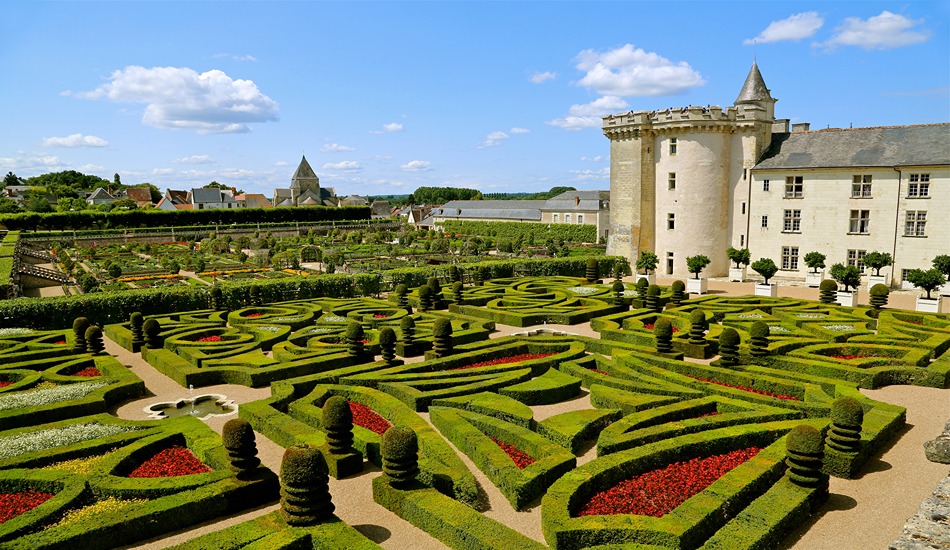
Chateau de Villandry. (Photo credit: CroisiEurope Cruises)
Chateau Hopping in the Loire Valley
Our last day’s shore tour spotlighted two of the central Loire Valley’s most magnificent Renaissance-era estates—Chateau d’Azay-le-Rideau and Chateau de Villandry. Both fulfilled my visions of stately French manors, but it was the latter that really captured my imagination, thanks to the elaborate geometric patterns of its terraced, Italian-influenced flower, vegetable and herb gardens, a photogenic display attended by 10 full-time gardeners.
Depending on time of year, you’ll see tulips, begonias, roses and forget-me-nots, among other flowers at Chateau de Villandry. Some of the hedges are shaped into symbols, including hearts, fans and daggers. Planted throughout the estate are 1,015 lime trees.
Grand views of the countryside, adjacent village and manicured gardens are available from atop the 12th century tower, the walled compound’s only remnant from medieval times. The chateau in its present form was built in 1536 by the finance minister of Francois I. Over the centuries, other owners have included an ambassador of Louis XV and a brother of Napoleon I.
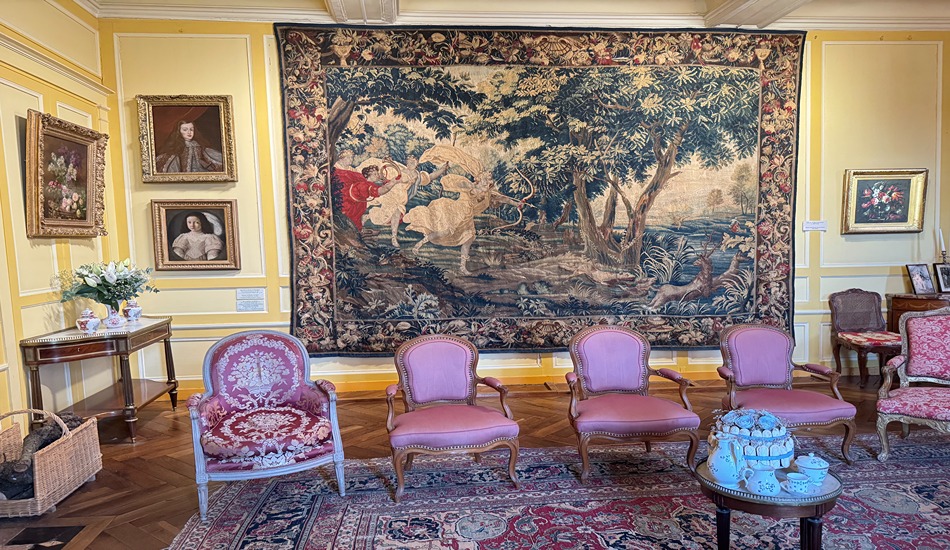
Exquisite furniture, artwork and tapestries adorn the interiors of Chateau de Villandry. (Randy Mink Photo)
In 1906, Joachim Carvallo and his wife, Ann Coleman, scientists from Spain and America respectively, became the owners of Villandry and restored its interiors and gardens. They were passionate collectors of old paintings, particularly 17th century Spanish art; some are displayed in rooms of the chateau. Of special note is the Oriental Drawing Room’s exquisite ceiling, a creation of Moorish craftsmen that was transplanted from a 15th century palace near Toledo, Spain. Joachim and Ann’s great-grandson, Henri Carvallo, now runs the estate and lives with his family in the former stables.
Ah, to be lord of the castle. The thought may be only a dream for us commoners, but it’s fun to fantasize. Having a chance to traipse through the Loire Valley’s aristocratic estates, along with receiving royal treatment as a guest of the Loire Princesse, is privilege enough for me.
Travel smarter, plan better – Get top destinations, itineraries, and industry trends by subscribing to Leisure Group Travel now.
By Randy Mink, Senior Editor
Lead photo – The Loire Princesse in Nantes, France. (Randy Mink Photo)