The additions deepen Virginia’s presence on the national trail, connecting local voices and landmark legal victories to the broader Civil Rights Movement
Looking for expert insights and fresh travel ideas? Download the latest issue of Leisure Group Travel for free and start planning your next unforgettable group adventure.
By Dave Bodle
The Civil Rights Movement wasn’t built in a single city or sparked by one moment alone. It took shape in courtrooms and communities, through everyday people who made extraordinary decisions when it mattered most. Virginia’s newest additions to the U.S. Civil Rights Trail tell that story well, shining a light on places where local voices and landmark cases helped push the nation forward. With the inclusion of the Caroline County Courthouse in Bowling Green and Gloucester County’s collection of historic sites, the Commonwealth continues to reveal how some of the movement’s most consequential chapters were written far from the spotlight.
Caroline County Courthouse, Bowling Green
On February 14, the Caroline County Courthouse in Bowling Green, Virginia, became a member of the U.S. Civil Rights Trail. The decision in Loving v. Virginia is one of the most important civil rights rulings in U.S. history, striking down all remaining state laws banning interracial marriage. The plaintiffs in the case were Richard and Mildred Loving, a white man and a Black woman whose marriage was deemed illegal according to Virginia state law. With the help of the American Civil Liberties Union (ACLU), the Lovings appealed to the U.S. Supreme Court, which ruled unanimously that so-called “anti-miscegenation” statutes were unconstitutional under the 14th Amendment. Richard and Mildred Loving’s case involved several key proceedings at the Caroline County Courthouse in Bowling Green before reaching the U.S. Supreme Court:
- Initial Plea and Sentencing: On January 6, 1959, the Lovings pleaded guilty to violating Virginia’s ban on interracial marriage. Judge Leon M. Bazile sentenced them to one year in jail, suspended on the condition that they leave Virginia and not return together for 25 years.
- Motion to Vacate: On November 6, 1963, the Lovings filed a motion at the courthouse to vacate their convictions, arguing they were unconstitutional.
- Final Local Ruling: On January 22, 1965, Judge Bazile denied this motion. It was during this ruling that he issued his infamous statement claiming that “Almighty God created the races… and he placed them on separate continents.”
- The landmark U.S. Supreme Court decision that finally overturned these convictions was decided on June 12, 1967.
Built around 1830, the Caroline County, Virginia Courthouse was placed on the National List of Historic Places in 1973. The Courthouse is just one of the dozen other buildings that comprise the Bowling Green Historic District.
Gloucester County
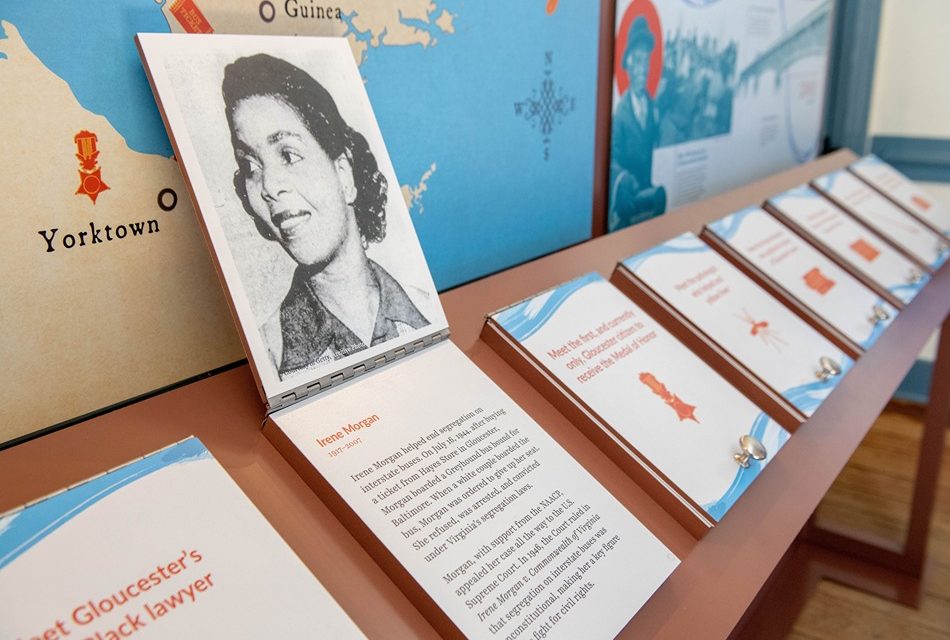
On February 21, 2026, Gloucester County, Virginia, became a proud member of the U.S. Civil Rights Trail. Gloucester County’s Civil Rights legacy is all about the achievements of civil rights pioneers and their lasting contributions that reached far beyond the Virginia borders. Their stories, along with many others, are told through exhibits at the Gloucester Museum of History, historic markers, churches, schools, and the African American Heritage Trail.
Thomas Calhoun “T.C.” Walker (June 16, 1862–1953) was a prominent African American lawyer, educator, public servant, and early civil rights leader in Virginia whose life spanned from slavery through the height of Jim Crow segregation. Born enslaved in Gloucester County, Virginia, he overcame immense barriers to become a force for legal, educational, and economic advancement for Black communities in Virginia.
Walker was born into slavery in Gloucester County in 1862, shortly before the end of the Civil War. After emancipation, he pursued education and attended Hampton Institute (now Hampton University), graduating in 1883. He studied law and was admitted to the Virginia Bar in 1887, becoming the first Black lawyer in Gloucester County. His legal work was part of his broader civil rights advocacy, seeking to protect the rights and dignity of Black citizens under oppressive Jim Crow laws.
Walker’s leadership extended into public office. He was elected to the Gloucester County Board of Supervisors, serving two terms beginning in 1891. He received two presidential appointments reflecting his influence beyond county lines.
Walker was a tireless advocate for education as a civil rights tool. He served as superintendent of Gloucester’s Negro schools and personally funded and organized efforts to create educational opportunities for Black children. In the early 1920s, facing resistance to public secondary education for Black students, heled a fundraising campaign, donating his own money and securing support from the Rosenwald Fund and other sources, to establish the Gloucester Training School, one of the first free public secondary schools for Black students in the county. His educational work included founding or aiding the creation of multiple schools and teacher housing, dramatically improving schooling in the community.
Beyond law and education, Walker promoted land ownership and economic independence as keys to racial uplift. He founded the Gloucester Land & Brick Company to help Black families purchase property and encouraged community self-reliance as a defense against systemic inequality.
Irene Morgan (1917–2007) was a pivotal but long-underrecognized figure in the American civil rights movement. Her courageous refusal to give up her bus seat in Virginia led to Morgan v. Virginia (1946), a landmark U.S. Supreme Court decision that struck down racial segregation on interstate transportation, nearly a decade before Rosa Parks’ protest in Montgomery.
In July 1944, Irene Morgan, a 27-year-old African American defense worker, was traveling by Greyhound bus from Gloucester County, Virginia, to Baltimore, Maryland. About 23 miles from Gloucester on the return trip, the driver ordered Morgan to surrender her seat to comply with Virginia’s Jim Crow segregation law. She refused and was arrested, fined, and jailed. Morgan chose to challenge the conviction, setting her case on a path to the Supreme Court.
In 1946, the U.S. Supreme Court ruled 7–1 in Morgan’s favor, holding that state laws requiring segregation on interstate buses were unconstitutional because they placed an undue burden on interstate commerce, which is regulated by Congress. The decision used the Commerce Clause, making it a powerful legal tool against segregation in transportation across state lines.
Morgan v. Virginia was a foundational victory that made segregation illegal on interstate buses and trains. Directly influenced the Journey of Reconciliation (1947), an early Freedom Ride organized by CORE, and helped pave the way for the Freedom Rides of 1961. While enforcement was uneven for years, the ruling gave activists a constitutional foothold to challenge Jim Crow travel laws nationwide.
Looking for expert insights and fresh travel ideas? Download the latest issue of Leisure Group Travel for free and start planning your next unforgettable group adventure.
Robert Russa Moton (1867–1940)was one of the most influential African American educators and national Black leaders of the early 20th century. When he built his retirement home, Holly Knoll, in Gloucester County, Virginia, he was already a figure of national stature whose presence carried symbolic and practical importance for Virginia’s Black communities.
By the time Moton retired to Gloucester in the mid-1930s, he was best known as only the second president of Tuskegee Institute (1915–1935). He was a leading Black advisor to U.S. presidents from Theodore Roosevelt through Franklin D.Roosevelt and a national spokesman for Black education and citizenship.
When Moton chose Gloucester for retirement, it was not accidental or merely personal. Gloucester already had a strong African American leadership tradition through figures like T.C. Walker and a well-organized Black community focused on education, land ownership, and civic advancement. Moton’s presence: elevated Gloucester’s status within Black educational and professional networks. It also reinforced the idea that rural Black communities could be centers of leadership, not just urban ones.
In retirement, Moton remained active as a mentor, advisor, and public intellectual, continuing correspondence and influence well beyond Tuskegee. His Gloucester home, Holly Knoll, became a symbol of achievement and dignity during the Jim Crow era. It reflected his lifelong belief in education as a tool for freedom, economic independence, and leadership rooted in service.
For groups, Visit Gloucester has developed an African American Heritage Trail. Discover Gloucester County through the stories of courage and leadership that shaped the Civil Rights era, aired with walkable historic districts, waterfront dining, gardens, and coastal adventure. The itinerary captures a dozen significant Civil Rights era locations.
These two wonderful additions join three other Virginians on the U.S. Civil Rights Trail.
Danville Museum of Fine Arts and History — Danville
Danville was a hotspot of civil rights activism in the early 1960s, notable for sit-ins and protests, including a major sit-in at the segregated Danville Public Library. Officials chose to close the library rather than integrate it, illustrating the intense resistance to desegregation at the time.
Fredericksburg Civil Rights Trail — Fredericksburg
This is a collection of locations rather than a single building. Known as Freedom, A Work in Progress, the trail weaves through historic downtown and the University of Mary Washington campus. It highlights local civil rights history from early Black activism through Jim Crow–era struggles and beyond.
Robert Russa Moton Museum — Farmville
The former Robert Russa Moton High School was a crucial early site of student activism challenging school segregation. In 1951, Black students staged a nonviolent strike over unequal conditions, a pivotal protest that helped feed into Brown v. Board of Education (1954), the landmark case that declared school segregation unconstitutional.
Virginia Civil Rights Memorial — Richmond
Situated on the grounds of the Virginia State Capitol, this memorial, the fourteen bronze statues commemorate the protests and legal actions that helped dismantle segregation in Virginia schools and society. It prominently honors Barbara Johns, a student leader whose activism helped push forward legal challenges linked to Brown v. Board.
Explore Virginia’s Sites on the U.S. Civil Rights Trail here, or dig a little deeper with our podcast.
Looking for expert insights and fresh travel ideas? Download the latest issue of Leisure Group Travel for free and start planning your next unforgettable group adventure.