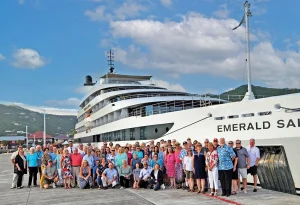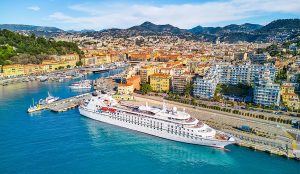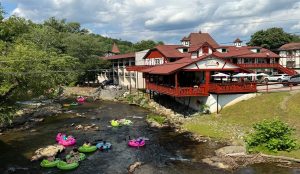
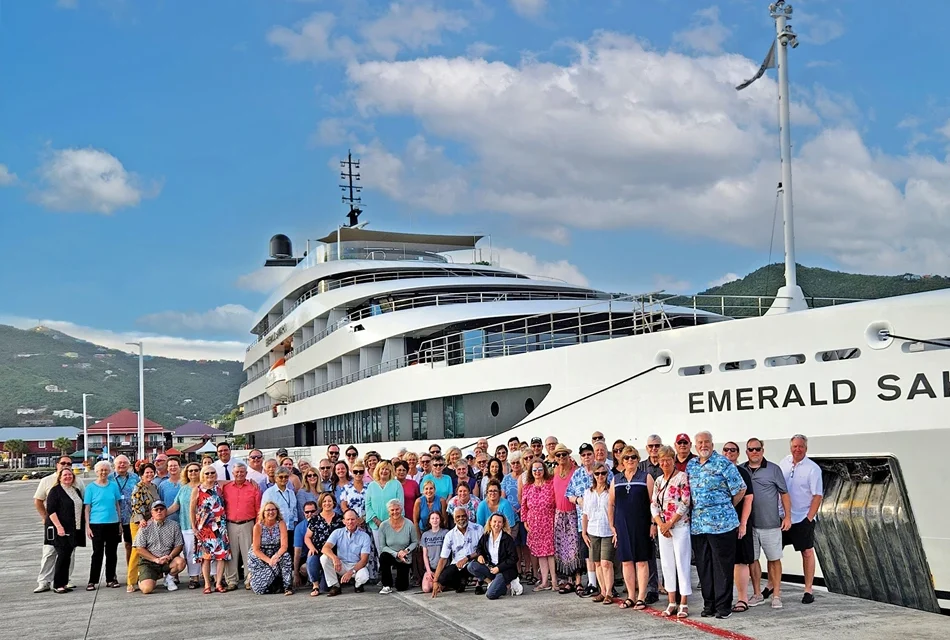
A motorcoach tour to National Parks, a European river cruise or luxury yacht experience. Mayflower’s pitch is that group leaders never have to leave their family of products
By Jeff Gayduk, Publisher, Leisure Group Travel
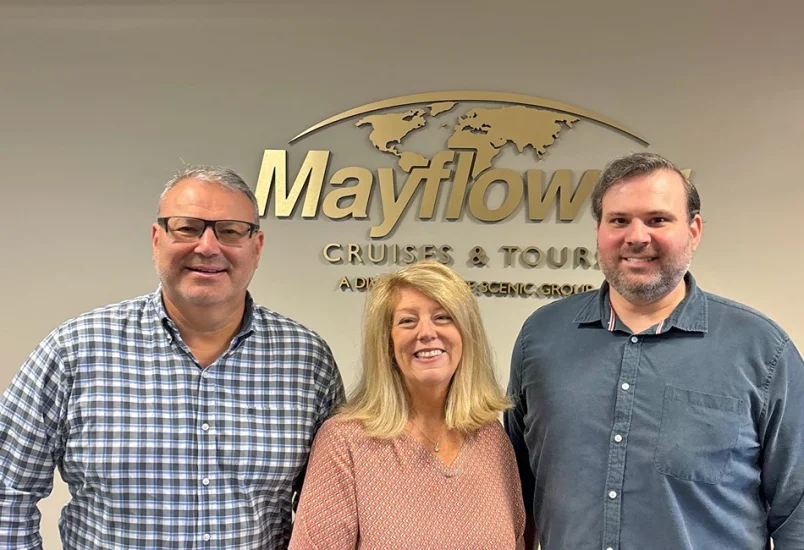
Mayflower Team
Ask a group leader to build a five-year plan and the seams in this industry show up fast.
Traditional tour operators offer a deep bench of land product but they either don’t sell cruises, or they block space or chartering specific cruise line departures, fronting deposits, and try to fill exactly what they bought. Cruise lines sell to groups, but the motorcoach tour through the national parks isn’t on their shelf. Group leaders end up managing multiple vendor relationships to keep the same travelers moving year after year.
Mayflower Cruises & Tours sits in an unusual position between those two. The suburban Chicago-based company operates a full land tour program and sells river, ocean and yacht cruising — and since John and Mary Stachnk’s 2018 sale to the Scenic Group, that cruise inventory belongs to its own parent. Scenic owns and operates the vessels; Mayflower sells into them.
“Some of our competition has to charter,” said Mike Schields, who took over as Mayflower president in June 2026. “They have to focus all their efforts on specific departures. But we have this whole world of departures that we can sell into.”
Schields came to Mayflower with a wide range of executive experience, including building the group direct program at Globus and competing against Mayflower for years. His mandate from ownership was short: this is a well-run business with a loyal customer base, protect that…And grow the cruise side. The harder half of the job is doing the second without compromising the first.

A ladder, not a catalog
The range only matters if travelers actually move through it, and that’s how Mayflower’s sales team is built to work it.
“Having the diversity of product keeps Mayflower relevant with those groups year after year,” said vice president of sales Sherri Guiborat. “If you’re just focusing on land tours and they want to take a cruise the next year, they have to go to a cruise company. Here, they can stay with us.”
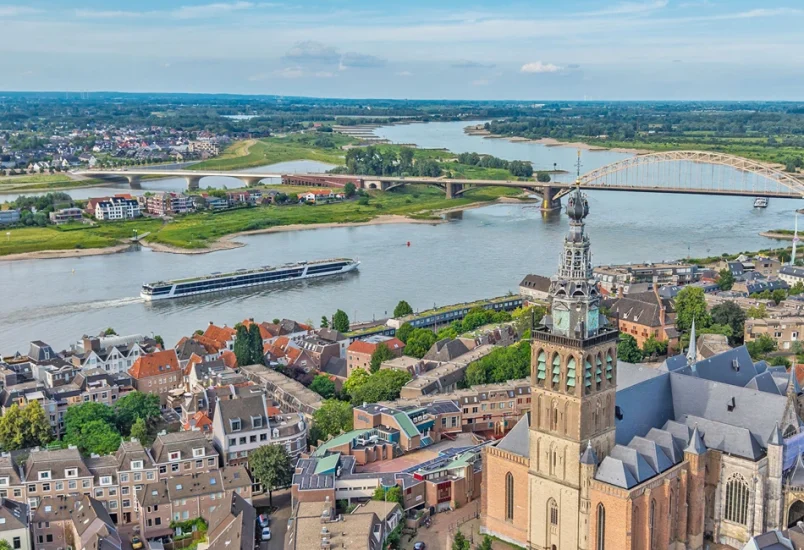
The progression runs from Mayflower’s land tours into Emerald’s river ships and up to the Scenic discovery yachts at the top. Schields describes it as a natural step rather than a sell: the land traveler who’s ready for a river cruise finds a comparable standard waiting, and the one ready for ultra-luxury finds that too.
Notably, land hasn’t shrunk to make room. It remains a consistent four-star program, and the demographics keep feeding it. As travelers age, Schields said, many lean back toward land product, and traditional motorcoach tours that require no airport at all are still moving well.
The top of the ladder gets sold differently. Rather than trying to move an entire group upmarket, Mayflower carves a subgroup out of one.
“There could be 5 or 10 percent of your database that wants that high-end, all-inclusive luxury experience,” Guiborat said. “It’s not going to be for everybody in the group who goes to Iceland or New England with free air. But there is that small nucleus that breaks off into a subgroup.” The pitch to the leader is direct: bring four or five couples on a Scenic Eclipse sailing and travel free in your own cabin.
That approach has found its market on the yacht product. Antarctica for example, Guiborat said, has performed strongly on the Scenic ships.
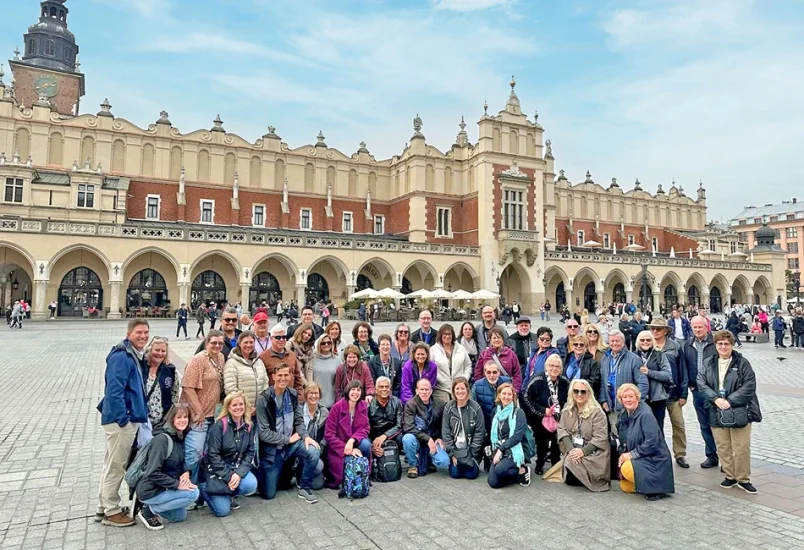
The group market is changing shape
The perennial problem in this business is that group leaders don’t grow on trees. There’s no IATA for them, no association, no directory to buy. Mayflower’s answer is a large sales organization for a company its size with a staff of 30 business development managers, regional directors and inside sales support. Mayflower still find groups the old-fashioned way, by knocking on doors, standing up in front of a room to give a presentation and picking up the phone.
What those BDMs are walking into has changed. The traditional feeders still produce — banks, senior centers, park districts, retirement communities, alumni associations and chambers — but Guiborat is seeing growth in categories that barely existed a decade ago.
“People want to have a little bit of ‘me time’ with their trips,” she said. “They want a little bit of independence and not necessarily have everything taken care of for them.”
That’s producing affinity groups organized around a shared interest rather than a shared institution like mahjong clubs, wine groups and ski groups. It’s also reshaping the itineraries themselves. A Greece departure runs Mykonos and Santorini into Athens with guided touring and a built-in free day. River and yacht programs are opt-in by design: ride the bike through Amsterdam or take the traditional walking tour of Budapest, and nobody has to choose in advance.
Home-based agents are the other growth channel, with Guiborat pointing to KHM Travel Group among the networks producing group business, alongside consortium relationships and the trade show circuit.
Schields sees particular room among smaller independent agencies, and he’s candid that this reflects a division of labor inside his own corporate family: Scenic USA works the large consortia partners, and given its size and regional history, Mayflower concentrates where it can be more useful.
“It’s finding these independent agencies that do groups and have networks of family and friends,” he said. “They’re looking for that service, they’re looking for the extra marketing support.”
Two patterns suggest the leader pipeline is regenerating rather than aging out. Cruise passengers keep converting: “they’ve gone on them and they think, oh my gosh, I’ve got friends and family that would love to do this,” Guiborat said. “And they have reincarnated themselves as group leaders, no doubt.”
More consequential is succession. Schields said a share of Mayflower’s long-tenured group leaders are handing their books to their children — a pattern he reads as evidence the model holds. Each of those leaders, he noted, runs a business under their own name and their own reputation and keeping it as part of a family succession plan only makes sense.
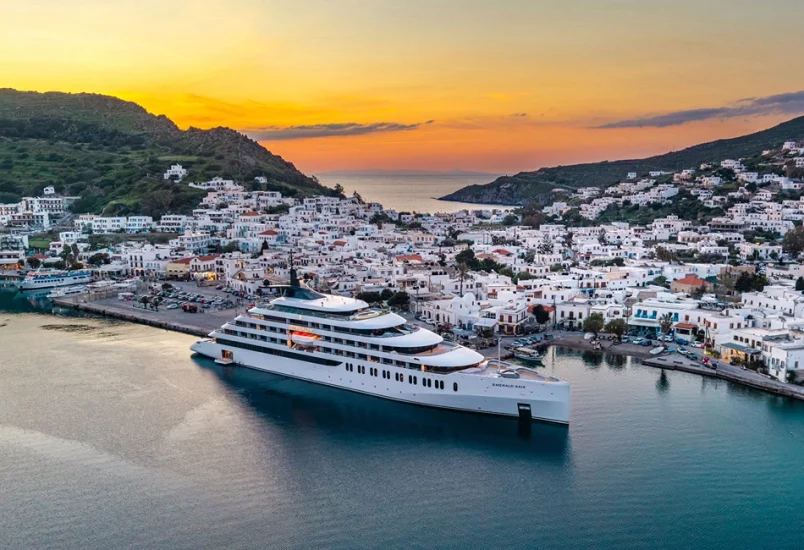
Marketing as the product
For a company competing against operators several times its size, the collateral operation is not a support function. It is a large part of what a group leader is buying.
Director of Marketing Chris Thorne describes an effectively open menu: individual tour flyers, postcards, posters, videos, PowerPoint presentations and increasingly, social ads and video built for leaders to publish under their own accounts. Educational pieces on selling travel and on group benefits go out through the BDMs to leaders building a program.
Schields frames the willingness to do that work as a deliberate position rather than a courtesy. “We still have the opportunity to customize a lot of things for groups. And that’s what they’re looking for,” he said.
The brochure remains central to all of it. Mayflower still produces and mails multiple product brochures and Thorne calls it the biggest thing the department does. Email runs alongside on a rotating product mix, an Antarctic eclipse sailing one week, northern lights in Iceland the next, Danube itineraries after that.
Modernizing without breaking it
Where Mayflower has automated, it has automated toward the leader’s convenience. Schields is quick to point out that customer service is priority one at Mayflower, phones are answered by humans, not automated phone trees.
At the same time, an online portal that lets group leaders pull a rooming list on demand, see immediately where a passport or a piece of information is missing, take payments, and email everyone on a departure with one button. This is work that gets done at 9 p.m. as often as 9 a.m., because leaders and home-based agents don’t keep office hours.
The traveler sign-up, though, is still a PDF form. Schields isn’t defensive about it, and he isn’t rushing.
“There are a wide variety of processes here,” he said. “They’ve been built over time, they’re honed, and they function well. Now we have to start looking at how do we optimize those processes. Which ones can we automate to the benefit of the business?”
Tour evaluations and reporting are on the list. So are group agreements, where the manual handoff between leader, sales and operations costs days. So, selectively, is AI.
“I’m not opposed to looking at AI. We’ve got to be careful, though — we don’t want to AI our entire business,” Schields said. “For me, it’s enabling our operations staff, our sales staff, all of our people to focus on what’s important, which is building the relationships. All of the mundane tasks and processes that absolutely have to happen can be automated.”
The website is the current project. Thorne has a content overhaul underway to bring the full detail of the tour and cruise experience onto Mayflower’s website. Schields wants video carrying the load, along with testimonials he describes as unvarnished.
The number to watch
Mayflower’s business is roughly 85 percent group. That concentration is the source of the company’s advantage. The customization, the field sales muscle, the marketing support all make sense at that ratio , and it’s the strategic question that will define Schields’ tenure.
Asked how competitive Mayflower is with individual travelers, Thorne pointed to marketing priorities: making the individual traveler aware that Mayflower is part of the Scenic Group, and putting the all-inclusive Scenic experience, the Emerald product and the land tours in front of them. What nobody offered was a target for what that mix should look like, or by when.
There’s an obvious reason for the caution. Schields spent years at Globus trying to pull Mayflower’s travelers away and finding out how hard that was. Loyalty and the personal relationships at every level of the company, were the obstacle. He was hired to protect that, not to trade it for a faster funnel.
Which is why the modernization is deliberate. Every process on his list gets the same test: does automating it free the staff to spend more time with customers, or does it put a screen between them?
“It’s balancing those two things,” Schields said, “and hoping that they can coexist — but making sure hope is more of a promise.”
Which brings it back to the group leader with the five-year plan. The proposition isn’t that Mayflower owns the ships, it’s that the motorcoach tour this year, the river cruise two years out, the yacht sailing for the handful of couples who want it, and the person who picks up the phone when a passport goes missing all sit under one roof, with no vendor handoff in between.
Schields’ job is to keep that true while automating operations behind it.