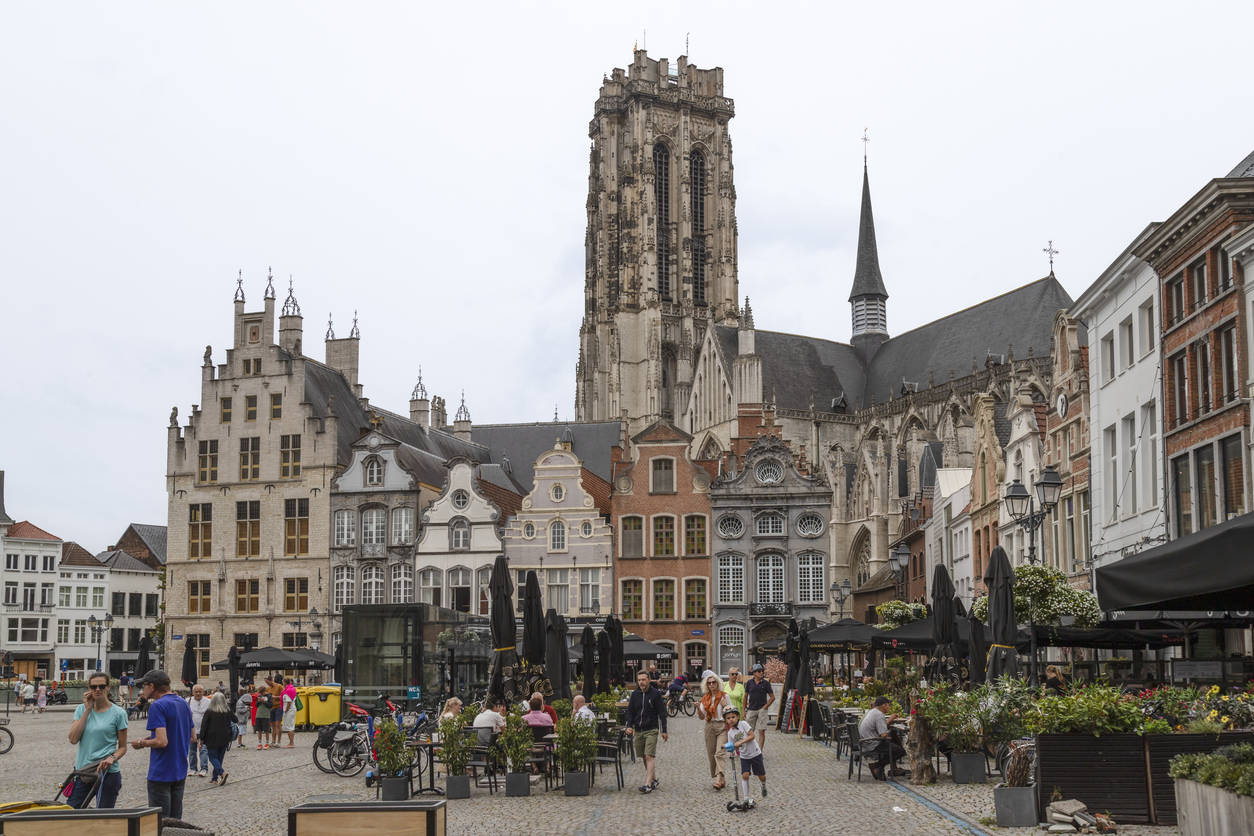
Mechelen may sit quietly between Brussels and Antwerp, but for faith-based travelers it has unusual depth. The city is home to St. Rumbold’s Cathedral, important historic churches, a UNESCO-listed beguinage, and one of Belgium’s most significant Holocaust memorial museums. Visit Mechelen also presents the city as the seat of the archbishopric of Mechelen-Brussels, which helps explain why religious heritage feels so central here
Mechelen is one of the best smaller faith-travel destinations in Belgium because it combines a major cathedral, walkable sacred sites, beguinage history, and a powerful place of remembrance at Kazerne Dossin.
St. Rumbold’s Cathedral
St. Rumbold’s Cathedral is the obvious starting point. Built from the 13th century onward, it became the city’s dominant church and today serves as the metropolitan cathedral of the Mechelen-Brussels archdiocese. Inside, visitors will find major sacred art, including Anthony van Dyck’s Christ on the Cross, while the cathedral’s long history is inseparable from the religious identity of Mechelen itself.
The tower adds a second experience. Visit Mechelen says the climb includes 538 steps and leads to a skywalk around the 97-meter tower, with close-up views of the clocks, bells and carillons. For travelers who do not mind the climb, it is one of the best ways to understand the layout of the old city and see how church architecture still shapes the skyline. (onzetoren.visitmechelen.be)
St. John’s Church and Rubens
Another essential church stop is St. John’s Church. It is especially important for art-minded religious travelers because the high altar holds Peter Paul Rubens’s Adoration of the Magi, one of the city’s major in-situ masterpieces. Visit Mechelen notes that the church was richly endowed because members of the Great Council lived nearby, which helps explain the quality of the treasures inside. (flemishmastersinsitu.com)
Mechelen works particularly well for this kind of church-hopping because the sites are close together. You are not dealing with a scattered citywide itinerary. Instead, you can move on foot from cathedral to parish church to beguinage streets and keep the religious story intact.
The Great Beguinage
The Great Beguinage adds another layer to Mechelen’s spiritual heritage. UNESCO includes it among the Flemish béguinages, describing these communities as an exceptional witness to the Beguine tradition that developed in medieval northwestern Europe. In Mechelen, the neighborhood still feels residential and intimate, which makes it easy to imagine the devotional rhythm that once shaped everyday life there. (whc.unesco.org)
That quieter atmosphere is part of the appeal. The little streets and small-scale houses contrast with the monumentality of St. Rumbold’s, giving faith-based groups a fuller sense of how religion shaped both public and private life in the city. Visit Mechelen also asks visitors to respect the privacy of residents, which is a helpful reminder that this is still a lived-in place, not a museum set.
Kazerne Dossin
Mechelen’s most affecting stop is Kazerne Dossin. The site today functions as a memorial, museum and research center on Holocaust and human rights. Official museum materials state that between 1942 and 1944, 25,490 Jews and 353 Roma were deported from the Dossin barracks on 28 transport trains, primarily to Auschwitz-Birkenau, and few survived.
For religious groups, Kazerne Dossin can deepen the itinerary in an important way. It shifts the focus from sacred art and ecclesiastical power to moral memory, persecution and human dignity. Visit Mechelen describes it as a very special place of remembrance for Belgium, and that is exactly how it feels in practice. (kazernedossin.eu)
Walking Mechelen
Mechelen is especially rewarding on foot. The Grote Markt remains the civic and visual center, and the Dyle Path adds a different view of the city. Visit Mechelen describes the floating towpath as a relaxing walk over and beside the river, passing the backs of old houses between Haverwerf and the botanical garden. It is a simple addition, but it helps the city breathe between church visits.
That walkable quality is one reason Mechelen works so well as a short city break. You can move from cathedral to Rubens altarpiece to beguinage to memorial museum without ever feeling rushed by distance.
Staying in a Church Hotel
For travelers who want the city’s religious character to extend into the overnight stay, Martin’s Patershof remains one of Mechelen’s most unusual options. Both the hotel’s own site and Visit Mechelen describe it as a restored church hotel, with some rooms in the former nave and breakfast served in the former chancel. (martinshotels.com)
It is not a pilgrimage site, of course, but it fits the city’s overall tone surprisingly well. Mechelen is the kind of place where religious heritage is not confined to one monument. It runs through the skyline, the street plan, the neighborhoods and even, in this case, the hotel experience.
Mechelen may not draw the same attention as Bruges or Ghent, but that is part of its strength. Its sacred heritage is compact, legible and easy to experience in a day or two. For church groups, heritage travelers and anyone interested in how faith shaped an urban landscape, Mechelen offers far more than its size suggests. (visit.mechelen.be)
–By Randy Mink
FAQ
What are the main religious sites to visit in Mechelen?
The top stops are St. Rumbold’s Cathedral, St. John’s Church and the Great Beguinage. Together, they give visitors the clearest picture of Mechelen’s ecclesiastical importance and religious heritage.
Is St. Rumbold’s Tower worth climbing?
Yes, for most visitors. The 538-step climb leads to a skywalk around the 97-meter tower and gives one of the best views in the city, along with a closer look at the bells and carillons.
Why is the Great Beguinage important?
It is part of the UNESCO-listed Flemish béguinages and preserves the history of the Beguines, women who lived religiously without taking formal monastic vows. In Mechelen, it still offers a strong sense of quiet, residential spirituality.
What makes Kazerne Dossin important for visitors?
It is one of Belgium’s key Holocaust memorial sites. The museum and memorial document the deportation of Jews and Roma from the Dossin barracks during World War II and place those events in a wider human-rights context.
Can travelers really stay in a former church in Mechelen?
Yes. Martin’s Patershof is a restored church hotel, and official descriptions note that some rooms are located in the former nave while breakfast is served in the former chancel.