Religious heritage in Liège runs deeper than many first-time visitors expect. For eight centuries, the city was the capital of an ecclesiastical principality ruled by prince-bishops, and local tourism materials still describe it as the “city of one hundred spires.” That history remains visible today in its former collegiate churches, cathedral district and monumental civic-religious core around Place Saint-Lambert.
Direct answer: The best way to experience religious heritage in Liège is to focus on the city’s prince-bishop legacy, then build an itinerary around St. Paul’s Cathedral, Saint-Jacques, Saint-Barthélemy, the Palace of the Prince-Bishops and the Archéoforum.
A City Built by Church Power
Liège’s religious importance is not a side note in its history; it is the framework that shaped the city. Official tourism sources describe Liège as an ecclesiastical principality governed by prince-bishops for roughly 800 years, and they point to the seven former collegiate churches as the clearest surviving witnesses to more than 1,000 years of art, worship and urban development.
That story comes into focus around Place Saint-Lambert. The square marks the historic core of the city, where visitors can still explore the Palace of the Prince-Bishops and descend into the Archéoforum, which preserves archaeological layers from prehistory through Roman, medieval and religious Liège. The palace now houses the law courts and provincial government, while the Archéoforum is presented by Liège tourism as one of Europe’s largest urban archaeological sites.
St. Paul’s Cathedral and Its Treasure
St. Paul’s Cathedral is the natural starting point for a faith-focused visit. Founded as a collegiate church in the 10th century and rebuilt in Gothic form from the 13th century onward, it became Liège’s cathedral after the destruction of Saint Lambert’s Cathedral during the French Revolution. Today it remains both an active church and one of the city’s central heritage sites.
The cathedral is even more rewarding when paired with the Treasure House in the cloister buildings. Official Liège tourism materials describe the museum as a three-floor collection devoted to the art and history of the old Principality of Liège, with goldsmith work, reliquaries, manuscripts, sculptures and textiles. For religious groups, that makes St. Paul’s more than a single church stop; it becomes the best introduction to Liège’s sacred patrimony. (groupes.visitezliege.be)
Saint-Jacques: Liège’s Gothic Masterpiece
Saint-Jacques is one of the city’s most impressive churches and one of the strongest arguments for lingering in Liège rather than treating it as a quick stop. Official tourism descriptions note that the Benedictine abbey of Saint James was founded in 1015 and that the surviving church was rebuilt in the 16th century in flamboyant Gothic style, while preserving a 12th-century Romanesque avant-corps and adding a Renaissance portal in 1558.
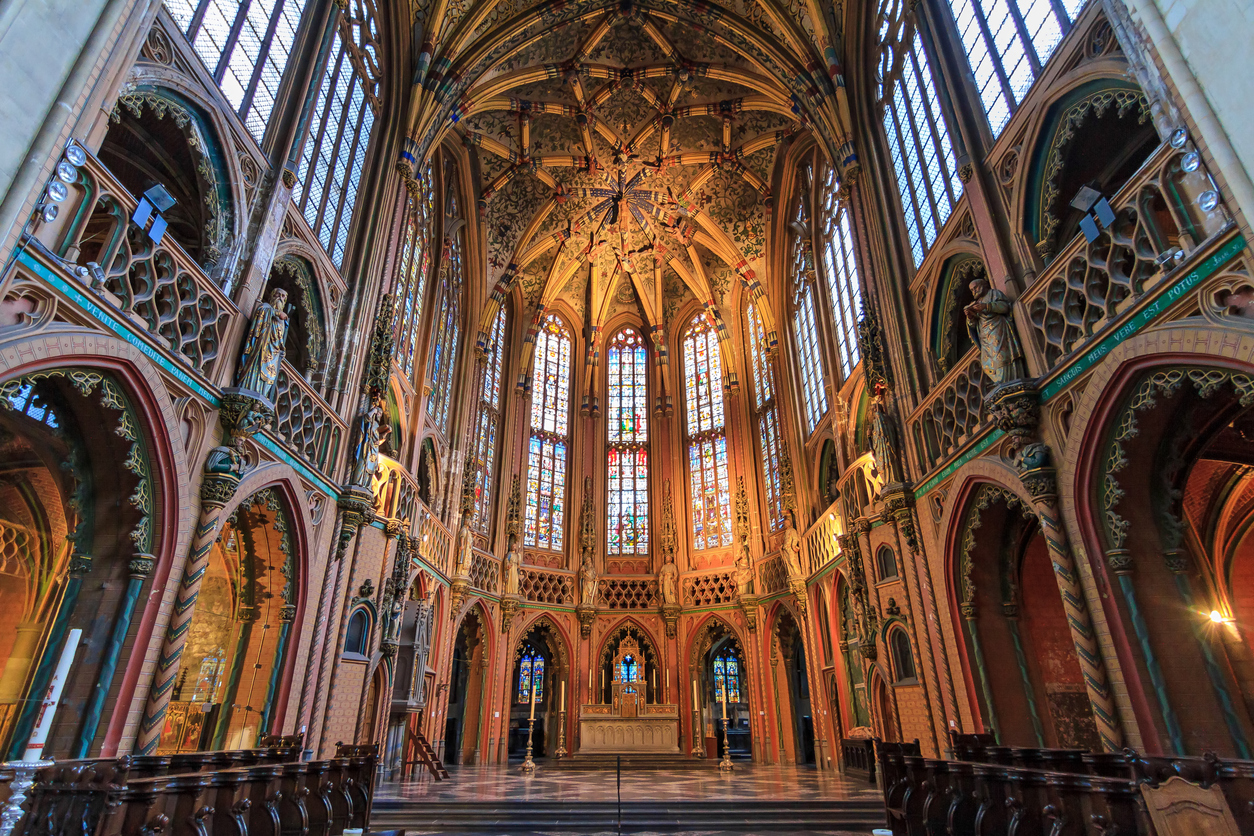
Inside, Saint-Jacques is known for its painted vaulting, stained glass, carved stalls and historic organ. Group-tour materials from Liège tourism describe it as one of the most beautiful churches in the country, and that does not feel like an exaggeration. For travelers interested in architecture, sacred interiors and the visual richness of late medieval and early modern Catholic Europe, Saint-Jacques is one of the city’s essential stops.
Saint-Barthélemy and the Baptismal Font
Saint-Barthélemy adds a different architectural and devotional register. Liège tourism identifies it as a Romanesque collegiate church founded between 1010 and 1015, notable for its Rheno-Mosan style and restored appearance. It is one of the clearest examples of how much religious heritage survives in Liège outside the cathedral district itself.
Its greatest treasure is the famous baptismal font. Official tourism materials single it out as the church’s defining masterpiece, and Liège’s own city guide lists the 12th-century font of Saint-Barthélemy among the city’s most important artistic wonders. For many visitors, this is the object that turns Liège from an interesting church city into a truly memorable one.
The Citadel Slopes and La Batte
Liège’s religious heritage is not confined to interiors. The slopes of the Citadel and the Terrasses des Minimes offer the kind of elevated perspective that makes the city’s old ecclesiastical layout easier to read, with church towers and historic quarters spreading below. Official tourism materials call the citadel slopes a must-see and describe them as one of the city’s most distinctive green urban landscapes.
For a broader sense of city life, Sunday morning at La Batte is still one of Liège’s best additions to a heritage itinerary. Liège tourism describes it as the biggest and oldest public market in Belgium, running every Sunday from 8:00 to 14:30 along the river. It is not a religious site, but it complements the churches and museum visits by showing the city’s civic rhythm in the same historic core.
Liège rewards travelers who prefer depth over checklist tourism. Its cathedral, collegiate churches, prince-bishop history and archaeological layers make it one of Belgium’s strongest destinations for church groups and heritage-focused travelers. Religious heritage in Liège is not a niche theme here; it is the story of the city itself. (visitezliege.be)
— By: Don Heimburger