New Mexico’s vibrant capital city appeals to the culturally curious traveler and anyone looking to explore a unique slice of the American Southwest
By Randy Mink, Senior Editor
Set in the foothills of the Sangre Cristo Mountains, Santa Fe is unlike anywhere else in the country. Branding itself as “The City Different” certainly makes sense.
Founded by Spanish colonists in 1610, Santa Fe ranks as the second-oldest city in the country—and, at 7,199 feet above sea level, its highest-elevation capital. (Only St. Augustine, Florida, is older.) The stucco-clad, earth-toned buildings, graced with rounded contours and flat roofs in traditional adobe style, lend an otherworldly touch.
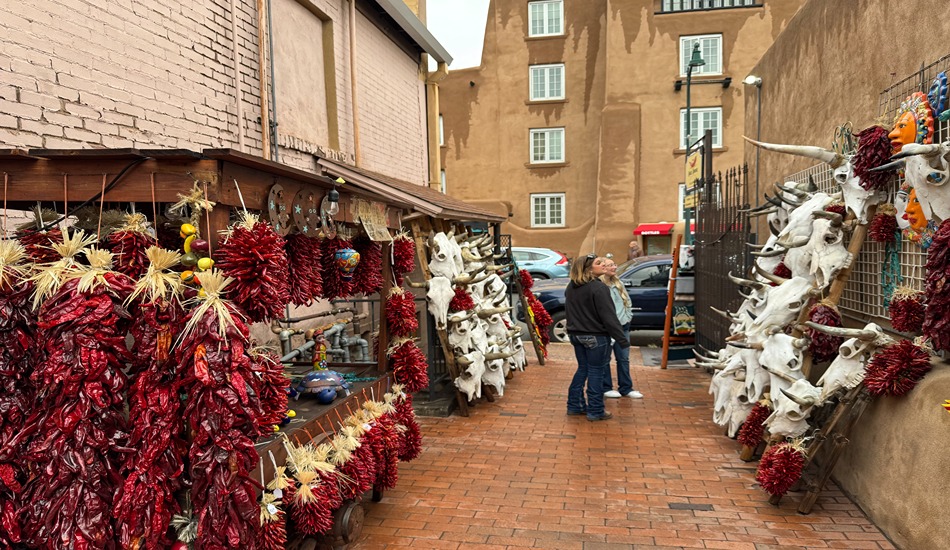
Shopping opportunities abound on the little streets off the Plaza. (Randy Mink Photo)
One of America’s great art centers, Santa Fe (pop. 91,000) probably has a higher proportion of artists and writers than any other community in the U.S. The city’s multi-layered cultural fabric, evident in its culinary scene as well as its artistic heritage, reflects the Spanish, Pueblo Indian and Anglo influences that make New Mexico a one-of-a-kind place. An air of casual sophistication prevails.
For three days, I based myself at Hotel Chimayo de Santa Fe, located just steps from the eclectic mix of shops, eateries, art galleries and museums clustered around the historic Plaza, downtown’s centrally located social hub. My balcony overlooked a linear brick courtyard where the columns are festooned with ristras, the pretty hanging arrangements of sun-dried red chile peppers used as decoration throughout New Mexico. The lobby and guest rooms feature art and furnishings created by more than 70 local artists; many of them have links to the northern New Mexico village of Chimayo, famed for its pilgrimage church and nearby sacred sites, and colony of weavers, artists and craftsmen.
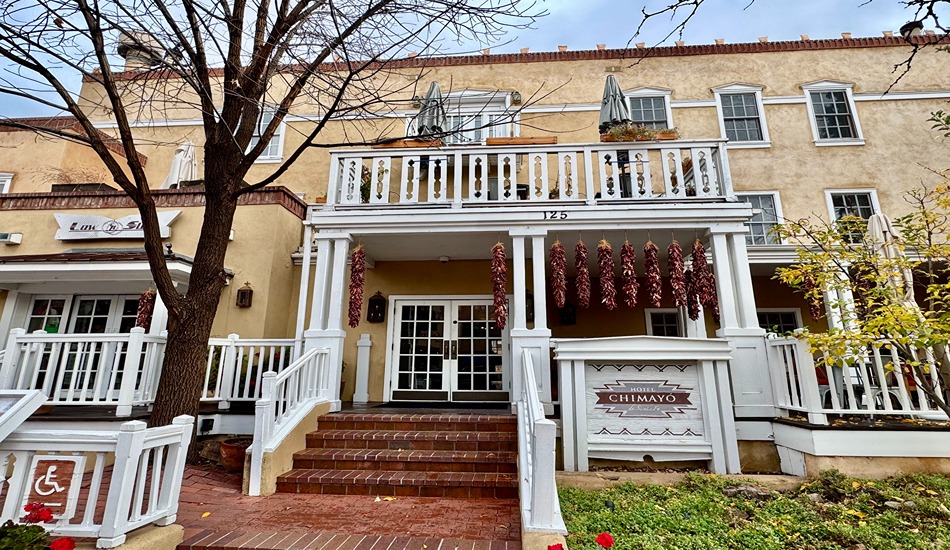
Hotel Chimayo de Santa Fe. (Randy Mink Photo)
A free amenity offered by the 56-room boutique hotel, a member of New Mexico’s Heritage Hotels & Resorts, is a “low and slow” cruise around town in a silver 1964 Chevrolet Impala lowrider. A reflection of Chicano youth culture that emerged after World War II in the Southwest, these customized vintage cars with a lowered body are symbols of Mexican-American identity and an expression of community pride. Hotel Chimayo’s Low ’n Slow Lowrider Bar sports lowrider photographs, hubcap accents and tables made of chrome chain-link steering wheels.
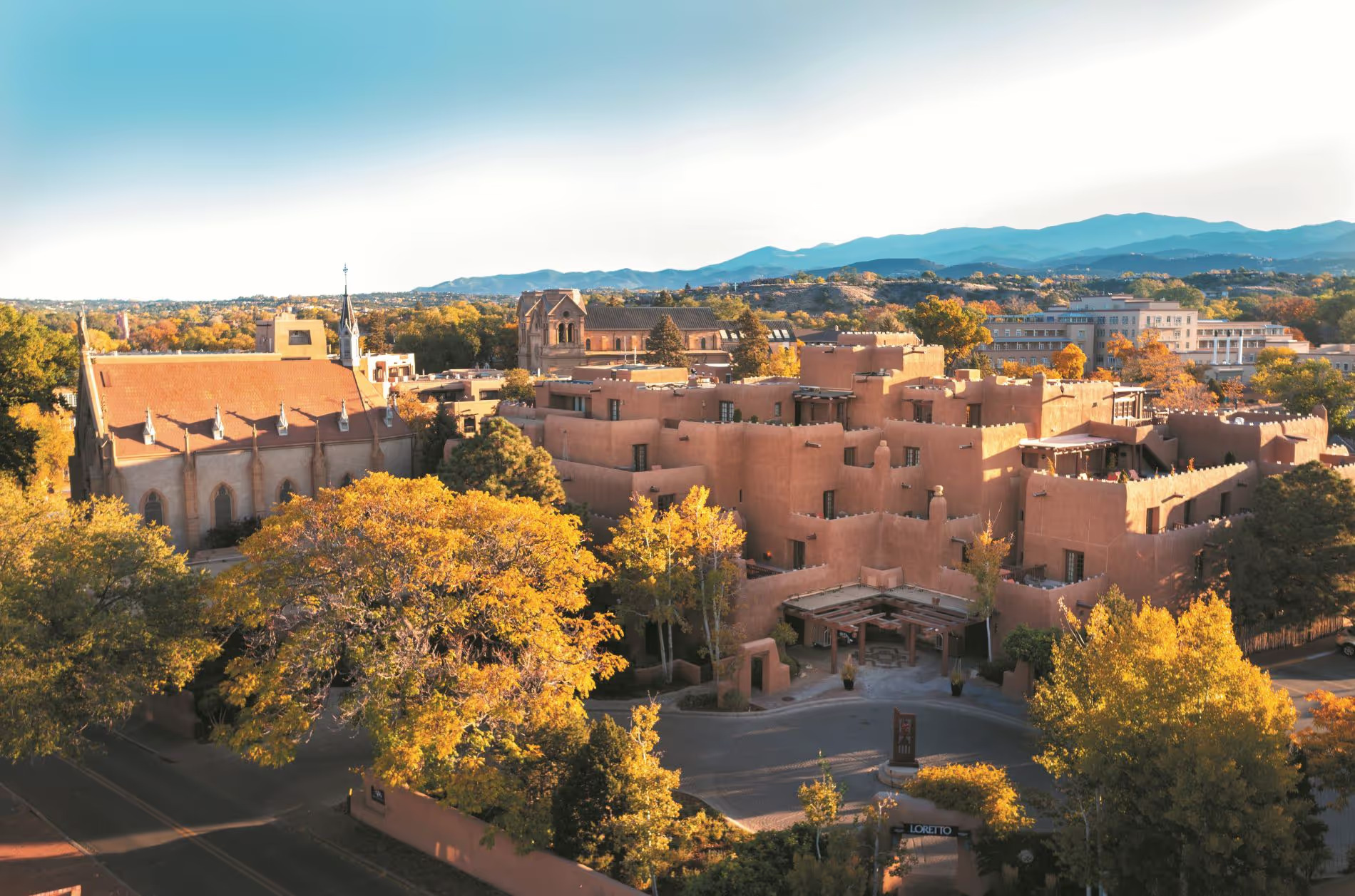
Next time I might stay at Heritage Hotels’ 138-room Inn & Spa at Loretto, a short walk from Hotel Chimayo. Built in 1975 to resemble Taos Pueblo, the multi-storied adobe complex in northern New Mexico that has been inhabited for more than 1,000 years. The rambling AAA Four Diamond luxury property shares a city block with the 1878 Loretto Chapel, famed for its “Miraculous Staircase,” a spiraling wooden phenomenon with two 360-degree turns and no visible means of support.
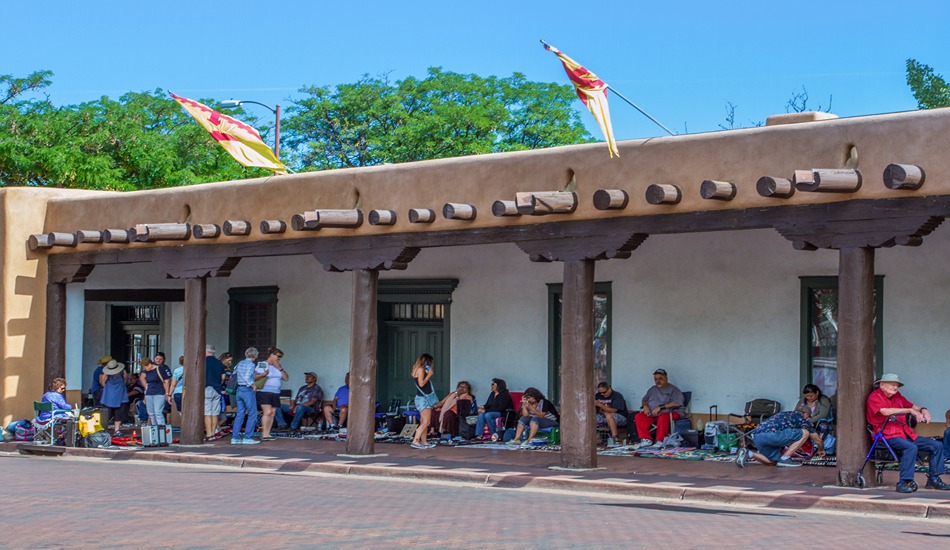
Native American artisans sell their wares under the portal of the Palace of the Governors, which fronts the Plaza. (Photo credit: New Mexico True)
Sightseeing Around Santa Fe’s Historic Plaza
The Plaza, laid out in 1610, is a grassy oasis crossed by shaded diagonal walkways, with plenty of benches for relaxing. The Palace of the Governors, once the seat of Santa Fe’s government, fronts the square’s north side. Under the portal of the long, low adobe building, American Indian artisans peddle their quality wares, from pottery and blankets to silver bracelets and turquoise earrings.
The must-see New Mexico History Museum occupies part of the Palace of the Governors, the oldest public building in the U.S. (1610-1612). Exhibits chronicle state history from the first Spanish foothold in 1598 to World War II, when New Mexico had Japanese internment camps and prisoner-of-war compounds that held Germans and Italians.
Museum visitors learn about Native Americans and the 1680 Pueblo Revolt that drove out the Spanish for a time, Mexican rule, fur traders and buffalo hunters, and pioneers on the Santa Fe Trail. They also get clued in on the advent of the tourism industry and the discovery of New Mexico’s beguiling landscapes by artists, writers and photographers. One exhibit spotlights the Fred Harvey hotels and restaurants that, starting in the late 1800s, served railroad towns throughout the Southwest.
Next door, the New Mexico Museum of Art, in a magnificent 1917 Pueblo Revival building just off the Plaza, is dedicated to works by New Mexican artists, including the Santa Fe and Taos masters.
The Cathedral Basilica of St. Francis of Assisi, a grandiose Romanesque-style church with Gothic-inspired features, resides a block east of the Plaza. Bordered by a tree-shaded park, it is one of Santa Fe’s most widely recognized landmarks.
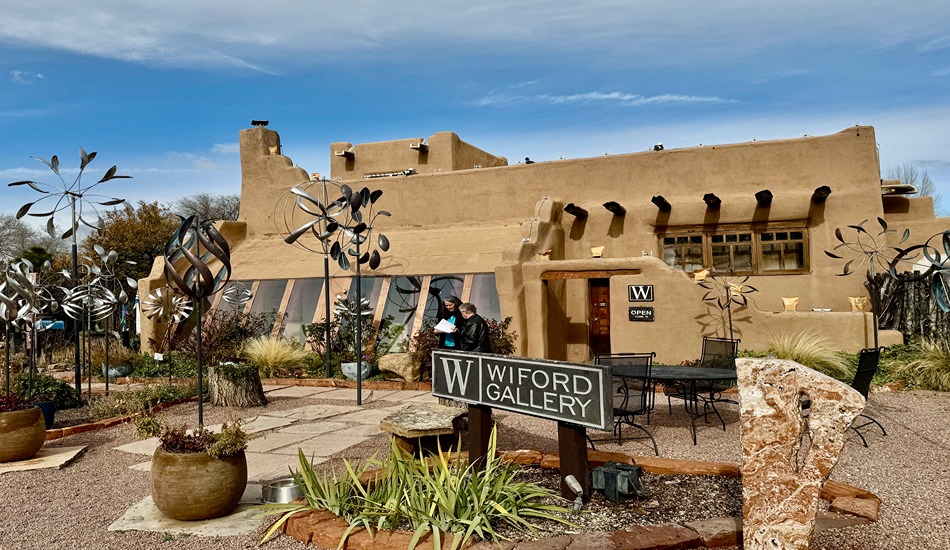
Stainless steel and copper wind sculptures dominate the garden at Wiford Gallery on Canyon Road. (Randy Mink Photo)
Exploring Santa Fe Beyond the Plaza
Canyon Road, within walking distance of the Plaza, comprises the heart of Santa Fe’s art scene. Strolling art lovers, both professional collectors and amateurs, find more than 80 mostly upscale galleries along a half-mile stretch.
Southwest of downtown, the revitalized Railyard District is home to the indoor-outdoor Santa Fe Farmers’ Market. More than 100 vendors show up on Saturdays year-round and on Tuesdays from May through December, 8 a.m. to 1 p.m.). For a purple sweet treat, try the cafe’s blue corn donuts with lavender lemon frosting. Cookies come in funky flavors like red chile chocolate pecan and turmeric ginger cherry pecan. Fans of green chile might like the green chile pot pie or green chile cheese croissant.
The Railyard Artisan Market features art and crafts from over 60 local creatives every Sunday year-round and seasonally on Tuesdays (May–December) alongside the Santa Fe Farmers’ Market. The neighborhood abounds with galleries, shops and restaurants.
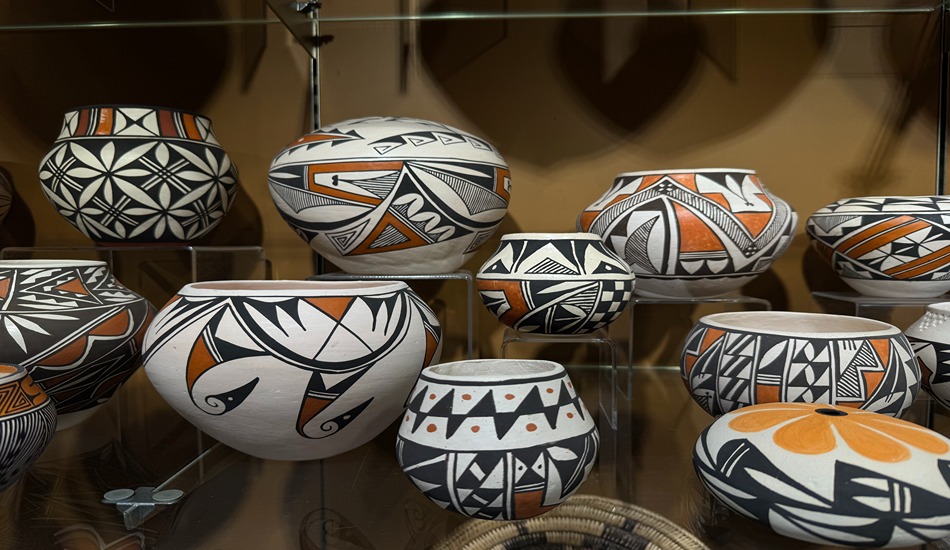
Museum of Indian Arts and Culture. (Randy Mink Photo)
Four museums reside on the Museum Hill campus, a five-minute drive from the Plaza. The Museum of Indian Arts and Culture spotlights the native peoples of the Southwest, from ancient times to today. A recreated Navajo reservation trading post and traditional Pueblo kitchen are enhanced with touchscreens offering video interviews of tribal members who tell their stories about everyday life.
Also on the campus are the Museum of International Folk Art, Museum of Spanish Colonial Art and Wheelwright Museum of the American Indian. Across the street, museum goers can take a break at the Santa Fe Botanical Garden.
Checking Out the Capitol Complex
The State Capitol, built in 1966 and known locally as the Roundhouse, features some of the most impressive art on display in Santa Fe. On every floor of the round four-story building are paintings of cowboys, Native American scenes and Southwestern landscapes, plus handcrafted furniture, from the studios of artists living and working in New Mexico. The rotunda floor sports a turquoise and brass mosaic of the Great Seal of New Mexico, and the stained-glass skylight represents a woven Indian basket. The house and senate chambers can be viewed from the second floor.
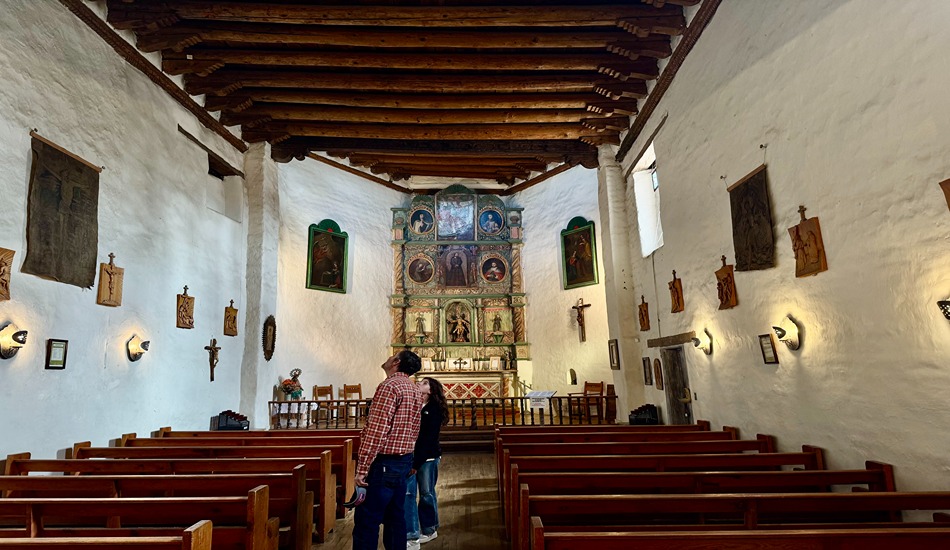
San Miguel Chapel. (Randy Mink Photo)
San Miguel Chapel, a short walk from the capitol, is said to be the oldest church structure in the United States. Originally built 1610 by Tlaxcala Indians from Mexico under the direction of Franciscan padres, the sturdy adobe building was rebuilt in 1710. The sanctuary has wooden pews, a hand-carved wooden altar screen (reredos) and massive timber roof beams (vigas). Visitors are welcome to ring the 780-pound San Jose Bell that once hung in the tower of the simple mission church.
Culinary Finds in Downtown Santa Fe
My favorite meal in Santa Fe was at The Shed, which dishes up genuine New Mexican fare in nine little, low-ceilinged rooms of a 1692 adobe building right around the corner from my hotel. I savored chicken enchiladas smothered in red chiles, accompanied by pinto beans and posole (a Pueblo stew of corn, lean pork, red chile, garlic and oregano). My companion had the green chile burrito, a large tortilla filled with beans, white cheddar cheese and onion, and drenched in green chile.
For lunch one day, the “world-famous Frito Pie” at the Five & Dime General Store really hit the spot. Sitting at the snack bar in back of this former Woolworth dime store on the Plaza, I enjoyed a bag of Fritos filled with spicy, piping-hot chili sprinkled with shredded cheese.
One night I popped into the 1920s Hotel St. Francis, the oldest hotel in Santa Fe. Public areas are furnished with religious art and artifacts, including a stone baptismal font near the lobby fireplace. One-hour history tours showcase the 76-room Heritage hotel, a Mission Revival-style gem graced with majestic archways. I soaked up some of the vibe over cocktails at the Secreto Bar and New Mexico sparkling wines at Gruet Winery Tasting Room. The hotel’s Wolf and Roadrunner restaurant grills steak and game over pecan and white oak. Menu items include venison, smoked elk sausage and bison striploin in bourbon-peppercorn sauce.
Food Tours New Mexico offers 2½-hour downtown walking tours that include three to five stops to sample the flavors of Santa Fe.
Travel smarter, plan better – Get top destinations, itineraries, and industry trends by subscribing to Leisure Group Travel now.
Lead photo – Inn & Spa at Loretto in downtown Santa Fe. (Photo credit: Heritage Hotels & Resorts)