
From the jungles of northern Thailand to the sandy shores of South Jersey, elephant encounters have left their footprints on this writer’s 2025 travels
I am not a collector of elephant tchotchkes, don’t seek out elephants in my travels and never thought I had a special affinity for them. But reflecting on the 16 trips taken this past year, I just realized that an elephant in some form lumbered into the picture in five far-flung places. Each experience made me happy, so maybe I do have a soft spot for these thick-skinned creatures.
Travel smarter, plan better – Get top destinations, itineraries, and industry trends by subscribing to Leisure Group Travel now.
Mingling with Elephants in Thailand
Spending a few hours at Patara Elephant Conservation was a highlight of my June trip to Thailand. One of many tourist-friendly elephant sanctuaries in the mountainous north, the reserve is home to domesticated pachyderms who roam freely in a lush green valley about an hour’s drive from the city of Chiang Mai. Each animal has a name and its own mahout, or handler.
After an introductory talk on elephant care, habits and conservation, our group headed to the forest in 4×4 vehicles. From a thatched platform, we fed sugar cane, corn and bananas to the gentle giants, and I bathed one in a muddy creek.
Obviously, the photo opportunities were plentiful. My favorite pictures capture a mother nurturing her baby. More than 45 births have occurred at Patara.
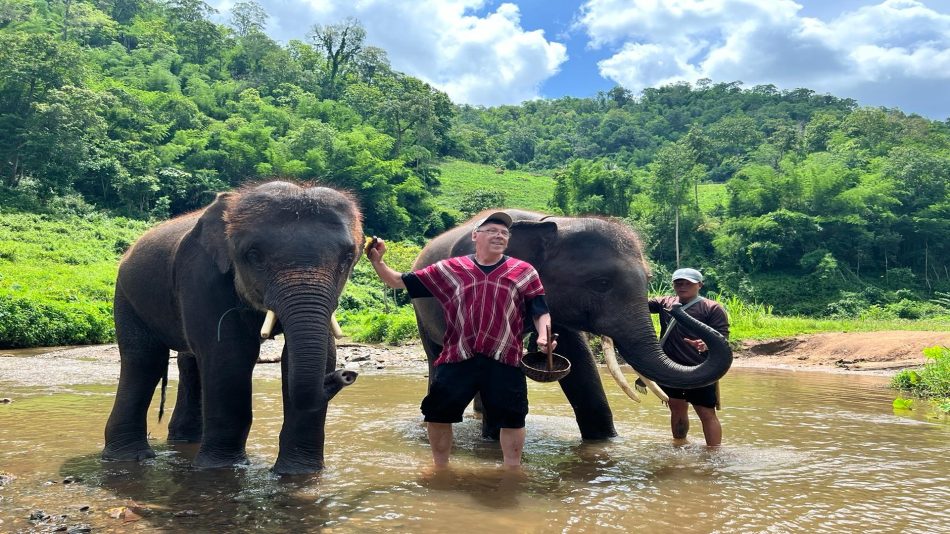
Patara Elephant Conservation, a sanctuary in northern Thailand, offers hands-on encounters.
These rescued elephants are descendants of the beasts of burden once used in the teak logging industry. When the country banned commercial logging in 1989, hundreds of elephants and mahouts lost their jobs
The number of wild elephants in Thailand has dropped by 70 percent in the last 60 years thanks to poaching and urban encroachment; fewer than 3,000 of the endangered beasts remain.
At the beginning of a tropical rainforest hike in southern Thailand’s Khao Sok National Park, we encountered a “Beware of Wild Elephants” sign and had to dodge elephant dung along the path. Later, we learned the trail closes when there’s more than a 60 percent chance of an elephant encounter. That’s reassuring… I think.
Images of the country’s symbolic animal are found in souvenirs of all kinds, from magnets and keychains to tablecloths and loungewear. At a shopping mall in Bangkok, I stocked up on elephant-print shirts, shorts and pajama-type pants made of 100 percent rayon.
Long ago, kings rode elephants into battle, and the tuskers are still associated with Thai royalty. Elephant statues grace Thailand’s royal parks, the Grand Palace compound in Bangkok and other public places.

Sweet treats and elephant memorabilia lure candy lovers to Mister Ed’s, a popular museum/store in Orrtanna, Pennsylvania.
Mister Ed’s Elephant Museum & Candy Emporium
Exploring the Gettysburg area in south-central Pennsylvania, I came upon this endearing tourist magnet, a landmark on Route 30 in Orrtanna.
Founded as a general store at a nearby location in 1975 by Ed and Pat Gotwalt, Mister Ed’s Elephant Museum & Candy Emporium claims a collection of 12,000-plus elephant items, many of them on display in the free-admission museum wing. At this third-generation family-owned business, you’ll see cookie jars, stuffed animals, rattan elephant tables, ceramic figurines, artwork, the list goes on.
On signs titled Pachyderm Points, fun facts about elephants shed light on the largest land mammal. Did you know that an elephant creates one ton of poop per week? Or that an elephant’s trunk has 40,000 muscles? A pregnancy lasts 22 months.
It’s hard to walk out of Mister Ed’s without buying something sweet. Among 1,200 candy varieties are 400 candy bars from around the world. Bagged and boxed candies include circus peanuts, gum drops and malted milk balls. Guests can create their own selection from loose hard candies like root beer barrels, Bit o’ Honey and Mary Janes. Other nostalgia items from yesteryear include bubble gum cigars, candy cigarettes and Pez. Don’t miss the impressive display of Pez dispensers in a truck attached to the building.
The store roasts Virginia peanuts every week in an antique roaster, and it makes more than 100 fudge flavors, from peaches and cream to dark chocolate caramel sea salt.
Mister Ed’s whimsical gardens feature water-squirting elephant sculptures and yard ornaments like Snow White and the Seven Dwarfs. A teapot museum counts more than 200 pots.

Margate, New Jersey, has been home to Lucy the Elephant since 1881.
Lucy the Elephant: A New Jersey Icon
Rising six stories above the sandy shores of Margate, New Jersey, Lucy the Elephant stands tall as a National Historic Landmark. Born in 1881, the 65-foot-high, wood-and-metal structure is advertised as “America’s Oldest Roadside Attraction” and “The World’s Largest Elephant,” so I had to check it out during my visit to Atlantic City, a 10-minute Uber ride away.
On a guided tour ($9), I climbed a spiral stairway inside a hind leg and stepped into the belly of the beast, then took another set of stairs for panoramic ocean views from the covered platform, or howdah, on its back.
There is no charge to visit the grounds and take pictures. The Lucy gift shop/ticket office is across the street.
The towering pachyderm originally was built to attract property buyers in what was South Atlantic City at the time. It and the surrounding property then were purchased by Anthony Gertzen of Philadelphia. He acquired the Turkish Pavilion from Philadelphia’s 1876 Centennial Exhibition and had it disassembled and moved to Margate, where it was reconstructed behind the famous elephant. The exotic building, with onion-shaped domes on the roof, was a popular nightclub for many years and later became a rooming house and the Elephant Cafe. The Gertzen family also operated a hotel across the street.
In 1902 an English doctor and his family leased the elephant as a summer home. They moved into Lucy’s ample interior and converted the main hall into four bedrooms, a dining room, kitchen and parlor. A bathroom was outfitted in one of the small front shoulder closets using a miniature bathtub.
In 1970, Gertzen descendants sold the land to a developer and donated Lucy to the city of Margate. That year the 90-ton structure was moved two blocks to its current location because the developer intended to build condominiums on the site and get rid of the decaying Lucy. In 1974 the beloved landmark, saved from the wrecking ball by concerned citizens, reopened after a major restoration.
Lucy has 22 windows. Both its legs and tusks are 22 feet long. The ears measure 17 feet long and 10 feet wide; each weighs about 2,000 pounds. It is estimated that Lucy can be seen (without use of binoculars) from up to eight miles.
Travel smarter, plan better – Get top destinations, itineraries, and industry trends by subscribing to Leisure Group Travel now.

The mechanical elephant at Machines de L’ile, a top attraction in Nantes, France, gives rides in the city’s former shipyards, now a cultural hub.
A Mechanical Elephant in Nantes, France
Machines de L’ile, a place where oversized mechanical animals come alive, is one of Nantes’ premier tourist attractions and, to my delight, lay just steps from the Loire River docks where I embarked on a five-day CroisiEurope cruise.
Creatures in the mind-boggling menagerie—including a giant spider, ant, heron, sloth, caterpillar and chameleon—are demonstrated in a gallery/workshop occupying former shipyard buildings. It’s a one-of-a-kind artistic project inspired by the fantasy worlds of science-fiction novelist Jules Verne (a native of Nantes), Leonardo da Vinci’s mechanical aesthetic and the city’s industrial history. Our group had a chance to visit the gallery before the river cruise.
Getting the most attention at Machines de L’ile is the Grand Elephant, which can be seen ambling along the quay carrying up to 50 people on its back. Made of steel and wood and fitted with a hybrid engine, the 39-foot-high, 48-ton creation has been offering rides since 2007 and is practically a symbol of modern Nantes, the sixth-largest city in France. Robotic-like, he walks through the open plaza next to the project’s massive Marine Worlds Carousel, a three-story, interactive ride populated by sea animals that can be manipulated with ropes and levers. A few in my group rode the carousel, but there was no time for an elephant ride.
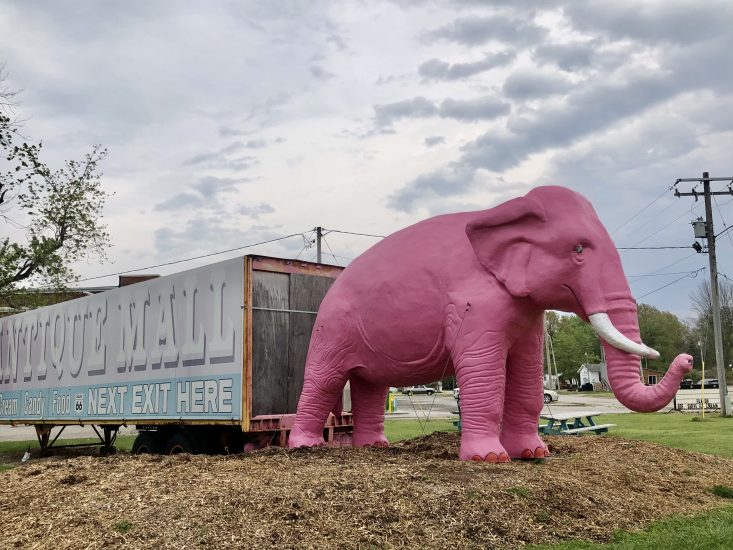
Pink Elephant Antique Mall, a must-visit attraction on Illinois Route 66.
Illinois’ Pink Elephant Antique Mall
A giant pink elephant statue visible from Interstate 55 beckons wayfarers to explore Pink Elephant Antique Mall in Livingston, Illinois, not far from St. Louis. Housed in a former high school, the cavernous emporium is my favorite stop on old Route 66, thanks to its tons of vintage treasures and an ice cream cone-shaped side building that serves up burgers, fries, milkshakes and sundaes amid 1950s-style trappings. Besides the bright pink elephant, the mall’s grassy yard offers other larger-than-life animal sculptures perfect for selfies.
Travel smarter, plan better – Get top destinations, itineraries, and industry trends by subscribing to Leisure Group Travel now.
Story and photos by Randy Mink, Senior Editor
Lead Photo – Patara Elephant Conservation in northern Thailand