Flashy signage shines a light on the glory days of Route 66
By Randy Mink
As cities and towns along old Route 66 rev up to celebrate the road’s 100th anniversary in 2026, classic neon signs, many of them lovingly restored in recent years, will be taking center stage. True icons of roadside Americana, these showstoppers present some of the best photo ops along the fabled ribbon of asphalt that went through eight states from Illinois to California during the heyday of automobile travel in the mid-20th century.
Though Route 66 was bypassed by soulless interstates decades ago, its spirit lives on, and parts of the original roadway can still be driven. In many cases, historic Route 66 runs parallel to the superhighways.
For the centennial, states, cities, and private organizations have stepped up by providing grants to rehabilitate and spruce up signs, ensuring that communities bask in the glow of neon while driving tourism and preserving local culture. Just as they beckoned weary travelers cruising down the “Main Street of America” long ago, these hallmarks of commercialism today attract nostalgia-minded wayfarers looking for selfie spots and a peek into the past.
Once prevalent, neon signs that advertised motels, diners, gas stations and other businesses are now at risk, thus the efforts to preserve these catchy calling cards as reminders of yesteryear for new generations. Some towns have set aside parks to display groups of neon signs.
For more great stories about Route 66, check out our Route 66 Tour Planner
Grants to support Route 66’s restoration
I’ve always been caught up in the mystique of Route 66, but after my recent road trip following the highway in New Mexico, I have even more appreciation for neon signs.
Albuquerque, the state’s largest city, boasts the nation’s longest continuous urban stretch of Route 66 in the nation. Known as Central Avenue, as it passes through town, the 18-mile commercial corridor is sprinkled with vintage neon motel signs. Some of them sparkle next to thriving businesses, while others stand by vacant lots, looking forlorn and at risk of fading into history.
In a project to revitalize the streetscapes and honor its roots, the City of Albuquerque is giving out grants to support the restoration and construction of 14 neon signs along the Route 66 corridor. Organizations such as Friends of the Orphan Signs, working with independent artists and signmakers, have stepped in as well. Thanks to this dedication, the future looks bright for Central Avenue’s Route 66-era signage.
At one point, I got out of the car to take pictures of three motel signs within easy walking distance from each other, starting at the El Vado Motel, which reopened in 2018 after serving motorists from 1937 until 2005. The impressive neon display shows an American Indian surrounded by a multicolored sunburst. Today’s 22-room boutique motel, a vision in white adobe, includes retail spaces, a food court, and a cozy taproom. Outside, folks crowd around tables in the motor court’s former parking lot turned shaded patio. Guest rooms feature mid-century furniture, vigas (log rafters typical of Southwestern architecture), and framed black-and-white photographs from Albuquerque’s Route 66 halcyon days.
Just down the sidewalk from the El Vado, a great sign with sharp geometric lines and skewed shapes, looms over the Monterey Motel, built in 1946. I particularly like the neon sign at the nearby El Don Motel, which opened its doors in 1950 but is now closed for redevelopment. It depicts a horseback-riding, lariat-twirling cowboy hovering over a turquoise backdrop.
Closer to downtown Albuquerque, the Imperial Inn also sports an original neon sign. The newly renovated 1960s motel has a cocktail lounge and a food hall with three eateries featuring Southwest and Latin flavors. Like the El Vado, Monterey, and other recently refurbished motels on Central Avenue, the Imperial offers modern amenities with retro charm.
In the heart of downtown, a dazzling neon sign (a replica of the original) graces the KiMo Theatre, the most iconic sight on Route 66 in Albuquerque. Built as a grand picture palace in 1927 and now a performing arts center, the KiMo blends Southwest Native American motifs with Art Deco elements in an extravagant architectural style called Pueblo Deco. Group tours are available.
The Dog House, known for its burgers and chili dogs, claims what may be Albuquerque’s most recognizable Route 66 neon sign. Familiar to fans of AMC’s Breaking Bad and Better Call Saul, the tail-wagging dachshund is one of the few animated signs along Central Avenue.
Other cool restaurants on the street are housed in former gas stations and automotive businesses that served Route 66 travelers.
In Gallup, another great New Mexico Route 66 city, I liked the flashing red rooftop sign that constantly switched back and forth between “Hotel El Rancho” and “Motel El Rancho,” as the “M” replaced the “H” and vice versa. Elaborate electronic billboards framed by twinkling white lights stand guard by the road.
Hotel El Rancho served as a base camp for 1930s and ’40s movie productions that used the area’s red rock scenery to represent the Old West. Glossy black-and-white photos of Hollywood stars (some of them autographed) and movie posters decorate the rustic hotel’s public areas.
Neon signs adorn other businesses in downtown Gallup, which also has an impressive collection of murals. My favorite attention-grabber was the one advertising “Mexican American Food” at Jerry’s Cafe, its crooked yellow arrow aimed at the building.
For more great stories about Route 66, check out our Route 66 Tour Planner

Illinois offers a variety of Route 66 attractions
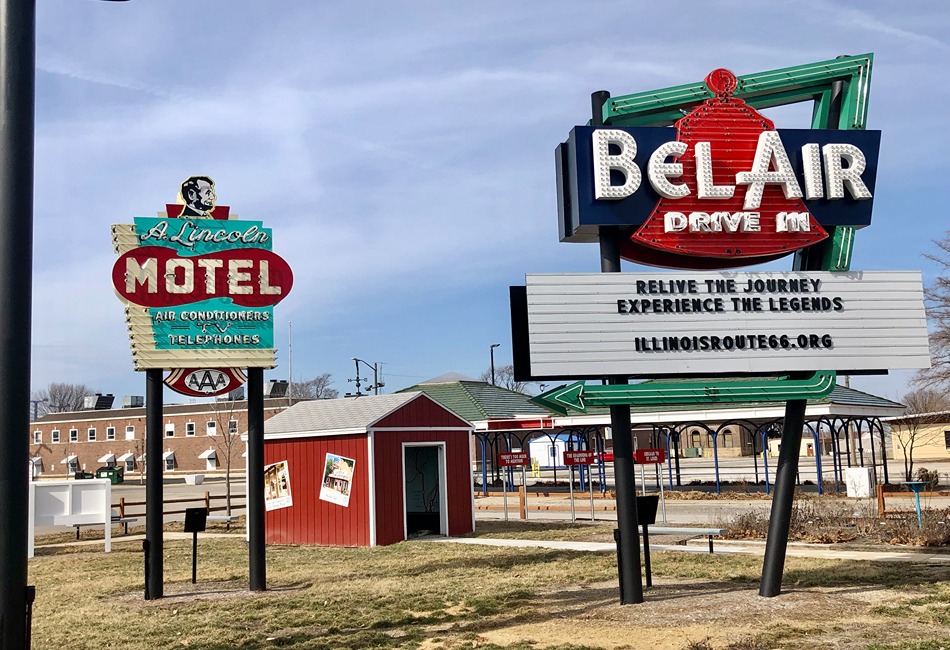
In Illinois, Springfield offers the best bet for getting your Route 66 fix. The capital city’ stop Mother Road attraction is the Illinois State Fairgrounds Route 66 Experience, an outdoor walk-through exhibit with little red sheds highlighting businesses and attractions, past and present, in 92 Illinois communities. The garden courtyard brims with replicas of billboards and neon signs that advertised motels, a drive-in movie theater, and other places along the revered roadway. Illuminated at night, the signs cast a magical glow.
The Fairgrounds’ Route 66 installations were done by Springfield’s family-owned Ace Sign Company, which offers free guided tours of its plant/museum, where dozens of rare signs from Springfield and Route 66 are on display next to tables where workers are drilling, trimming and welding. Among notable neon signs are a 12-foot-tall neon Pepsi bottle cap (1953) and one that graced Springfield’s Sonrise Donuts, a Ninth Street shop that enticed donut lovers for 70 years. Housed under a wood-barreled ceiling of a warehouse built for Sears Roebuck in 1952, Ace’s state-of-the-art factory, located two blocks from Historic Route 66, makes neon, LED, and electric signs for clients across the nation.
The Route 66 town of Lincoln, a half hour north of Springfield, takes pride in its Tropics Restaurant Neon Sign, a magnificent replica complete with a palm tree. Recalling a beloved institution that operated from 1950 until closing in 1997, the sign is best seen in the evening.
Lincoln is also home to the Railsplitter Covered Wagon, the largest covered wagon in the world, as recognized by the Guinness World Book of Records. Sitting in the driver’s seat is a 12-foot-tall statue of Abraham Lincoln as he might have appeared when traveling around the state as a circuit lawyer.
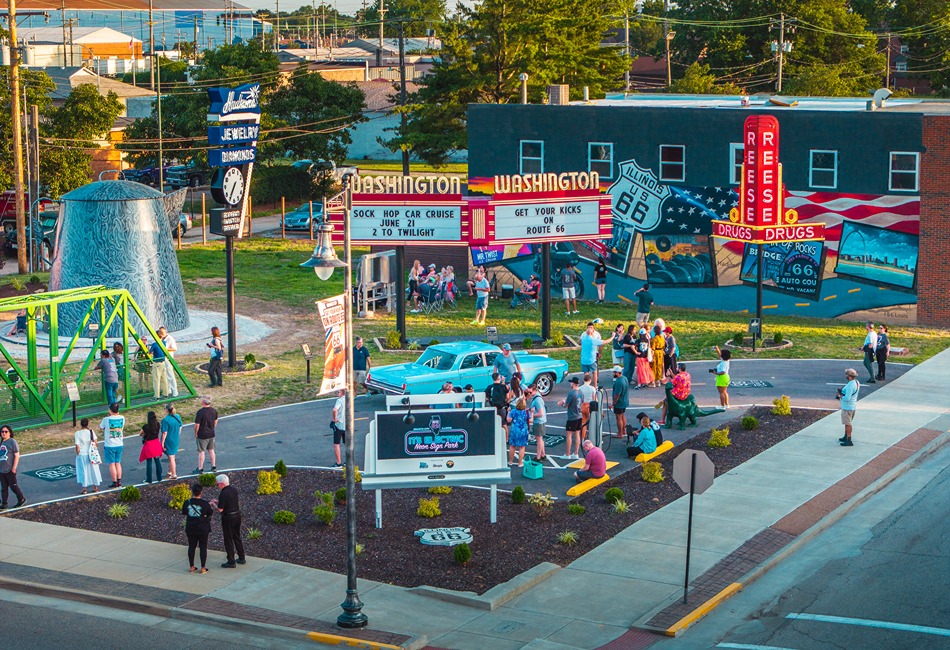
In southwestern Illinois, near St. Louis, the past comes to life at Granite City’s It’s Electric Neon Sign Park, where restored neon signs from local businesses, plus large murals, celebrate the town’s place on Route 66. The signs are turned on from dusk to dawn.
In mid-Missouri, the city of Saint Robert last year unveiled Route 66 Neon Park. The project brought together eight neon signs that once stood at motels and other businesses along Route 66 in Missouri. Featuring a storyboard and historical photo for each restored sign, the open-air museum is situated among oak trees in the existing George M. Reed Roadside Park, the longest continuously operating roadside park along Missouri Route 66. The vintage artifacts are lit from sunset to midnight and during winter from 5 to 7 a.m.

Oklahoma’s collection of neon signs
In northeastern Oklahoma, Tulsa abounds with Route 66 lore, including a small neon sign park called Southwest Avery Plaza. Located on the west side of the Arkansas River, the three re-creations of lost neon signs represent the three alignments of Route 66 in Tulsa during its formal life: Admiral Place (the original alignment, represented by the Tulsa Auto Court), 11th Street (themost commonly traveled historic alignment, represented by the Will Rogers Motor Court) and the Skelly Bypass (which became Interstate 44, represented by the Oil Capital Motel).
On the other side of the bridge lies Cyrus Avery Centennial Plaza, where larger-than-life bronze sculptures honor the Tulsa businessman and state highway commissioner called the “Father of Route 66.”Avery was responsible for plotting out the paved highway and assigned the road its 66 number designation. The artwork depicts Avery getting out of his Model T to help a farmer in a horse-drawn carriage, capturing the collision of the past and the future along the Mother Road.
Route 66 enthusiasts find numerous other treasures in Tulsa, especially along 11th Street with its collection of neon signs, colorful murals, old motor courts and roadside kitsch.
Selfie spots in the Meadow Gold District, named for the huge neon dairy company sign at 11th and Quaker Avenue, include the newly installed space cowboy and cowgirl statues at Buck Atom’s Cosmic Curios souvenir store, one of several fun shops and galleries on 11th Street. Such 20-foot-tall fiberglass figures, referred to as “Muffler Men” by pop culture historians, were considered the height of outdoor advertising in the 1960s.
The towering Meadow Gold sign and its restoration were a catalyst for economic development along Tulsa’s Route 66 corridor. It originally stood at another location, but when its long-time home was endangered, several groups came together to save it. That project inspired the city’s Route 66 Neon Grant Program, which has been wildly successful. Many of the old and newly built signs adorn buildings on 11th Street.
The new Reedy Press book Route 66: The First 100 Years by acclaimed Route 66 ambassadors Jim Ross and Shellee Graham celebrates the road’s centennial with a compelling narrative and hundreds of photographs, including neon signs from today and yesterday.
For more great stories about Route 66, check out our Route 66 Tour Planner