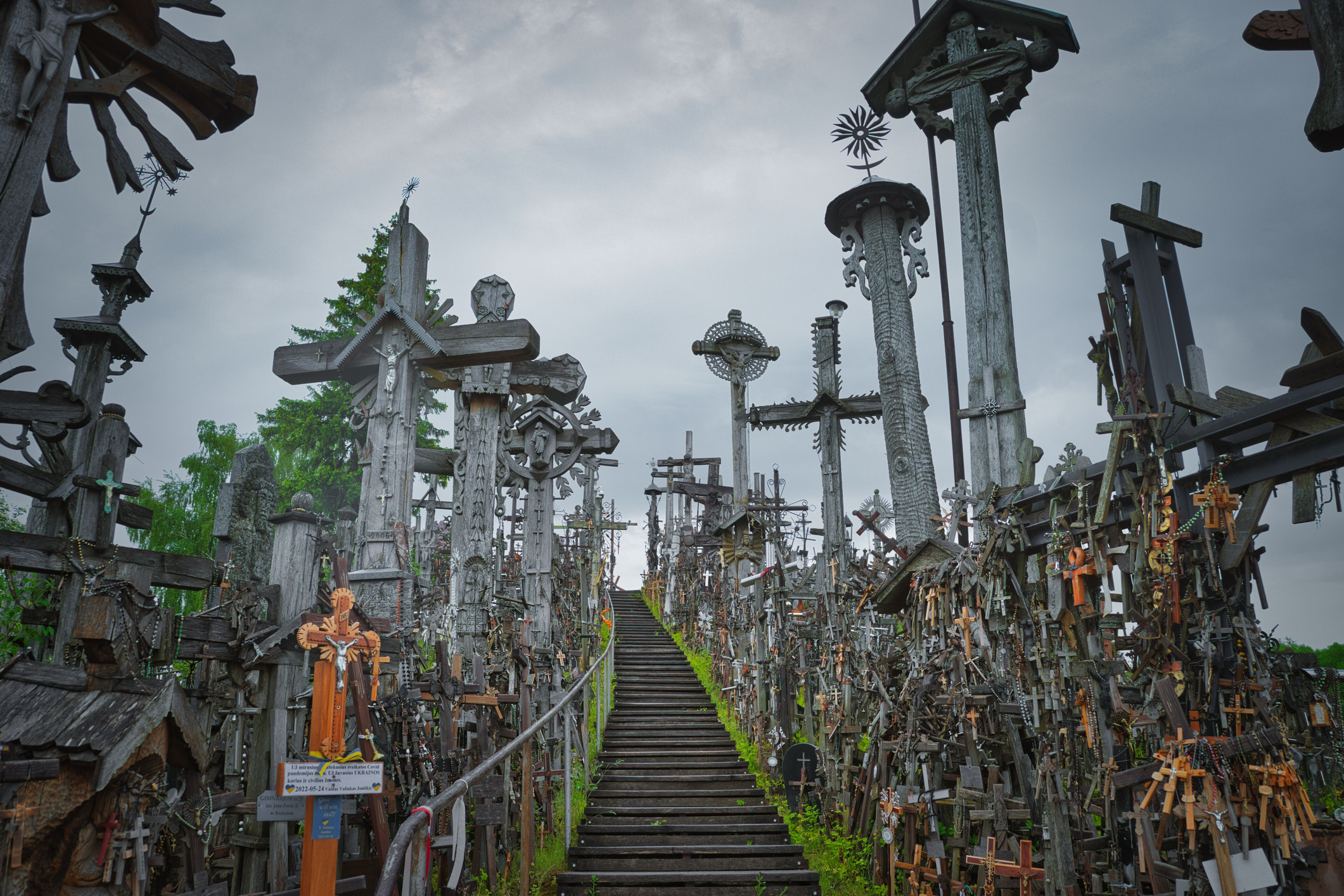
Just north of Šiauliai stands one of Lithuania’s most powerful religious sites: the Hill of Crosses. Covered with crosses, rosaries and other devotional objects, it is both a Catholic pilgrimage destination and a national symbol of endurance. Lithuania Travel describes it as a one-of-a-kind sacral site and a testament to faith and hope that survived repeated attempts at destruction by Tsarist and Soviet authorities.
The Hill of Crosses matters because it unites faith and history in one place. Visitors come not only to see the thousands of crosses, but to experience a site that symbolizes prayer, remembrance and peaceful resistance.
The exact origins of the tradition are not fully certain, but the site is widely linked with the 19th-century uprisings against Russian rule, when families began placing crosses in memory of the dead and missing. Over time, the hill grew into a public witness of devotion and national identity.
During the Soviet period, the Hill of Crosses took on even greater meaning. Authorities repeatedly destroyed the crosses, yet people continued returning to place new ones. That pattern of removal and replacement turned the hill into one of Lithuania’s clearest symbols of spiritual and cultural resistance.
Today, the hill is covered with an immense number of crosses of every size and style. Lithuania Travel currently describes the site as holding around 200,000 crosses, along with rosaries and other devotional items left by pilgrims praying for health, wellbeing and intentions of many kinds.
The site gained global attention in 1993, when Pope John Paul II visited, prayed there and celebrated Mass. Pilgrim-route materials tied to his visit say he addressed a crowd of 100,000 people, and Lithuania Travel notes that his visit helped bring the hill to international fame.
That papal connection still shapes the site today. Lithuania Travel notes that pilgrimage events continue through the year, including the indulgenced feast on the last Sunday of July, and processions often begin or end at the crucifix brought by Pope John Paul II.
A short walk from the hill is the Franciscan monastery associated with the site. Local tourism sources say it stands about 300 meters from the Hill of Crosses and was consecrated on July 8, 2000, after Pope John Paul II encouraged the Franciscans to establish a monastery nearby. The chapel is open daily, and Mass is celebrated there regularly.
For travelers, the practical access is straightforward. The Hill of Crosses is in Domantai village, near Šiauliai, and official local guidance says visitors can take the Šiauliai–Joniškis bus from Šiauliai Bus Terminal, get off at Domantai and walk about 2 kilometers to the site. The hill is also reachable by car or bicycle from the A12 road.
What makes the Hill of Crosses memorable is not only its scale, but its atmosphere. It feels personal and communal at the same time: a place where private prayers, family memory, national history and Catholic devotion all meet in one landscape. For many visitors, that is what turns a stop at the hill into a pilgrimage experience.
FAQ
Why is the Hill of Crosses important in Lithuania?
It is important both as a Catholic pilgrimage site and as a symbol of Lithuanian resilience. Official tourism materials describe it as a testimony to faith and hope that survived repeated destruction under Tsarist and Soviet rule.
How many crosses are on the Hill of Crosses?
The exact number is not fixed because people continue leaving new crosses. Lithuania Travel currently describes the site as being covered in about 200,000 crosses of many shapes and sizes.
Did Pope John Paul II visit the Hill of Crosses?
Yes. He visited on September 7, 1993, prayed there and celebrated Mass. Pilgrim-route materials say he spoke to a crowd of 100,000 people, and his visit helped elevate the site internationally.
How do you get to the Hill of Crosses from Šiauliai?
Official local guidance says to take the Šiauliai–Joniškis bus from Šiauliai Bus Terminal, get off at Domantai and walk about 2 kilometers to the hill. Driving and cycling routes are also marked from the A12 road.
Is there a monastery at the Hill of Crosses?
Yes. A Franciscan monastery stands about 300 meters from the hill and was consecrated in 2000. Its chapel is open daily, and it continues to serve pilgrims visiting the site.