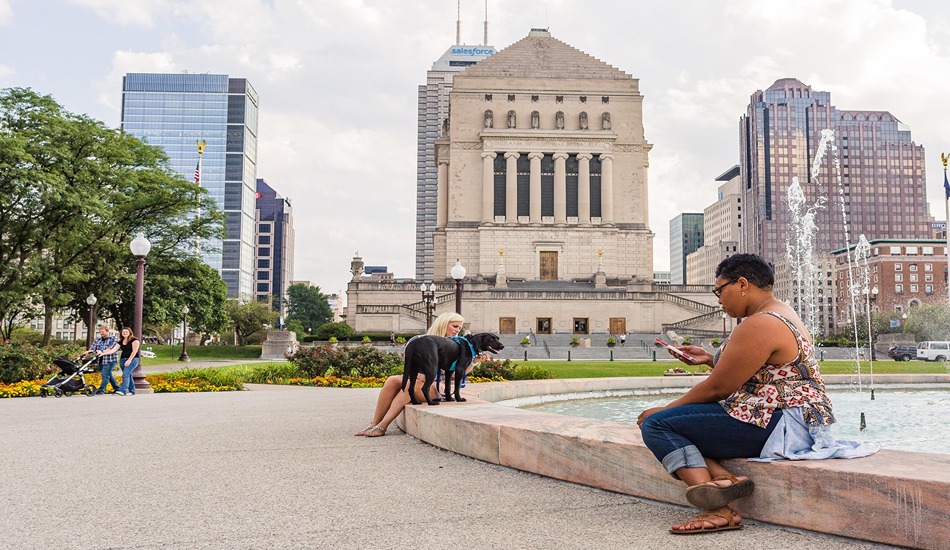
Indiana’s capital abounds with tangible tributes to our nation’s heroes. Multiple memorials are likely to instill visitors with a renewed sense of patriotism.
Having watched a DVD of the 2016 war movie USS Indianapolis: Men of Courage right before recent my trip to Indianapolis, I arrived in town with one of America’s worst naval tragedies fresh in my mind. Ready to visit the city’s stellar collection of military monuments, I was haunted by visions of the sailors who survived the enemy’s sinking of their ship and then clung to for life for five days in shark-infested Pacific waters.
The USS Indianapolis CA-35 Memorial was one of the many impressive war memorials on my must-see list in Indiana’s capital, a city second only to Washington, D.C. in the number of military shrines. No other U.S. city, moreover, maintains as many acres dedicated to honoring veterans.
As we celebrate America’s 250th anniversary this year, it’s appropriate we salute our heroes by visiting these reminders of their courage and sacrifice.
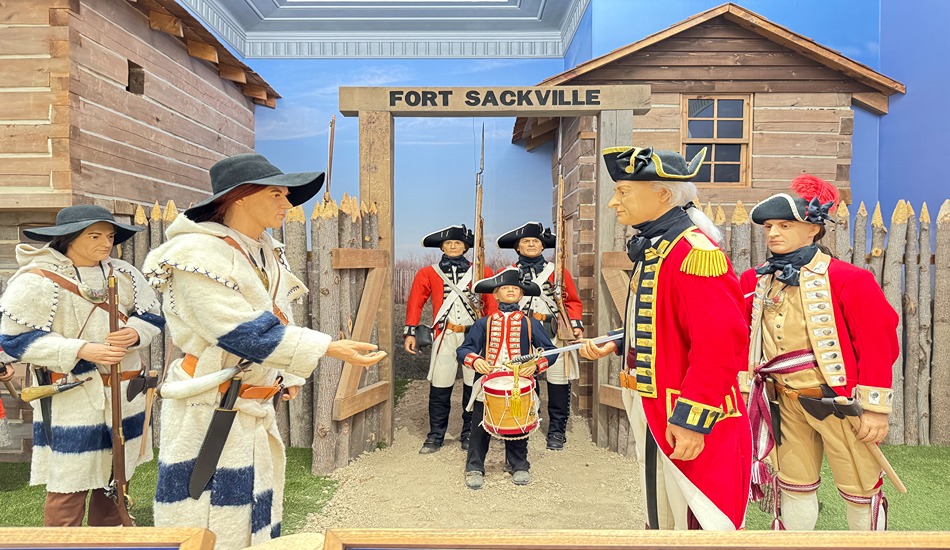
A museum exhibit at the Indiana War Memorial depicts Britain’s surrender to General George Rogers Clark at Fort Sackville in western Indiana, capping a big American victory in the Revolutionary War. (Randy Mink Photo)
Indiana War Memorial Museum: A Treasure House of Military Memorabilia
Happily for history-minded travelers in Indianapolis, most of the memorials are clustered in a five-block-long mall in downtown’s Indiana War Memorial Plaza Historic District. Visiting the free-admission museum at the Indiana War Memorial, a monumental three-story building constructed more than 90 years ago to honor World War I veterans, requires the most time. As the plaza’s crown jewel, it’s a good place to begin your journey into the past.
The museum covers conflicts from the American Revolution to 21st century wars in Iraq and Afghanistan. Artifacts—originals or replicas—include rifles, swords, uniforms, helmets and gas masks, along with war bond posters and battle flags. The Civil War gallery displays a surgical kit with an explanation that some 30,000 amputations accounted for three-quarters of Union battlefield surgeries.
A notable relic is the “war souvenir” snatched from the rubble of Adolf Hitler’s office in Berlin’s Chancellery building after Germany had surrendered—a bronze bust of the German dictator uncovered by a U.S. Army lieutenant from Bedford, Indiana.
Many other exhibits spotlight heroic actions and noteworthy exploits by Hoosiers in various wars. Huntington’s Helen Purviance, for example, came up with the idea of frying donuts for the Doughboys in WWI, becoming the Salvation Army’s first “Doughnut Girl.” Also remembered is Ernie Pyle, an Indiana native who became one of WWII’s most famous war correspondents; he was killed by Japanese machine-gun fire in 1945 while covering the Battle of Okinawa. The 9/11 gallery recognizes four Hoosiers who died in the World Trade Center attack and displays a fragment of the Pentagon from that fateful day, plus a steel beam recovered from New York’s World Trade Center.
Items dating back to the Revolutionary War include a Continental eight-dollar bill and a metal button from the coat of a Continental Army soldier. One display portrays the British surrender in 1779 to General George Rogers Clark, who scored a crucial Revolutionary War victory in Vincennes, Indiana that resulted in American control of the western frontier. The land would become the Northwest Territory. A video monitor, one of several in the museum, shows a present-day re-enactment of the battle.
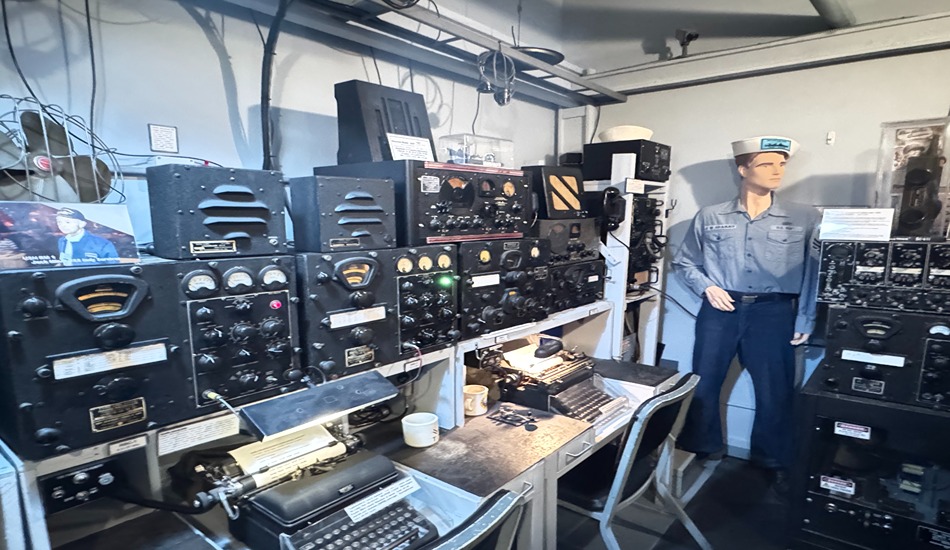
The Indiana War Memorial’s museum has a functioning re-creation of the radio room on the ill-fated battleship USS Indianapolis. (Randy Mink Photo)
Among the larger exhibits are a Vietnam-era Cobra helicopter and working replica of the radio room on the USS Indianapolis, the battleship ship sunk by the Japanese in World War II after it had completed a top-secret mission delivering parts of the atomic bomb that devastated Hiroshima. One gallery has artifacts from the vessel.
Shrine Room: A Sacred Space
The cavernous Shrine Room at the top of the Indiana War Memorial, closed for renovations until late spring 2026, is a grand 110-foot-tall space with 16 soaring columns made from blood-red Vermont marble, softly lit alcoves with framed portraits of WWI Allied Forces generals and the Altar of Consecration—a giant marble altar flanked by torch standards. Above the altar hangs a 30-foot-tall American flag suspended from invisible wires and a huge crystal light fixture.
Truly awe-inspiring, the mausoleum-like room is illuminated with light reflected through blue stained-glass windows on all four walls. Each corner contains flags from nations that assisted the Allies in WWI. (The building is modeled after the Greeks’ Mausoleum at Halicarnassus, one of the Seven Wonders of the Ancient World.)
More Points of Reflection on Indiana War Memorial Plaza
Farther down the mall, by the national headquarters of the American Legion, you’ll find the World War II Memorial, Korean War Memorial and Vietnam War Memorial. The latter two are etched with the names of Hoosiers who lost their lives or went missing in action, the walls imprinted with excerpts of letters to loved ones. For example, these words were written in Vietnam on December 13, 1967:
“Dear Mom and Dad & Kids,
Most of us are scared to death, but somebody has to fight this dirty war.
Love always,
Fred (the soldier boy)”
(The letter writer, Frederick B. King, was killed in action on November 25, 1968.)
Also by the American Legion offices is the Cenotaph, an empty tomb in a sunken garden designed to honor Corporal James Gresham, an Evansville, Indiana native and the first American casualty of WWI. Today, it is dedicated to all the dead in that war.
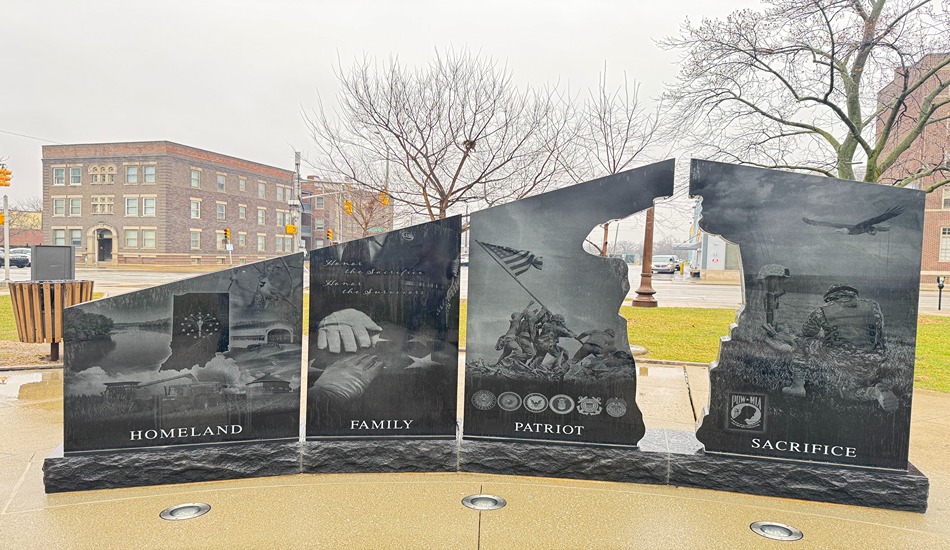
This memorial on Indiana War Memorial Plaza salutes Gold Star families. (Randy Mink Photo)
Nearby, the Indiana Gold Star Families Memorial Monument pays tribute to families whose sons and daughters made the ultimate sacrifice. The soldier silhouette cut-out in the black granite sculpture suggests the absence and void of a loved one who died serving the country. The monument’s four panels represent homeland, family, patriotism and sacrifice.
Monument Circle: Hub of Downtown Indianapolis
Indianapolis’ most familiar war shrine is the Soldiers and Sailors Monument, which rises 284 feet in the middle of a downtown traffic circle four blocks south of Indiana War Memorial Plaza. The imposing landmark, crowned by a 38-foot-tall bronze figure of Victory holding a torch and a sword, has come to symbolize the city and stands at its very center.
A city ordinance provides that no building can cast a shadow on the monument, which measures 15 feet shorter than the Statue of Liberty. Every year from mid-November to mid-January the monument becomes the world’s largest Christmas tree.
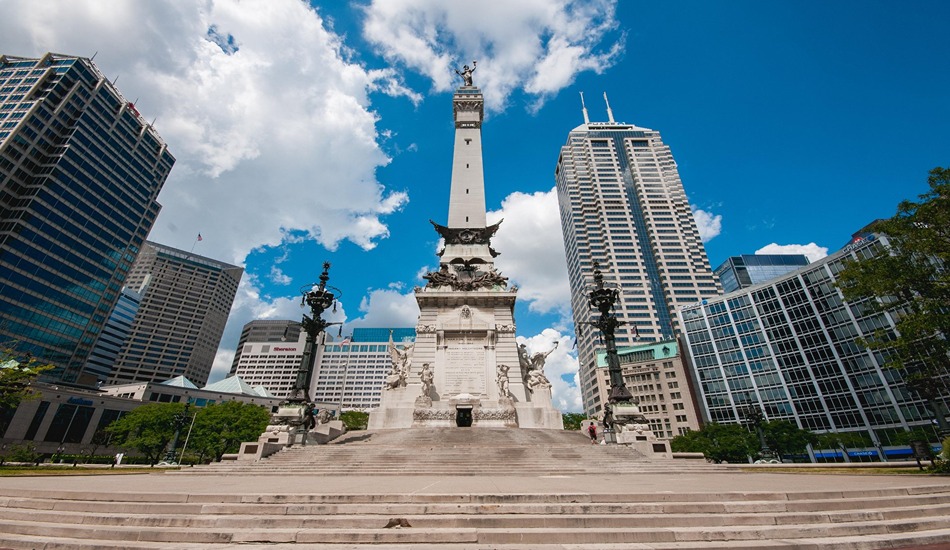
Soldiers and Sailors Monument in Monument Circle, the center of downtown Indianapolis. (Photo credit: Visit Indy)
Adorned with statuary and flanked by cascading fountains on two sides, the native Indiana limestone tower, dedicated in 1902, was erected to honor the 24,000 Hoosiers who died in the Civil War, but it also recognizes those who fought in all wars prior to WWI. The lower level inside once housed the Colonel Eli Lilly Civil War Museum, whose collection now resides in the Indiana War Memorial. When the monument’s interior reopens after repairs, visitors will be able to access the glass-enclosed observation deck via 333 steps or elevator.
Your Patriotic Pathway Continues Along the Central Canal
At the north end of Canal Walk, seven blocks west of Indiana War Memorial Plaza, lies the USS Indianapolis CA-35 National Memorial, a black-and-gray granite monument engraved with names of the ship’s crew and a likeness of the vessel that had earned 10 Battle Stars before being sunk on July 30, 1945, in the Philippine Sea by torpedoes from a Japanese submarine.
The ship’s story is told in limestone panels at the base. An estimated 800 of the 1,196 men aboard made it into the sea in the 12 minutes before she sank, but only 316 survived long enough to be rescued from the water five days after the explosions. They had suffered from starvation, thirst, delirium, exposure and gruesome shark attacks.
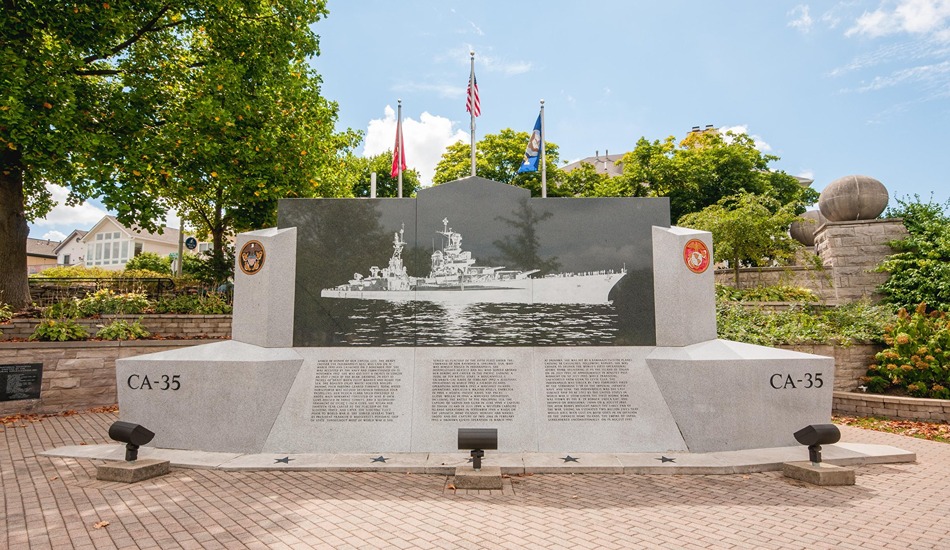
The USS Indianapolis National Memorial honors the crew of one of America’s great battleships in World War II. (Photo credit: Visit Indy)
Captain Charles B. McVay III, commander of the USS Indianapolis, was court-martialed by the Navy for his decision-making in the catastrophe. Haunted by the sinking and after years of mental health problems, he committed suicide 23 years later. McVay was posthumously exonerated in 2000 by Congress and President Bill Clinton. Nicholas Cage played McVay in the movie.
Also by the Central Canal, the Congressional Medal of Honor Memorial features 27 curved glass panels inscribed with the names of those who have received America’s highest award for military valor. Each day at dusk the sound system plays recorded stories of some of the 3,500-plus medal recipients or of conflicts in which they fought. Located behind the Indiana State Museum in downtown’s White River State Park, the only memorial to the nation’s most highly decorated war heroes represents 15 different conflicts, from the Civil War to the wars in Iraq and Afghanistan. Not far away is the Indiana 9/11 Memorial, a canalside shrine with two 11,000-pound beams and a tree taken from the World Trade Center, plus a stone from the Pentagon.
Travel smarter, plan better – Get top destinations, itineraries, and industry trends by subscribing to Leisure Group Travel now.
By Randy Mink, Senior Editor
Lead photo – The Indiana War Memorial dominates one end of Indiana War Memorial Plaza. (Courtesy of Visit Indy)