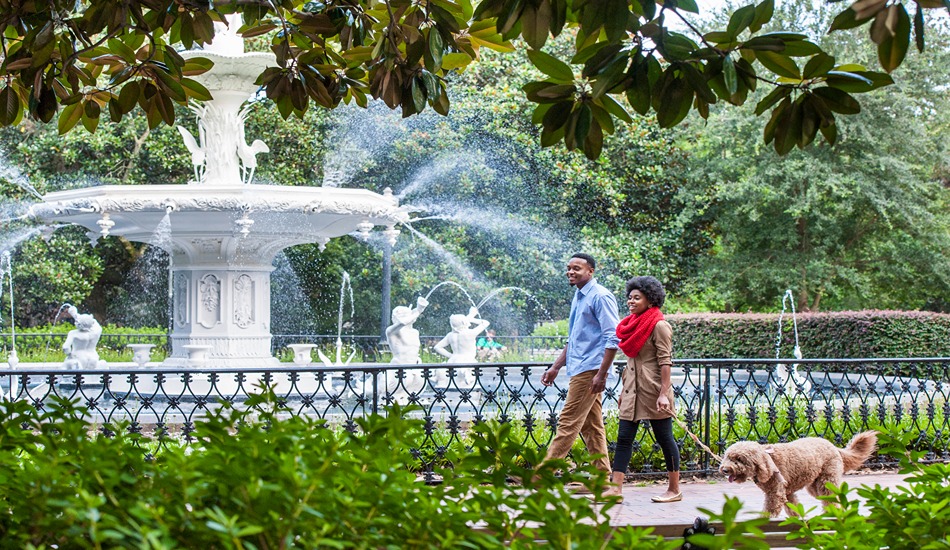
This Georgia port city’s extensive historic district, an open-air museum, brims with Southern charm. Walking is the best way to immerse yourself in the past.
By Randy Mink, Senior Editor
Relaxing on a wooden bench with a pimento cheese sandwich and bottle of chocolate milk, I could not have been more content under the canopy of drooping live oak branches in Columbia Square. Across the way were a boy strumming his guitar and a woman reading a book.
Rustling leaves, twittering birds and a splashing antique fountain set the stage for soaking in the genteel majesty of this pocket of greenspace, one of 24 squares laid out in a grid pattern three centuries ago by British colonists who founded the Atlantic port city of Savannah, Georgia.
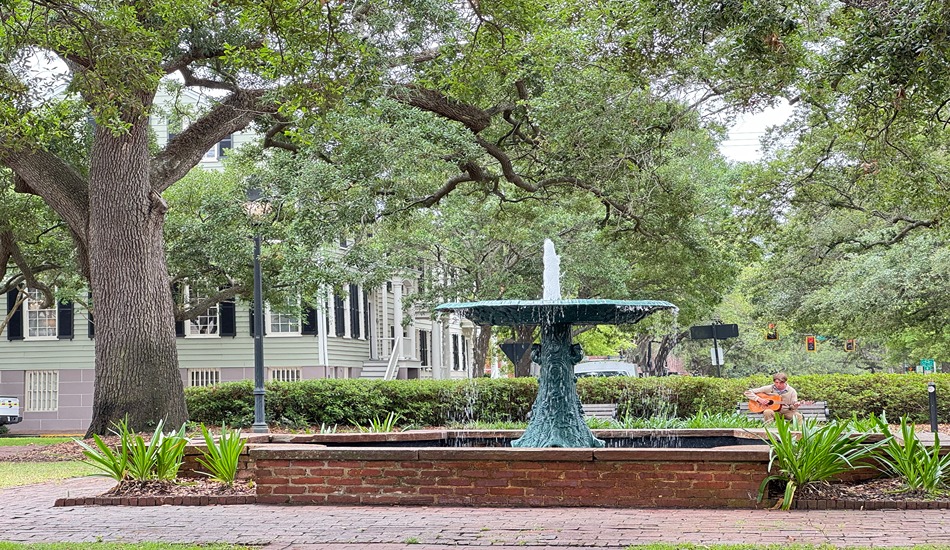
Columbia Square, a peaceful retreat in Savannah’s historic district. (Randy Mink Photo)
I had spent the morning square-hopping in the very walkable historic core, perusing monuments, admiring styles of architecture and just communing with the past at my own pace. Chapters in American history, including significant events in the Revolutionary War and Civil War, sprang alive as I wandered about, footloose and fancy-free.
Savannah, established in 1733, boasts one of the largest historic districts in North America. A model of urban design, it was the first city in Georgia, southernmost of the original 13 colonies and last to be settled. After Atlanta, Savannah is Georgia’s most visited city, a magnet for travelers looking to immerse themselves in yesteryear.
To get a lay of the land before exploring by foot, I joined Old Town Trolley Tours for an hour-long swing through Savannah’s venerable center, a little world of its own. The hop-on, hop-off narrated circuit makes 16 stops between the Savannah River and Forsyth Park, a vast grassy expanse that anchors the district’s south end. Several companies offer guided walking tours, and horse carriage rides are available as well.
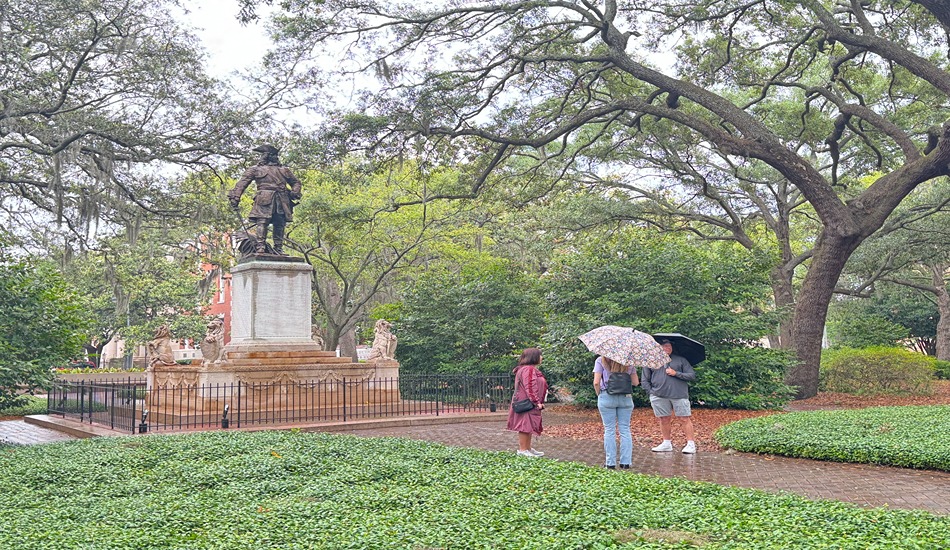
A statue of British General James Oglethorpe dominates Chippewa Square. (Randy Mink Photo)
Besides tangles of ancient live oaks bearded with wisps of Spanish moss, massive magnolias shelter some of Savannah’s manicured squares, and you’ll see the occasional palm. Azaleas brighten the gardens in spring.
Chippewa Square, one of my favorites, features a bronze statue of General James Oglethorpe, leader of the first colonists who put down stakes on the Savannah River. In the movie Forrest Gump starring Tom Hanks, a few scenes show the main character on a bus bench in Chippewa Square. That fiberglass bench now rests in the Savannah History Museum, courtesy of Paramount Pictures.
The Savannah Theatre resides just off Chippewa Square. Dating from 1818, it is one of the oldest theaters in America. Restored in 1940s Art Deco style, the showplace presents Broadway musicals and other entertainment year-round. Step into the lobby to view objects, newspaper articles and photographs from long ago. In 1993, the theater was leased to Paramount Pictures for the production of Forrest Gump and served as the wardrobe and makeup headquarters for actors and extras in the “bench” scenes. (Hanks had his own trailer at the opposite end of Chippewa Square).
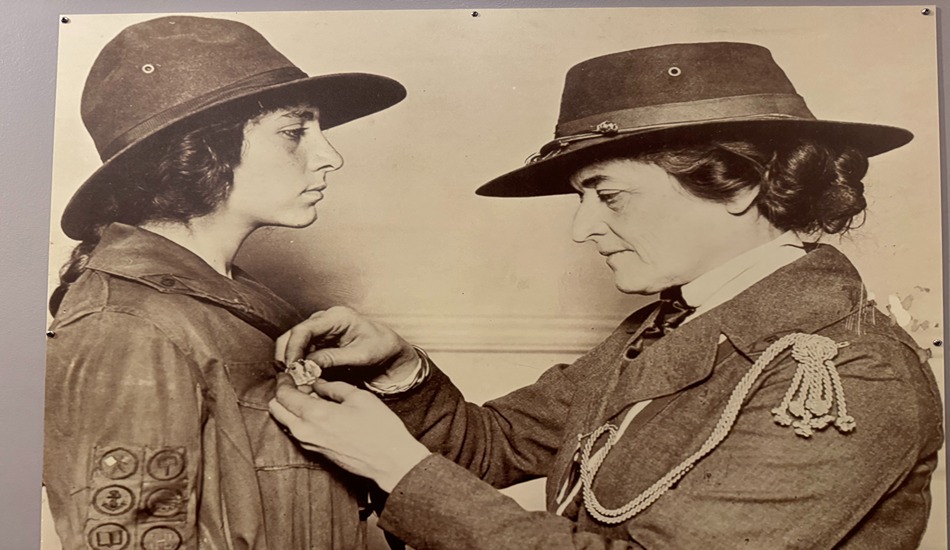
Juliette Gordon Low (right), founder of the Girl Scouts.
Touring Savannah’s Historic Homes
Drifting among the lovely squares, I popped into a few house museums for docent-led tours. At the Juliette Gordon Low Birthplace Museum, I learned about the upper-class upbringing of the woman who started the Girl Scout movement in the United States with 18 girls from the Savannah Female Orphan Asylum.
The visionary also was an accomplished painter and sculptor. Some of her work, along with many family possessions, is on display in the mansion where she grew up and lived for a time as an adult. The home was declared the city’s first National Historic Landmark in 1965.
Other houses open for tours include:
- Andrew Low House Museum. Mid-19th century furnishings and decorative arts, plus a beautiful garden and courtyard, make this 1840s home on Lafayette Square a top choice. Juliette Gordon Low was Andrew’s daughter-in-law and lived there for a significant period up until her death. The carriage house, left by Juliette to the Girl Scouts, held the country’s first Girl Scout headquarters and houses the Savannah council’s archives.
- Green-Meldrim House. One of the finest examples of Gothic Revival architecture in the South, this 1850s gem on Madison Square was the headquarters of Union General William Tecumseh Sherman during the Civil War. It serves as the rectory of adjacent St. John’s Episcopal Church.
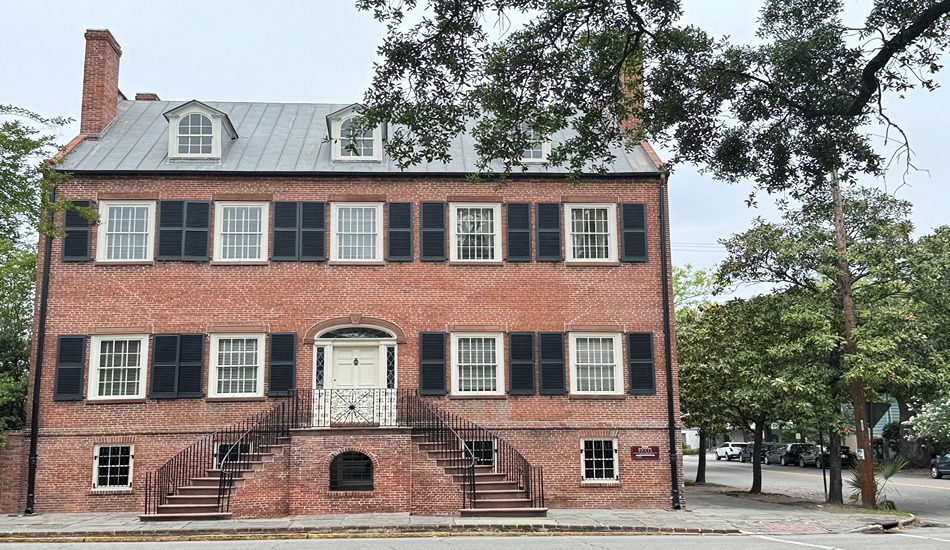
Davenport House Museum. (Randy Mink Photo)
- Davenport House Museum. It’s said that Savannah’s organized preservation efforts began when this handsome, Federal-style home was saved from demolition in 1955. It was the founding activity of Historic Savannah Foundation, which leads the movement today. Fronting Columbia Square, the handsome red-brick building was built in 1820 by Isaiah Davenport. An exhibit explores the role enslaved workers played in supporting the family.
- Owens-Thomas House. Guides discuss not only the wealthy Owens family but the enslaved people who labored there. Tours of the 1819 Regency-style home on Oglethorpe Square include the slave quarters.
Forsyth Park, ringed by live oaks, dotted with memorials and surrounded by Victorian homes, is a must see. Its photogenic cast-iron fountain, based on a French model and dedicated in 1858, is practically the symbol of Savannah.
Museums in Savannah’s Historic District
The Savannah History Museum occupies the old Central of Georgia Railway passenger station, showcasing the city’s story from 1733 to the present. Highlights include an 18-minute movie and an excellent exhibit on Gordon Low and Girl Scout memorabilia. Next door, the Georgia State Railroad Museum, in a 19th century railroad facility, preserves vintage rolling stock and offers a 20-minute train ride.
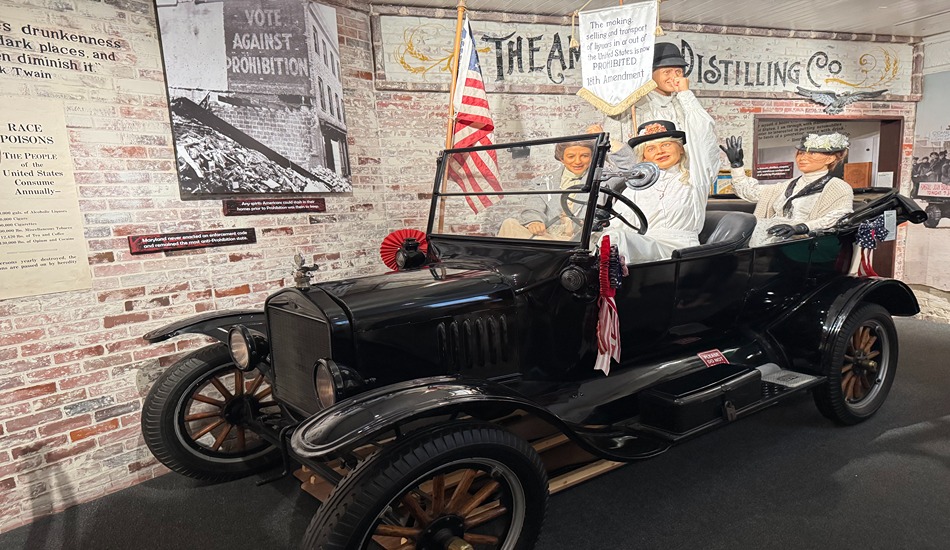
American Prohibition Museum. (Randy Mink Photo)
Savannah was a major rum-running point on the bootlegging circuit during the Prohibition era, when the nation imposed a ban on alcohol. The period (1920-1933) is dramatized in the American Prohibition Museum, a popular attraction that brings the Roaring Twenties to life. Exhibits spotlight the efforts of early Temperance Movement women like Carrie Nation, the anti-alcohol crusader known for smashing up saloons with a hatchet to get her point across. Museum goers also learn about backwoods moonshiners and notorious gangsters like Al Capone. There is archival footage of federal agents seizing illicit booze and pouring it into the streets. Scattered throughout are quotes about alcohol consumption by Mark Twain, U.S. presidents and other famous people.
Artifacts, including four antique cars, plus live actors and wax figures, help tell the Prohibition story. For guests 21 and over who whisper the secret password, the “speakeasy” bar serves up 1920s cocktails. Located among Savannah City Market shops, the Prohibition museum is connected to the Savannah Pirates and Treasure Museum.
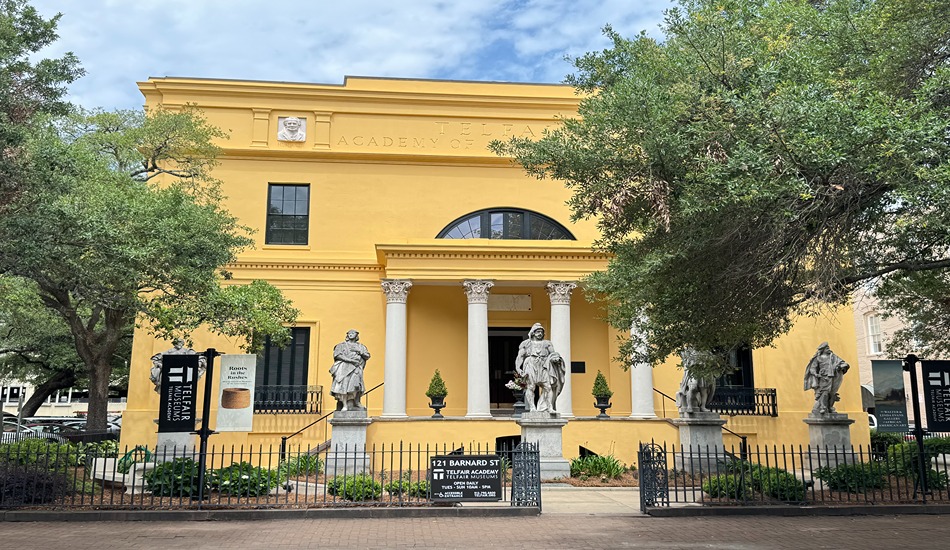
Telfair Academy, a mansion-turned-art museum. (Randy Mink Photo)
Art lovers flock to the Telfair Academy. The distinguished collection of American and European art graces galleries in the former Telfair family mansion, a stately yellow building facing Telfair Square. Established in 1886, it is the oldest public art museum in the South and first art museum in America founded by a woman.
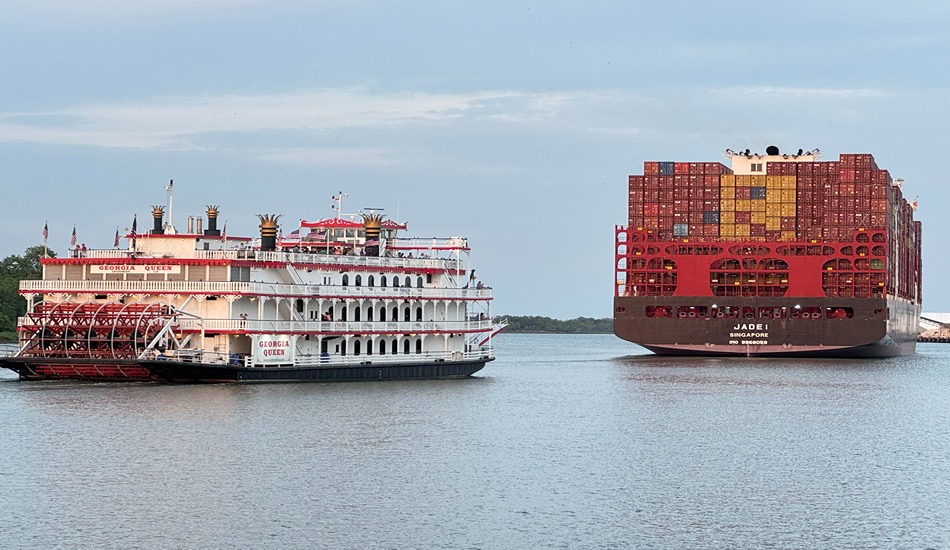
Sightseeing boats and cargo ships ply the Savannah River. (Randy Mink Photo)
Exploring the Historic Waterfront
Many sightseers start their explorations on the riverfront, strolling along the ballast stones of tourist-thronged River Street and going into shops occupying former cotton warehouses. Those with a sweet tooth will want to visit River Street Sweets for pralines, chocolate bear claws and glazed Georgia pecans.
Savannah Riverboat Cruises’ Georgia Queen paddlewheeler offers narrated harbor cruises. You’ll see mammoth cargo ships from all over the world, as Savannah is one of the East Coast’s busiest seaports.
Restaurants, pubs and rooftop bars keep the riverside strip hopping well into the night. The cavernous lobby of the JW Marriott Plant Riverside, built inside the generator hall of a decommissioned power plant, is worth a peek for its over-the-top displays of fossils, minerals and replica dinosaurs.
At the east end of River Street, the Waving Girl statue honors the eccentric Florence Martus, who, starting in 1887 and for the next 40-some years, greeted passing ships with a wave of the handkerchief by day, a lantern at night.
That gracious gesture of Southern hospitality reflects Savannah’s welcoming personality today.
Travel smarter, plan better – Get top destinations, itineraries, and industry trends by subscribing to Leisure Group Travel now.
Lead photo – The famous fountain at Forsyth Park captures the elegance and grandeur of Savannah’s historic district. (Photo credit: Visit Savannah)