New Jersey’s leading seaside resort has much to offer curious explorers looking for connections to yesteryear. It’s not all about nightlife and casino gaming.
It was my first time in Atlantic City, and, for nostalgic reasons, I wanted to tap into its historic past as well as check out the beachfront and casino hotels. I had always known it as the inspiration for the Monopoly board game and for hosting the Miss America Pageant, a major national event that was televised every September. And who has not heard of the Atlantic City Boardwalk?
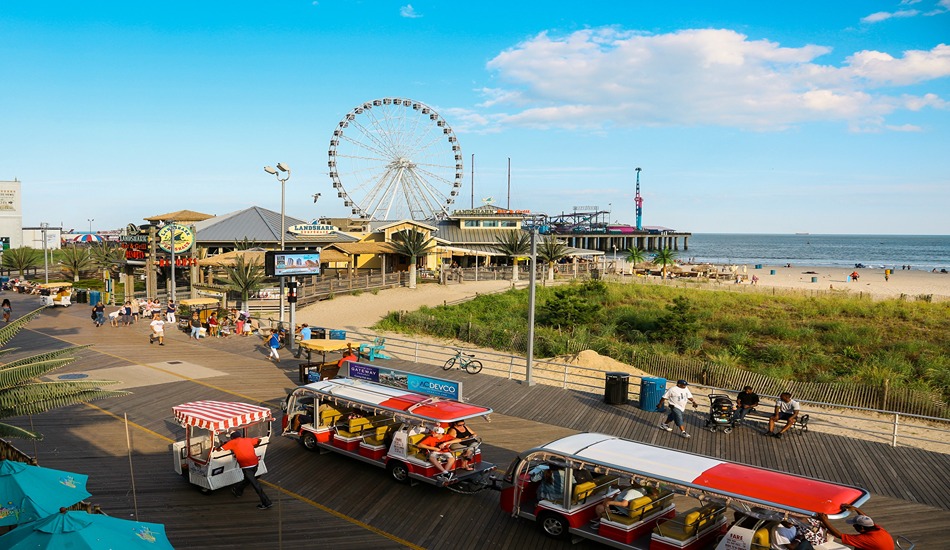
Soon after getting settled at Caesars Atlantic City, I walked out its doors and onto the Boardwalk, a car-free promenade that celebrates the spirit of Jersey Shore beach culture. On one side of the wooden walkway you’ve got white-sand dunes and beaches; hotels, eateries and souvenir shops flank the other. A pleasant space for pedestrians, the Boardwalk abounds with amusements—carnival rides, mini golf, go-kart racing and more. At one point I sat down on a bench to breathe the sea air, listen to the waves and watch the parade of people cruising down one of America’s great thoroughfares.
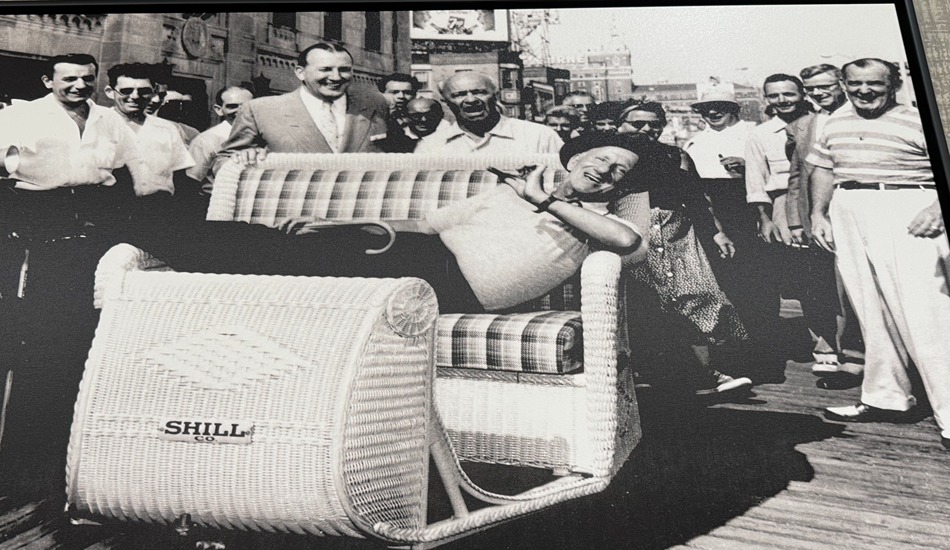
Comedian/actor Jimmy Durante clowning around in a rolling chair on the Atlantic City Boardwalk.
That parade includes rolling chairs, a Boardwalk staple since the 1880s, when the wheeled wicker conveyances were used primarily by disabled persons. Today’s chair pushers stand ready to take you and a companion on a short whirl (starting at $5, plus tip) or a tour lasting up to an hour. Electric tram cars provide another way of going up and down the Boardwalk. Bicycle riding is allowed during designated hours.
When built in 1870, the Boardwalk was only a mile long, eight feet wide and not even permanent—it was dismantled after the summer season. The walkway was built for a practical reason—to help keep sand from being carried into hotel lobbies by strollers’ long dresses and shoes. Today the Boardwalk is an official city street that skirts the seashore for 5.5 miles, stretching into the neighboring town of Ventnor.
Jim Whelan Boardwalk Hall Exhibits
The resort town’s glorious past comes alive at the free-admission Atlantic City Experience, a collection of exhibits just inside the doors of Jim Whelan Boardwalk Hall, a massive arena/event center. Dedicated in 1929, the massive brick building covers a whole city block and once held the world’s largest auditorium without obstructing columns.
Originally named Atlantic City Auditorium & Convention Hall, the building resembles a National Guard armory. For many years, it hosted the Miss America Pageant and in 1964 welcomed delegates to the Democratic National Convention.
Today the 14,770-seat arena (it once had 41,000 seats) stages everything from boxing matches and hockey games to ice shows and touring musical acts under its barrel-shaped ceiling. Alongside the arena is the 3,200-capacity Adrian Phillips Theater.
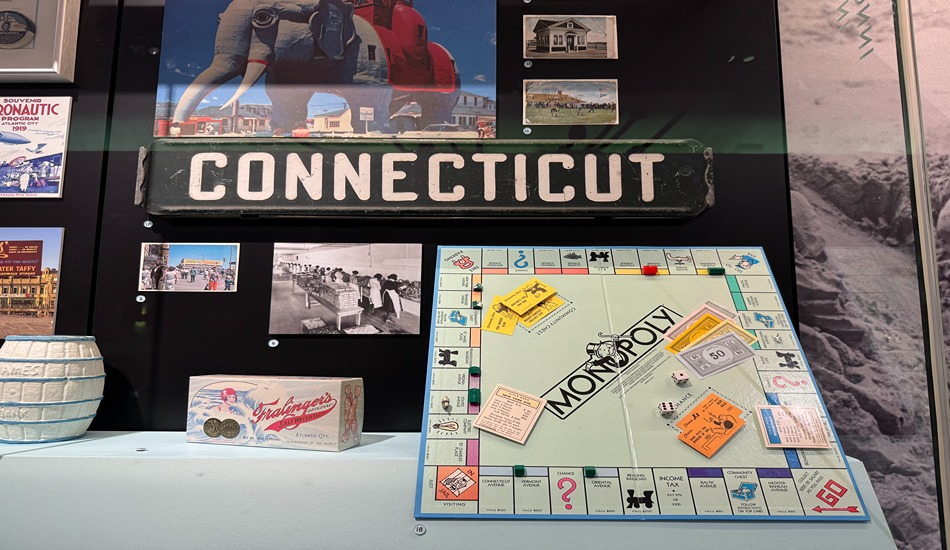
The Atlantic City Experience in Jim Whelan Boardwalk Hall recalls the city’s connection to the Monopoly board game. (Randy Mink Photo)
Artifacts on display at the Atlantic City Experience tell the city’s story, and a timeline traces its development as a beach resort from the 1870s on. Perhaps the 1947 saltwater taffy box or 1930s swimsuits will catch your eye. Maybe you’ll appreciate a reproduction ticket for the 1964 Beatles concert with a black-and-white photo of the Fab Four holding a super-long submarine sandwich.
Miss America items include a contestant’s gown, crown and trophy, plus a 1941 program. And there’s the sheet music of “(There She Is) Miss America!”—sung at the crowning by the pageant’s longtime master of ceremonies, TV/radio personality Bert Parks.
The Atlantic City Experience also showcases a vintage Breakers Hotel sign that reads “Please SHOWER SAND FROM BODY before going to room.” The city’s Monopoly connection is illustrated by a game board and Connecticut Avenue street sign. One exhibit recognizes the workers who have kept Atlantic City running over the years, people like waitstaff, bartenders, hair stylists and rolling chair attendants.
The Atlantic City Labor Museum, a separate area just inside the entrance doors, honors union members who built the casino hotels after New Jersey in 1977 became the second U.S. state to allow casino gaming. Atlantic City is the country’s second-largest gaming market.
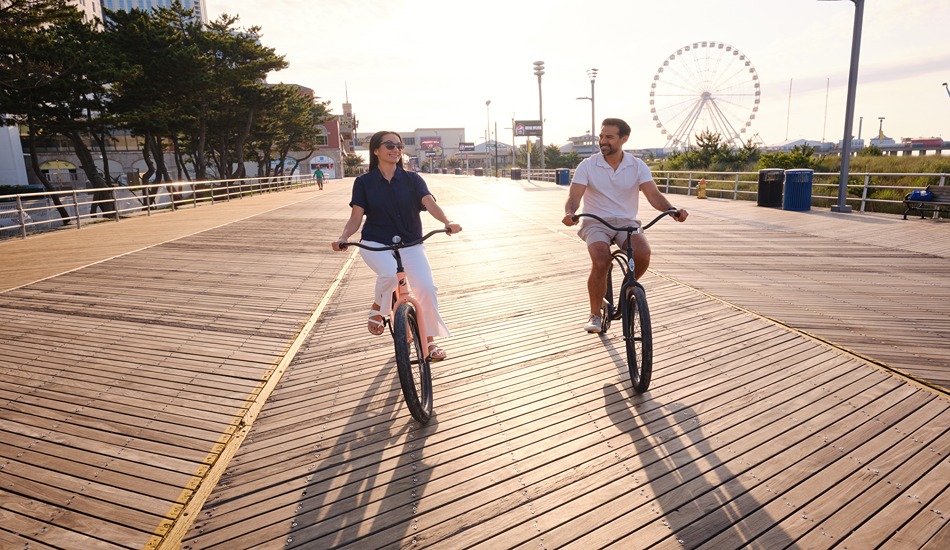
Bicycle riding is allowed at designated times along the Atlantic City Boardwalk. (Photo credit: Visit Atlantic City)
Jim Whelan Boardwalk Hall Tours
Jim Whelan Boardwalk Hall is home to the world’s largest pipe organ. Billed as the “largest musical instrument on earth,” it contains 33,112 pipes. Built between 1929 and 1932, the organ has not been fully functional for decades, but volunteers are working to restore its original grandeur and expect to finish the project by 2030.
A free half-hour organ recital combined with a half-hour tour is offered at noon weekdays from Memorial Day to Labor Day and at select times in December, but groups can schedule a tour anytime. Also available is the two-hour “Curator’s Tour,” which goes inside the organ and through areas of Boardwalk Hall normally closed to the public.
Other Attractions on the Boardwalk
In Kennedy Plaza, across from Jim Whelan Boardwalk Hall, stands a bronze Miss America statue holding a crown for anyone to slip under and pose for a mock crowning. A memorial in the plaza is dedicated to men and women of organized labor who lost their lives in construction accidents while building the casino hotels.
Another marker in Kennedy Plaza recognizes a milestone in the nation’s civil rights movement. Installed in 2024, the only Mississippi Freedom Trail marker outside of Mississippi honors the efforts of the Mississippi Freedom Democratic Party to be represented in the state’s delegation at the 1964 Democratic National Convention inside Boardwalk Hall. The riveting testimony of Fannie Lou Hamer, a founding member of the party, before the credentials committee garnered national media coverage. She declared, “All my life I’ve been sick and tired. Now I’m sick of being sick and tired.” Though Black Mississippians were not seated in Atlantic City, the groundbreaking campaign led to Mississippi’s first integrated delegation in 1968 and helped shape the future of voting rights in America.
A Boardwalk foray is not complete without visiting the Steel Pier, a classic Jersey Shore playground with rides, games and fun foods. Its iconic observation wheel looms 227 feet above the sea, and the Grand Carousel depicts scenes from the city’s history. A Boardwalk institution dating back to 1898, the Steel Pier is the place to indulge in saltwater taffy, fudge, cotton candy, ice cream, funnel cakes and deep-fried Oreos. Perhaps you hunger for a cheesesteak or pizza slice, a hot dog or hamburger, BBQ or seafood.
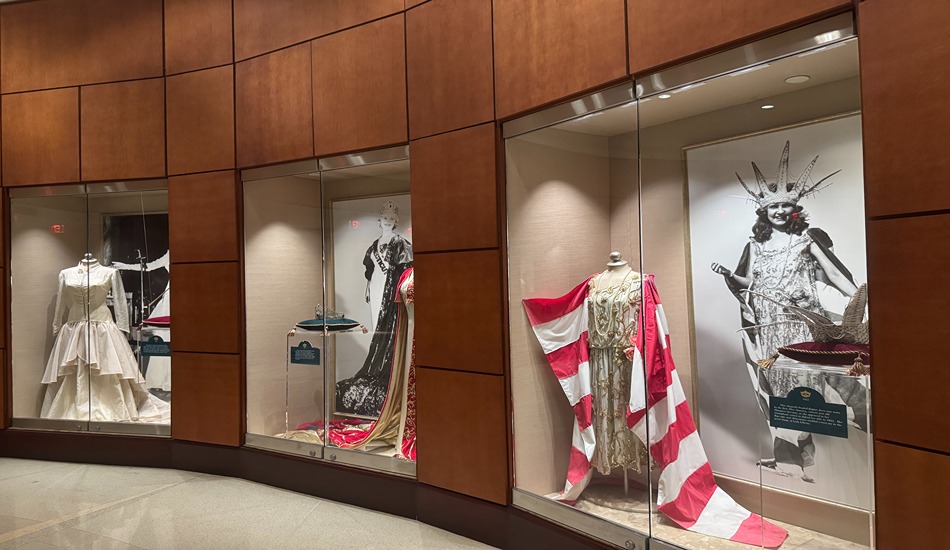
Miss America fans enjoy the exhibit cases off the lobby of the Sheraton Atlantic City. (Randy Mink Photo)
More Miss America Memories
Off the lobby of the Sheraton Atlantic City, the Atlantic City Convention Center hotel, are displays of Miss America memorabilia, including re-created competition gowns worn by such winners as 16-year-old Margaret Gorman, the first Miss America in 1921; Lee Meriwether (1955), who went on to become a successful actress; and Phyllis George (1971), one of the first woman sportscasters on national TV and first lady of Kentucky for four years.
The second floor chronicles the Miss America Boardwalk Parade, one of many festivities that were held in conjunction with the pageant. Known as the “Shoe Parade,” the gala procession featured contestants kicking up their heels when the raucous crowds shouted, “Show us your shoes!” On display by the Shoe Bar are examples of footwear, from ice skates and cowboy boots to glass slippers and quirky novelty shoes.
In a small garden at the Sheraton stands a bronze statue of Bert Parks holding out a jeweled crown. Visitors step into the empty spot, head positioned between Bert’s hands, and a motion sensor in the palms trigger an audiotape to play “There She Is.” Parks emceed the pageant from 1955 to 1979.
Before evolving into a nationwide competition, the pageant was a small-scale affair, started in September 1921 to extend the tourist season past Labor Day. Called the Inter-City Beauty Contest, it judged the women solely on their physical looks and appearance in a bathing suit. By 1945 the talent portion was added and contestants competed for scholarships. The swimsuit portion was eliminated in 2018.
Atlantic City hosted the event for more than 80 years before it moved to Las Vegas in 2006. (The 98th Miss America, Cassie Donegan of New York, was crowned in September 2025 in Orlando, Florida.)
Metal plaques recognizing Miss America winners from 1921-1979 line a sidewalk at Tanger Outlets, an open-air retail and dining district spanning 15 blocks in the heart of downtown Atlantic City, a short hop from the Convention Center and Boardwalk. The 100+ stores and restaurants include Under Armour, Crocs, Coach, Michael Kors, Tommy Hilfiger, Timberland, Gap, Old Navy Outlet and J. Crew Factory, just to name a few. (In New Jersey there is no tax on most clothing and shoes.)
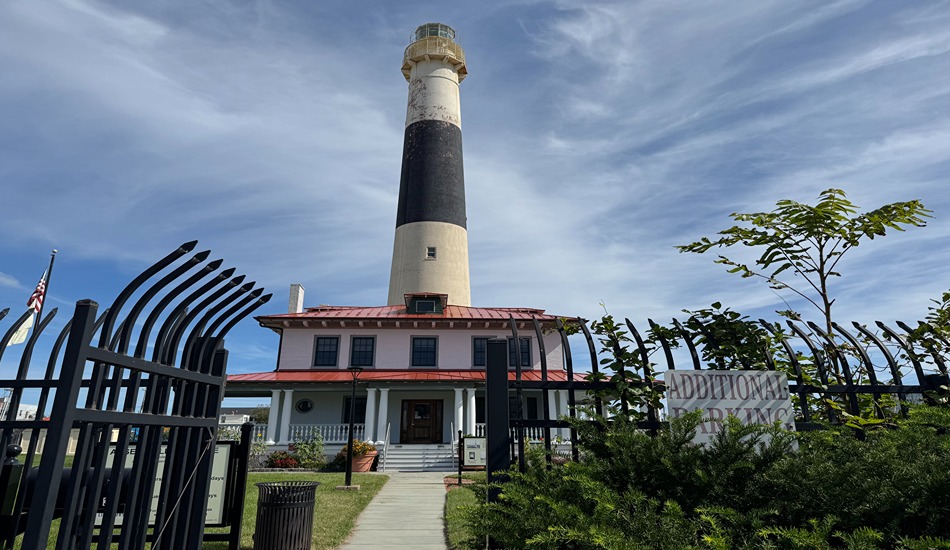
Absecon Lighthouse. (Randy Mink Photo)
More to See and Do in Atlantic City
The Orange Loop, a three-block district not far from the Boardwalk, offers an eclectic mix of restaurants, bars and public art. Centered on New York Avenue, Tennessee Avenue and St. James Place, it’s named after the corresponding orange spaces on the Monopoly board. (Monopoly fans will find other familiar street names in town—from the game’s low-budget Mediterranean and Baltic avenues to high-rent Park Place and, of course, Boardwalk.)
Absecon Lighthouse, a state-owned historic site one block off the Boardwalk, is the third-largest masonry lighthouse in the country. Visitors who climb the 228 steps to the top are rewarded with 360-degree views of the skyline and back bays. First lit in 1857, the 171-foot tower was decommissioned in 1933. Signboards on the grounds and exhibits in the replica lightkeeper’s house shed light on Atlantic City’s maritime history.
Gardner’s Basin, a peaceful retreat nestled on a protected channel along the back bays, provides a refreshing maritime atmosphere away from the Boardwalk’s hustle and bustle. Enjoy outdoor dining with bay views at Back Bay Ale House and Gilchrist Restaurant. The park-like area is home to the Atlantic City Aquarium and the docks for sightseeing and dolphin-watching cruises.
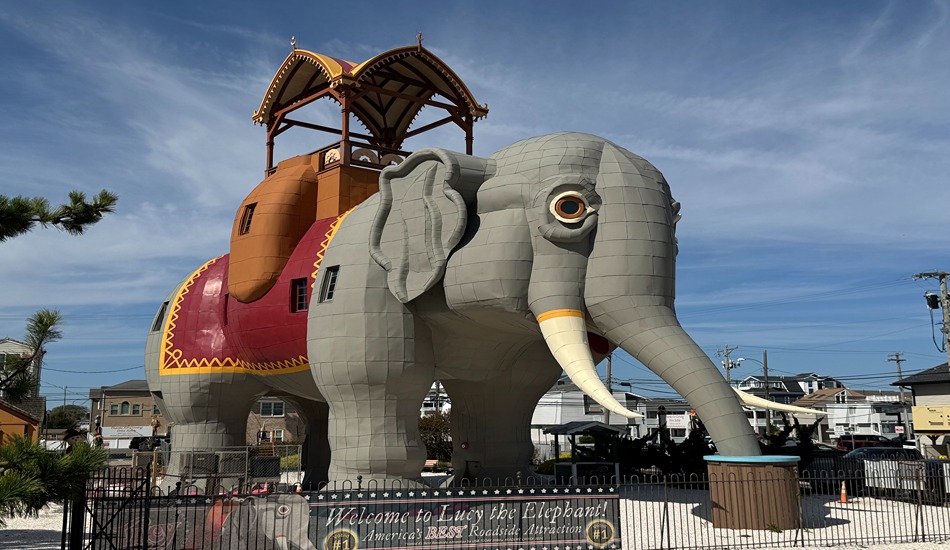
Lucy the Elephant. (Randy Mink Photo)
World’s Largest Elephant
Rising six stories above the sandy shores of Margate, New Jersey, Lucy the Elephant stands tall as a National Historic Landmark. Born in 1881, the 65-foot-high, wood-and-metal building is advertised as “America’s Oldest Roadside Attraction” and “The World’s Largest Elephant,” so I had to check it out during my visit to Atlantic City, a 10-minute drive away.
On a guided tour ($9), I climbed a spiral stairway inside a hind leg and stepped into the belly of the beast, then took another set of stairs for panoramic ocean views from the covered platform, or howdah, atop its back.
There is no charge to visit the grounds and take pictures. The Lucy gift shop/ticket office is across the street.
The whimsical pachyderm originally was built to attract property buyers in what was South Atlantic City at the time. In 1970, owners of the land sold it to a developer and donated Lucy to the city of Margate. That year the 90-ton structure was moved two blocks to its current location because the developer intended to build condominiums on the site and get rid of the decaying Lucy. In 1974 the beloved landmark, saved from the wrecking ball by concerned citizens, reopened after a major restoration.
Lucy has 22 windows. Both its legs and tusks are 22 feet long. The ears, each weighing about 2,000 pounds, measure 17 feet long and 10 feet wide. It is estimated that Lucy can be seen (without use of binoculars) from up to eight miles.
Travel smarter, plan better – Get top destinations, itineraries, and industry trends by subscribing to Leisure Group Travel now.
By Randy Mink, Senior Editor
Lead photo courtesy of Visit Atlantic City