As soon as I set eyes on Rome, I was overcome by the beauty and splendor of the city. Its architecture, sacred art and historic churches create a sense of deep spirituality, and for Christian travelers, Rome remains one of the world’s most compelling pilgrimage destinations.
For most faith-based visitors, the Vatican experience centers on three major highlights: the Vatican Museums, the Sistine Chapel and St. Peter’s Basilica. Together, they offer a rare combination of sacred history, Christian symbolism and some of the world’s most important art.
Dubbed the “Eternal City,” Rome is layered with centuries of history, and the Vatican forms one of its most spiritually significant focal points. For religious travelers, this is not just a sightseeing stop. It is a place where art, devotion and church history are closely intertwined.
Entering the Vatican Museums
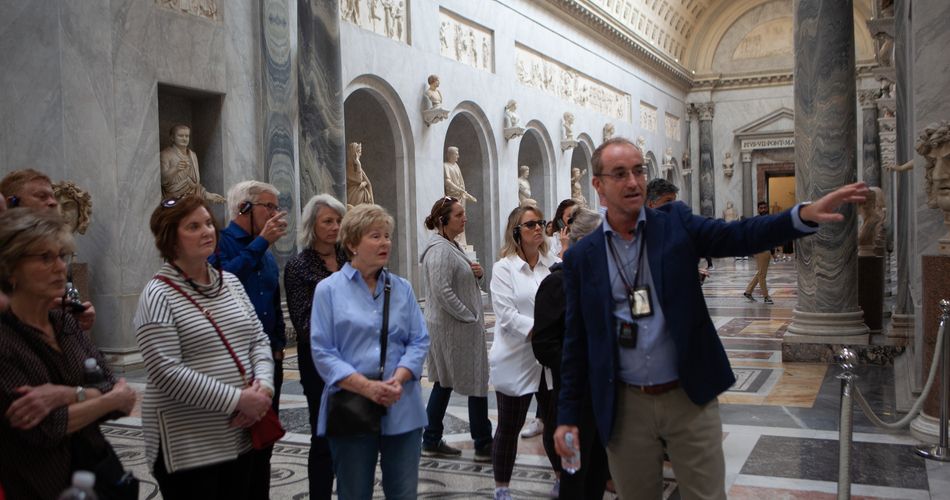
As soon as I saw the entrance to the Vatican Museums, I knew a special experience was coming my way. The Vatican Museums lead visitors through an extraordinary collection that spans classical sculpture, Egyptian and Etruscan collections, Christian art, the Raphael Rooms, the Borgia Apartment and, ultimately, the Sistine Chapel. The museums’ official site continues to position the complex as both a major art collection and the gateway to the Sistine Chapel.
The sheer variety can be overwhelming in the best possible way. It is easy to feel, almost immediately, that you are moving through far more than a conventional museum. The collections reflect centuries of papal patronage, artistic ambition and religious symbolism.
The Raphael Rooms and Borgia Apartment
Among the most memorable stops are the Raphael Rooms, the four rooms of the papal apartment decorated by Raphael and his workshop between 1508 and 1524. These rooms remain one of the Vatican Museums’ signature attractions, especially for travelers interested in Renaissance art and the connection between faith, philosophy and papal history.
The Room of the Segnatura is especially important, since it contains Raphael’s School of Athens as well as works tied to theology, philosophy and poetry. Elsewhere in the suite, visitors encounter rooms associated with papal authority, biblical episodes and major moments in church history.
The Borgia Apartment also stands out, though this is an area where many older descriptions can feel overly specific or dated. Official Vatican Museums material describes it as a set of six monumental spaces decorated for Pope Alexander VI and now partly housing the Collection of Modern and Contemporary Art. That broader framing is more accurate and useful for today’s traveler than focusing too narrowly on individual ceiling details.
The Gallery of Maps and the Sistine Chapel
On the way to the Sistine Chapel is the Gallery of the Geographical Maps, one of those spaces that can stop a visitor in his or her tracks. The gallery is named for its 40 painted maps of the Italian territories and Church dominions, created under Gregory XIII. Its length, decorative richness and sense of ceremony make it one of the most visually memorable passages in the museum.
Then comes the Sistine Chapel, one of the great artistic and spiritual spaces in the world. Official Vatican Museums materials note that the chapel takes its name from Pope Sixtus IV and that its walls include fifteenth-century cycles on the lives of Moses and Christ, along with portraits of the popes. Michelangelo’s ceiling and The Last Judgment remain the best-known masterpieces, but the chapel’s power comes from the totality of the space. It is also still used for the conclave that elects a new pope.
That combination of beauty, history and continuing religious function is what makes the Sistine Chapel feel different from almost any other room a traveler will ever enter.
St. Peter’s Square
Walking into St. Peter’s Square is breathtaking. The vast open space, framed by Bernini’s sweeping colonnades, was designed to gather pilgrims and focus the eye toward the basilica. The square also features the central obelisk and two fountains, all of which contribute to the powerful first impression that so many travelers remember. Official basilica materials describe the square as Bernini’s work for Pope Alexander VII, completed in the seventeenth century.
Older travel copy often lingers on exact counts of statues or other details, but what matters most for the visitor is the emotional effect: the sense of arrival, scale and welcome before entering one of Christianity’s most important churches. The square truly feels designed for pilgrims.
St. Peter’s Basilica
St. Peter’s Basilica stands on the site traditionally associated with the burial of Saint Peter, and the official basilica site states that his tomb lies beneath the main altar. That alone gives the church immense significance for Christian travelers.
The present basilica is also one of the defining masterpieces of Renaissance and Baroque architecture, shaped over time by figures such as Bramante, Michelangelo and Bernini. Inside, the scale can be hard to process at first. Every direction offers something worth studying, from the immense nave to the papal altar and the many chapels, monuments and sculptural details.
One of the great focal points is Bernini’s bronze baldacchino over the papal altar. In front of it lies the Confessio, the sacred space that opens downward toward the tomb of Saint Peter. The official basilica site describes the Confessio as the place where the tomb can be seen from above, making it one of the most spiritually charged points in the church.
There is so much to take in that it can be hard to know where to begin. That may be the defining feeling of a first visit to the Vatican: not confusion, but awe. I found myself wanting to absorb every detail and remember as much as possible from what truly felt like a once-in-a-lifetime experience.
Rome itself is filled with architectural and spiritual wonders, but the Vatican gives that experience a particular intensity. It is a place I could return to again and again.
FAQ
What should faith-based travelers prioritize at the Vatican?
Most visitors should focus on the Vatican Museums, the Sistine Chapel and St. Peter’s Basilica. Those three experiences capture the Vatican’s strongest blend of sacred history, papal tradition and world-famous art.
Is the Sistine Chapel still used for church functions?
Yes. Beyond being one of the world’s most famous artistic spaces, the Sistine Chapel is still used for the conclave that elects a pope. That ongoing role adds to its spiritual significance.
Why is St. Peter’s Basilica so important to Christian travelers?
St. Peter’s Basilica is traditionally associated with the burial place of Saint Peter, and the official basilica site states that his tomb is beneath the main altar. For many Christians, that makes it one of the most meaningful churches in the world.
What makes the Vatican Museums different from a typical museum visit?
The Vatican Museums combine major art collections with spaces that are deeply tied to papal history and Christian identity. The visit builds toward the Sistine Chapel, so the experience often feels devotional as well as cultural.
Should travelers buy Vatican Museums tickets from the official site?
Yes. The Vatican Museums explicitly warn visitors to use their official ticketing portal and to beware of lookalike websites that charge inflated prices.