
By Douglas Quinby, Arival
Multi-day tours have always been one of travel’s most complex sectors, bringing together accommodation, transportation, and experiences into a single, curated journey. Unlike hotels or cruises, there is no single format or standard. Escorted tours, custom FITs, group tours, self-guided, the product types and business models are many, and the complexity is real.
For more travel tips and ideas for groups, be sure to Download the June edition of Leisure Group Travel and Subscribe for FREE
But it is also a sector of enormous opportunity. Traveler demand for more immersive, experience-driven travel is fueling growth, while a new wave of entrepreneurs, enabled by evolving technology and software, is bringing fresh products and approaches to market.
Arival’s State of Multi-Day Tours, 2nd Edition, produced in partnership with TourRadar, kimkim, and Lemax, takes a close look at how this segment is evolving, from operators and product design to traveler behavior and industry trends. Based on a global survey of 569 multi-day tour operators, along with nearly 50 in-depth interviews across operators, OTAs, and technology providers, the report explores the forces shaping this increasingly dynamic marketplace.
The picture that emerges is not of a market that is settling into a clear direction, but one that is stretching in multiple directions at once. Product is shifting, traveler expectations are changing, distribution is evolving, and technology, long a constraint, is on the move.
Product Is Expanding, But Complexity Comes at a Cost
The multi-day tour market has never been neat. Operators offer everything from escorted group tours to fully customized itineraries, and most don’t specialize in just one format. While escorted,or scheduled guided tours and custom guided tours are the most common, the majority of operators now offer multiple tour types, often spanning both group and customized products.
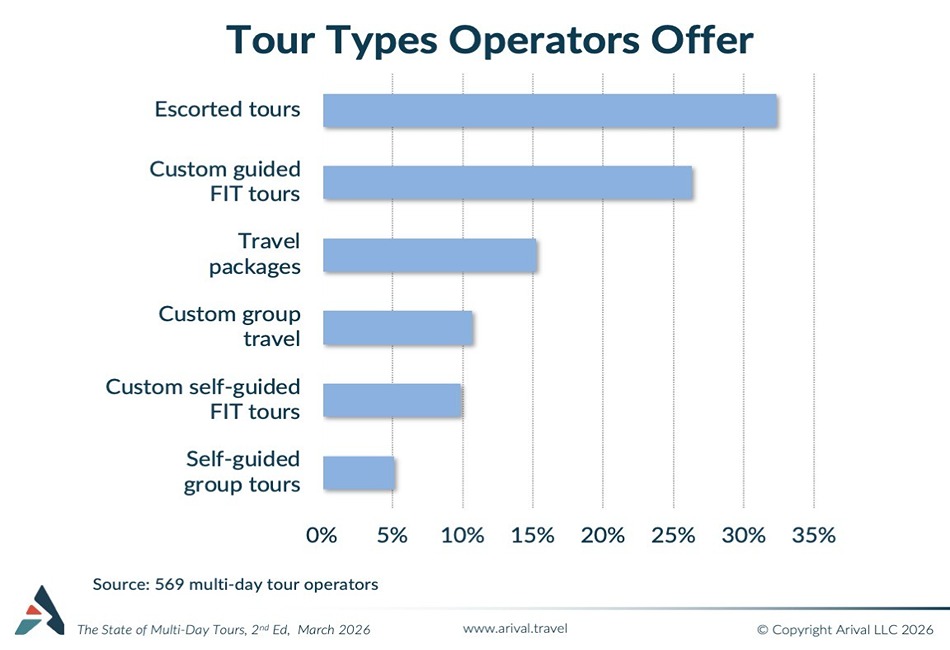
There is a clear reason for this. Travelers want choice, flexibility, and personalization, and operators are responding by broadening their product range. Customized FIT itineraries, both guided and self-guided, are becoming more prominent alongside traditional escorted tours.
But as operators expand their offerings, they are also adding layers of operational complexity. Each new product type brings different requirements, pricing structures, supplier relationships, and fulfillment challenges.
What stands out in the research is that more products do not necessarily mean better business. Operators with a narrower, more focused set of offerings are more likely to achieve stronger margins.
For more travel tips and ideas for groups, be sure to Download the June edition of Leisure Group Travel and Subscribe for FREE
A New Kind of Multi-Day Traveler
At the same time, the traveler is changing.
Sightseeing, and in particular, seeing the most popular, iconic sites and attractions, remains a primary driver of tourism overall, and multi-day tours, the ways in which travelers want to experience those attractions are changing.
Operators consistently point to a shift toward smaller groups, more customized itineraries, and a greater emphasis on immersive experiences. The modern multi-day traveler still wants to see Sagrada Familia and the Eiffel Tower, but not through rigid, pre-set itineraries. They want tourists who are more focused on flexibility, pacing, and personalization.
Demographically, the audience is also broadening. While older travelers remain a core market, younger travelers, particularly millennials and Gen Z, are playing a larger role, bringing different expectations around discovery, planning, and booking.
Perhaps the most significant shift is not what travelers want, but how they expect to access it. Increasingly, they expect multi-day trips to be as easy to research and book as any other part of travel.
That expectation is difficult for this sector to meet. Multi-day tours are inherently complex, often involving multiple suppliers, custom elements, and manual processes. The challenge for operators is not just to design compelling experiences, but to present them in a way that feels simple and accessible to the traveler. Enabling digital distribution is one of the sector’s biggest challenges and opportunities.
Distribution: Evolving, But Still Uneven
This has traditionally been a trade-driven business, built on relationships between outbound operators, inbound partners, and travel advisors. Those channels remain essential. But direct-to-consumer sales and online platforms are playing a growing role.
No one channel dominates in multi-day tour sales. Offline channels, including third-party resellers and travel trade, as well as direct offline booking with operators (e.g., over the phone), account for 61% of bookings. Online channels, operator websites, and online travel agencies (OTAs) such as TourRadar, kimkim, evaneos, and others account for 39% (see figure).
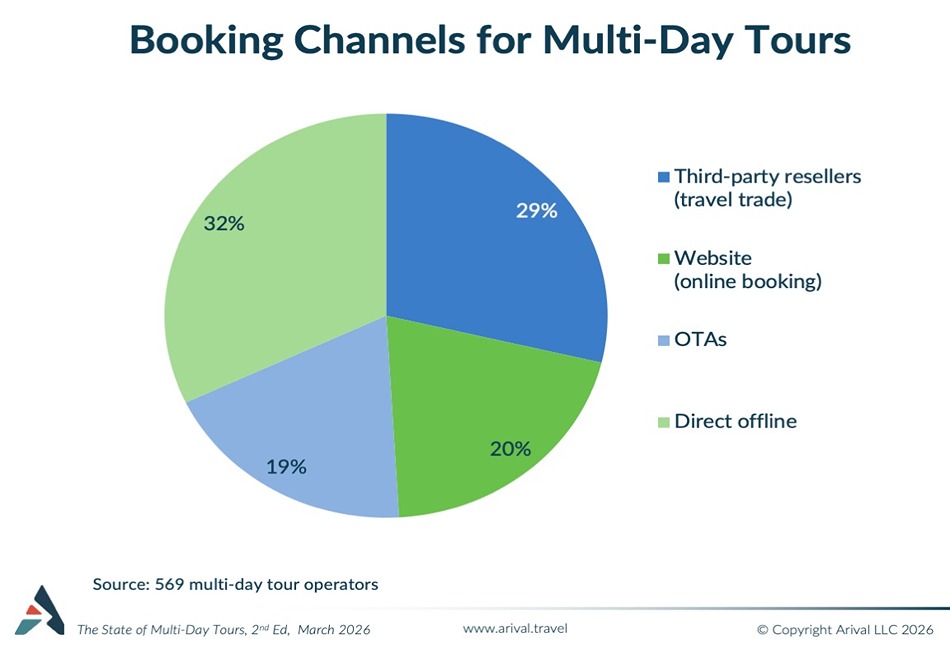
Travelers clearly want more digital discovery and booking; however, the structure of multi-day products makes them difficult to standardize and scale online. Unlike a hotel room or a flight, a multi-day itinerary is rarely a like-for-like comparison. Variations in routing, inclusions, group size, and customization make aggregation a substantial challenge.
The result is a distribution landscape that is expanding, but not consolidating. Traditional channels persist, direct sales are growing, and OTAs are gaining traction, but none fully dominate.
What adds another layer to this is the diversity of operators themselves. Some are actively investing in new channels, partnerships, and digital distribution. Others are not. The sector includes both growth-oriented businesses and operators who are focused more on stability and lifestyle.
Technology: The Longstanding Constraint
If distribution is evolving unevenly, technology is one of the reasons why. Many operators still rely on a patchwork of systems, or in some cases, manual processes, to manage bookings, suppliers, and customer relationships. Fewer than two in three operators use a fully fledged booking management system.
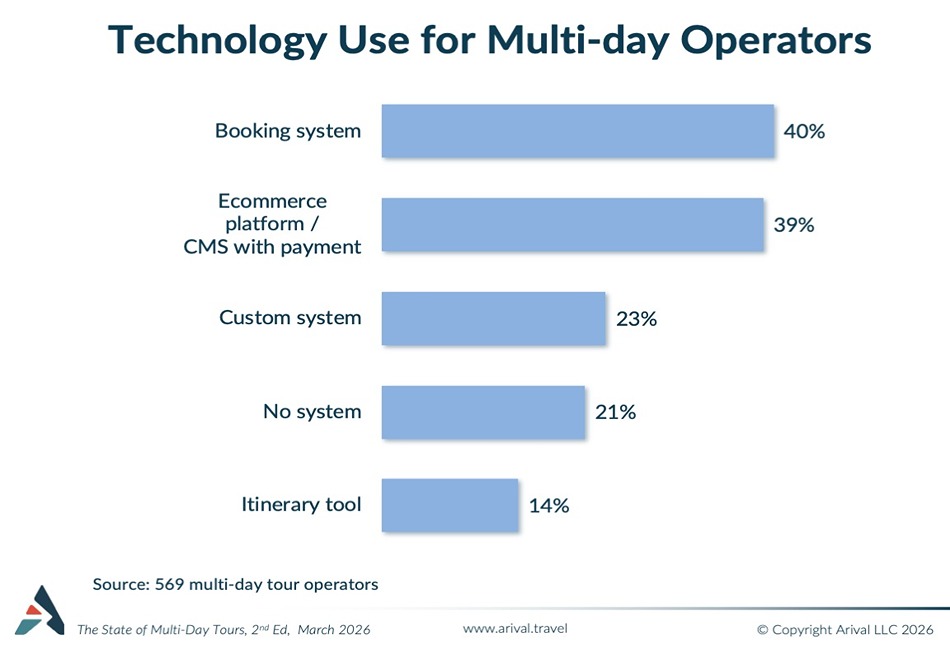
This is not simply a matter of slow adoption. The complexity of the product itself makes technology harder to implement. Multi-day tours often require coordination across multiple suppliers, destinations, and services, along with the ability to handle customization and changes.
Many operators and resellers in the study also point to persistent gaps in the technology landscape and in the implementation by operators. This is particularly the case around supply connectivity (the ability of the tour operator to efficiently manage their bookings with hotels, local transportation, restaurants, and attractions), as well as with customized itineraries, the demand for which is growing. Custom itineraries often require personal handholding and consultation with the traveler, and multiple changes in the planning process.
There is progress, however. More operators are adopting booking systems, APIs, and other digital tools. Larger and more growth-focused companies, in particular, are investing in more complete technology stacks that bring together sales, operations, and customer data.
AI Presents a Big Opportunity to Address the Hard Problems
Against this backdrop, AI is emerging as a potentially important shift.
For now, its use in the multi-day sector is largely practical and targeted. Nearly two in three operators are actively using AI in their operations, primarily to support content creation, streamline internal workflows, and assist with customer communication.
What is more interesting is where AI may go next. Multi-day tours present some of the most complex challenges in travel, from building itineraries to managing customization and coordinating multiple components of a trip. These are areas where traditional systems have struggled, but where AI could create next-generation solutions.
It is still early, and adoption varies widely across the sector. But the direction is clear. AI is not replacing the operator. It is beginning to support them in managing the very complexity that defines this business.
A Sector Still Defining Itself
One of the most striking aspects of the multi-day tour market is that it still resists easy definition. Consumers do not have a clear mental model for what a multi-day tour is in the way they do for a cruise or a hotel stay.
“It’s a dog’s breakfast in terms of what consumers are booking,” said Tour Radar CEO Travis Pittman.
That lack of standardization creates challenges, but it also creates opportunities. It allows for a wide range of products, formats, and approaches from highly structured group tours to fully customized journeys.
What is becoming clearer, however, is that the sector is entering a new phase. Traveler expectations are rising. Distribution is shifting. Technology is improving. And AI is offering real opportunities to tackle some longstanding problems.
For operators, the challenge is not simply to keep up with these changes, but to navigate them in a way that makes sense for their business. In a market defined by complexity, the advantage does not go to those who do everything. It goes to those who manage that complexity best.
Learn more about Arival’s latest report, The State of Multi-day Tours, 2nd Ed. This new report provides a comprehensive overview of the global multi-day tour marketplace, explores how this sector is changing across product design, traveler demand, distribution, and technology, and provides actionable guidance for operators, resellers, and destinations engaged in the rising multi-day sector.
A free summary report of the study is available here with sign-up at Arival.travel.
Arival is the leading resource for creators and sellers of tours, activities, attractions, and experiences. It provides in-depth market research, industry news, and networking events for travel professionals to connect and gain insights, focusing on the in-destination tourism sector. Learn more at Arival.travel.
Douglas Quinby co-founded Arival to fill the void in insights, information, and conferences for travel’s third-largest and most important sector: in-destination experiences. Since its founding in 2016, Arival has become the defining platform for the sector, with conferences worldwide, a series of definitive research reports, and the Arival.travel media site and newsletter covering news and insights for day tours, activities, attractions, and experiences.
Prior to arrival, he served as Senior Vice President, Research at Phocuswright, where he led seminal studies on numerous travel trends and sectors, including Tours, Activities & Attractions,as well as programming for Phocuswright conferences around the world.
For more travel tips and ideas for groups, be sure to Download the June edition of Leisure Group Travel and Subscribe for FREE